Wednesday, 1 July 2020

The Walford Murder, Dodington, July 1789

John Walford was born in Over Stowey in 1762.  His parents were William and Ann Walford and they lived in Bincombe.  His father was a self-employed charcoal burner and John followed in his father's footsteps.  John worked alone in the woods six days of the week and slept in a small wooden hut close to the charcoal burner.  During the winter of 1784 he was visited by local girl Jane Shorney and she became pregnant by him.

Illegitimate pregnancies were considered a disgrace at this time. Parishes wanted to avoid illegitimate children becoming a burden on the poor rates.  Therefore if expectant mothers named the father of their child on oath before a Justice of the Peace, the Overseers of the Poor were given the power to apprehend him and imprison him, unless he agreed either to pay for the upbringing of the child or to marry the mother. On 7th February 1785 Jane Shorney was brought before the local Justice, James Bernard of Crowcombe Court and she declared that she was pregnant with an illegitimate child by John Walford.  He was arrested but released when his mother agreed to pay to support the child.  A son was born a few months later.

In 1786 Jane Shorney got pregnant again - this time the father was John's brother William.  William agreed to pay for the upbringing of his daughter, who was called Betty.  

In 1787 John became engaged to Ann Rice, who lived with her parents at Adscombe Mill but the engagement was broken off after a few weeks and Ann went into service.  However she and John continued to meet and she became pregnant.  Jane Shorney resumed her visits to John in the woods and became pregnant again.  John was arrested again but could not pay to support the child and he was therefore obliged to marry Jane.  

Jane Shorney and John Walford married on 10th June 1789.  However John arranged with Jane's mother that Jane and the two children would live with her and that Jane would only join John in his rented cottage at Bincombe at night.

On 27th June 1789 John met his friend William Bishop at the Dial Inn in Aley Green and asked him if he would go to London with him but William said he didn't have enough money to do this.  John admitted to William that he did not like his wife and said he would either have to murder her or leave the area.

On 4th July 1789 John Walford returned home from work at about 8pm.  He ate his supper with his neighbours - the Rich family.  He returned to his own cottage at about 10.30pm and shortly after Jane arrived.  She wanted to go to the Castle of Comfort inn at Dodington for some cider. John gave her a shilling and as it was dark and Jane didn't want to walk there on her own, he accompanied her.  As they approached the Counting House at Dodington they argued and John hit Jane, firstly with his fist and then he beat her with a post and fractured her skull.  He then attempted to drag her unconscious body, possibly to the shaft of the nearby copper mine, but she was too heavy, so he cut her throat with a pocket knife.  He returned home after midnight and went to sleep.

The following morning two children saw blood running under a gate on Dodington Common and told their neighbours John Mogg and William Sellick about this.  Mogg and Sellick discovered Jane's body.  Sellick went to John Walford's cottage to tell him the news.  Walford said that Jane had gone out to buy some cider the previous night but had not returned home and he had assumed that she had gone to her mother's house.  Walford set off to go to his mother-in-law's house to tell her that Jane was dead.  On the way he met Sarah Phillips and told her that he wished that he had never married Jane and that he also wished he had left the area.  He then accompanied his mother-in-law to see Jane's body.  When he arrived he spoke to Thomas Chidgey.

John Walford was interrogated by Thomas Poole (a tanner and farmer who lived in Nether Stowey).  He asked Walford why he had not gone out to look for his wife and queried why the shilling he had given her to pay for the cider was not found on her body.   Thomas Poole, Richard Briffet and Thomas Mogg then accompanied John Walford to his cottage where they found bloodstains on the clothes that John had been wearing the previous day.  His shoes were very dirty and the missing shilling was found in the pocket of his trousers.  Thomas Poole asked Walford where his knife was and Walford first of all claimed that he had lent it to Thomas Ware and then later that he had given it to his brother William.  A few days later Thomas Mogg returned to the cottage and found the knife under a window seat.  It had blood on it.

John Walford was arrested and taken to the Globe Inn in Nether Stowey to wait for the results of the inquest into Jane's death.  The inquest was held the following day and the coroner, William Blake pronounced a verdict of wilful murder by John Walford.  Walford was taken to the county gaol at Ilchester to wait for the summer assizes at Bridgwater.  Jane Walford's body was buried at Over Stowey.

On 18th August 1789 John Walford was escorted to the courtroom in Bridgwater.  The judge that day was the Lord Chief Justice, Lord Kenyon.  The court listened to the testimonies of Joan Rich and her daughter (Walford's neighbours); John Mogg; William Sellick; Sarah Phillips; Thomas Chidgey; Thomas Poole; Thomas Mogg; Thomas Ware; Richard Briffet; James Shorney (publican of the Castle of Comfort who said that Jane had not visited his inn on the night in question) and William Bishop.  The jury retired briefly before returning a verdict of guilty.  Lord Kenyon sentenced John Walford to death by hanging the following Thursday.  Walford then confessed to the murder but said it was not premeditated.

On Thursday 20th August 1789 Walford was taken by cart to the Globe Inn in Nether Stowey to wait while the final preparations were made for the execution on the hill above Dodington.  Ann Rice appeared and spoke to John Walford for several minutes.  The cart then moved on to the execution site where he again spoke to Ann Rice before he was hanged on a gallows.  When he was dead his body was put into an iron cage and this was hoisted on to a gibbet.  It stayed there for a year until the iron cage fell to the ground and John Walford's body was buried below the gibbet.  The site is now known as Walford's Gibbet.

In November 1789 Ann Rice gave birth in Stogursey to a daughter who she called Sarah.  Ann died in Nether Stowey in February 1790.

Site of the murder near the Counting House at Dodington

View of Walford's Gibbet from the murder site

The former Globe Inn in Nether Stowey
It has been greatly altered since 1789 and is now called The Clock House.

Castle of Comfort on the A39

Over Stowey Church

Walford's Gibbet

Walford's Gibbet

View from Walford's Gibbet

Walford's Gibbet

Signpost at Walford's Gibbet

Wednesday, 17 June 2020

Norma Huxtable: Exmoor author

Norma May Huxtable (nee Devereux) lived at Lower Chilcott Farm near Dulverton with her farmer husband Arthur and ran a bed and breakfast at their farmhouse for over 35 years. She wrote three humorous books about running a B&B, life on Exmoor and local characters:
  • The Last Word on Exmoor - published 2001
  • Positively the Last Word on Exmoor - published 2002
  • Norma Huxtable's Exmoor Exposed - published 2007
She was also an after dinner speaker at local events.  

Norma Huxtable died on 17th January 2012, aged 85.  There is a wooden cross with a memorial plaque dedicated to her located by the side of a public footpath, which runs from Higher and Lower Chilcott to Willway.  It is much closer to Chilcott than Willway. 


Norma's memorial cross

Plaque on the cross

Lower Chilcott Farm

Monday, 1 June 2020

Ball Cottages, Buncombe Wood, Broomfield

The ruins of a deserted farmstead called Ball or Ball's Cottages are located at head of an unnamed combe deep in Buncombe Wood, half a mile ESE of Cothelstone Hill and 150 metres below it.  The ruins are comprised of a farmhouse and an outbuilding, both built from the local slatey sandstone.  The west gable end wall of the farmhouse still stands to its original height and the chimney can be seen.  On the inside you can see where the fireplaces on the ground and first floors once were.  The east gable end is more ruined but may contain a bread oven.  Both the farmhouse and the outbuilding, which is located to the north west of the farmhouse across a forestry track, were probably built in the late 18th or early 19th centuries.  The ruins are located by the side of a public footpath at ST 198 324 and close to the Kingston Stream.

The farmstead may have been a tenement of Buckland Priory, which was located at Durston.  It was known as Buncombe Farm in 1801 but had changed its name to Ball's Cottages by 1888.  It looks on the 25" scale Ordnance Survey map as though it might have been divided into 2 cottages at some point.

West end of Ball Cottages

West gable end wall of Ball Cottages

West end gable wall from inside

Remains of the fireplaces on the ground and first floors 

Inside of the west gable end wall 

Remains of the outbuilding

West gable end

Sunday, 17 May 2020

The Port of Lilstock

In around 1820 Sir John Acland of Fairfield House near Stogursey built a boathouse on the beach at Lilstock where boats from South Wales could beach to bring in coal for domestic use on his estate and to burn in his lime kilns.  Pit props and lime were exported in return.  A few years later Sir John had a wooden house built at Lilstock, for his granddaughter Isabel to use, as her health was poor and her doctor prescribed sea air and light exercise.  He also built a promenade where she could walk or drive in her carriage.  

At around the same time the unnamed stream that entered the sea at Lilstock was diverted eastwards through an excavated stone lined channel with a lock gate at its seaward end, so water could be impounded.  This meant that boats could berth at high tide and be unloaded in a sheltered dock at all states of the tide.  When no boats were inside the dock, the lock gates could be opened quickly and the subsequent rush of water cleared the entrance of pebbles.

Trade increased and by 1848 a coastguard was living at Lilstock.  By 1855 the harbour also had its own customs officer.  Warehouses, a couple of houses and lime kilns were constructed on the landward side of the harbour and in 1860 a stone pier was built to protect the mouth of the harbour.  A small pavilion was built and in the 1860s and 1870s pleasure paddle steamers made regular stops at Lilstock.  There was a public house at Lilstock called the Limpet Shell.

Trade declined at the end of the 19th century and it was always a struggle to keep the harbour entrance clear of pebbles.  On 28th/29th December 1900 there was a big storm in the Bristol Channel, which badly damaged the pier and the shape of the beach was altered.  By the end of the First World War Lilstock Harbour had been abandoned.

The remains of the dock are still clearly visible, as are the ruins of the lime kilns and warehouses, although you have to battle through the undergrowth to reach them.  At low tide the remains of the pier and the stone breakwater beyond it can still be seen.


Pebble beach at Lilstock

The dock at Lilstock Harbour

Ruined warehouse at the back of the beach

Ruined warehouse at Lilstock Harbour

Ruined warehouse

Ruined warehouses

Remains of the pier at Lilstock Harbour at high tide

Remains of the pier at low tide

Pebbles across the entrance to the dock

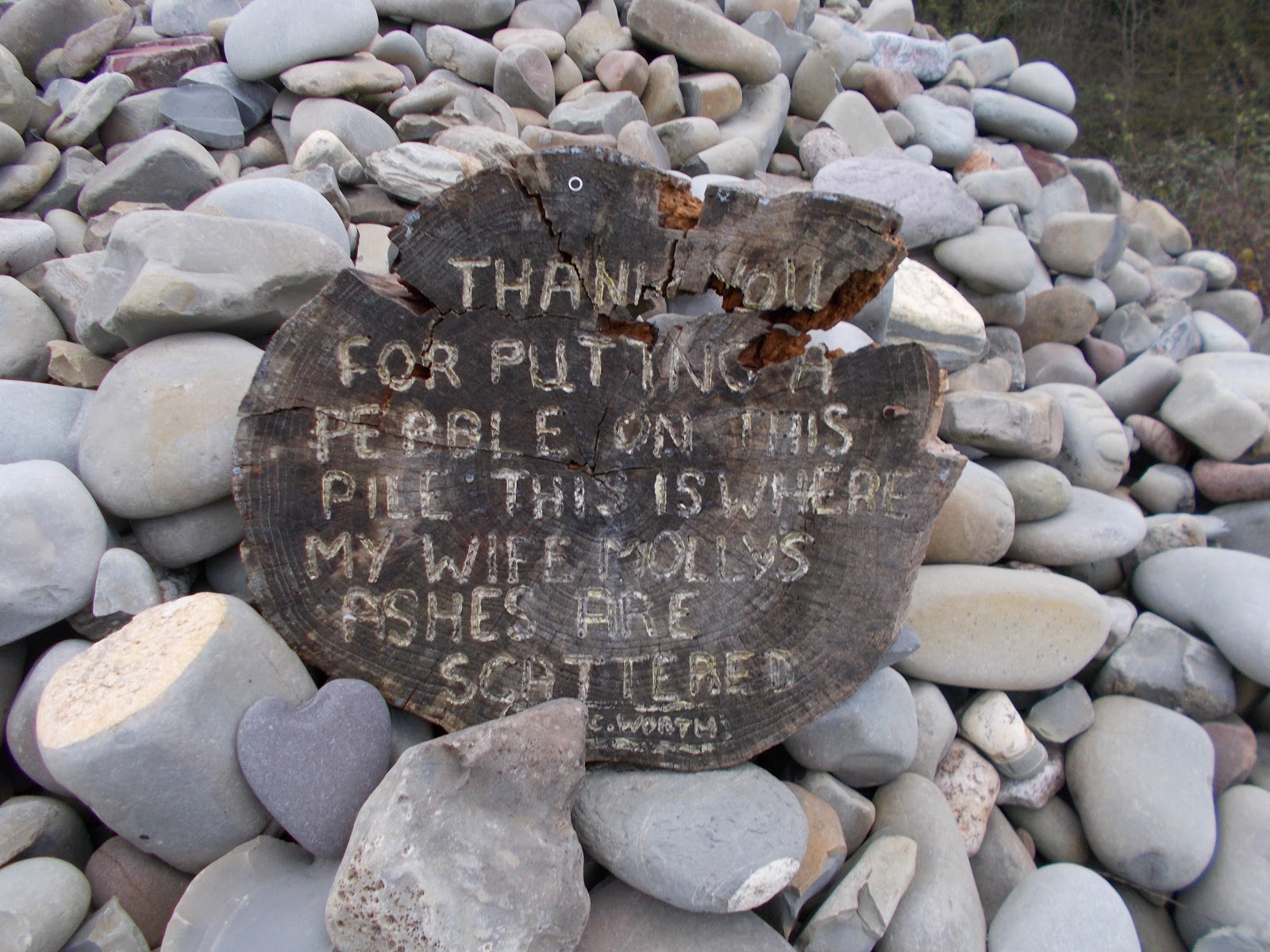
Modern personal memorial cairn on the beach at Lilstock

Notice on the memorial cairn at Lilstock

Monday, 4 May 2020

As if by magic, a pond has appeared!

A large pond has recently appeared to the south west of the church at Cheddon Fitzpaine.  To be more accurate, it has actually reappeared - until April 2020 it was completely overgrown and almost invisible from the footpath that runs along the eastern side of it.  According to the parish council minutes of April 2020, it is an irrigation pond and belongs to Glebe Farm.  It was attracting unwanted visitors who were leaving rubbish and drug paraphernalia behind, so the decision was made to open it up and make it more visible.  It is called Edison's Pond.  Apparently Edison is or was the landowner's dog.  Presumably he likes/liked swimming in the pond.  Update 30/5/20 - the pond has now been fenced off, so the path around it is no longer accessible but the pond can be seen from the public footpath.

Edison's Pond, Cheddon Fitzpaine

Edison's Pond, Cheddon Fitzpaine

Saturday, 2 May 2020

Wiveliscombe's Children of the Great War Mosaic

The Children of the Great War memorial mosaic is located in the Jubilee Gardens in West Street, Wiveliscombe.  8 panels of 12 decorative tiles, plus 22 activity tiles and 8 haiku are displayed on a post, which is over 7 feet high. They tell the story of the Home Front in the Wiveliscombe area during the First World War.

In 2014 the project to create the memorial was awarded £10,000 by the Heritage Lottery Fund.  Wiveliscombe Primary School children researched the history of their town and its residents during the First World War by visiting the Somerset Heritage Centre, the Museum of Somerset, the churchyard of the parish church, by talking to residents of a local care home and by doing research online.  Local artists Jo Dove and Sara Fairfax worked with 40 Wiveliscombe children to create the tiles using the sgraffito method.  The children also each wrote a haiku, some of which are included in the mosaic.  The mosaic was unveiled on 24th September 2016.

Examples of the haiku:


Dad's gone to war
See him 
When it's over
I'm here alone
With Mum


On the homefont
Feeling Sad
And Lonely
"Start sitting" 
Said Mum

During the First World War some of the farms around Wiveliscombe were used as temporary accommodation for thousands of mules, which were imported from Portugal, Ireland and North & South America to be used on the Western Front to transport food supplies, artillery and wounded soldiers.  They arrived at the port of Avonmouth and were sent by train to Wiveliscombe. They were then led through the town to nearby farms at Lambrook, Culverhay, Maundown and Whitefield.  They were allowed to rest and recover from their sea voyage for a few days before being broken into harness and trained for war work.  They were then sent by train and boat to the Western Front.  There were also mule training depots located in the Minehead and Keynsham/Saltford areas.  The 8 main panels on the mosaic tell the story of the mules' journeys.

The 22 activity tiles are displayed on the sides of the memorial.  These represent the activities that the children of Wiveliscombe would have undertaken to support their families and their community during the First World War e.g. harvesting apples, potatoes and conkers; queueing for food; knitting scarves and socks; delivering milk; feeding chickens; trapping rabbits for food and chopping wood.


Back of the memorial mosaic

Front of the memorial mosaic


The mules' sea journey

The mules arrive in Avonmouth and travel by train to Wiveliscombe

The mules recover in Wiveliscombe after their long sea journey

Mules in Somerset

Mules on the battlefield

Mules at work during the First World War

Activity tile - collecting conkers
The conkers were used to produce acetone, which was needed for the manufacture of cordite.

Activity tile - collecting waste paper

Activity tile - harvesting potatoes

Wednesday, 15 April 2020

Baptist Burial Ground, Five Ashes, Odcombe

There is a Baptist burial ground located in an isolated position off Ham Hill Road at Five Ashes, which is half a mile to the north west of the village of Odcombe.  

The burial ground is said to have been established in 1606 but the first internment recorded there was in 1720.  The land for the burial ground was given by Mrs Miller.  She lived in Odcombe and was the mother of John Miller, who was the second pastor of Yeovil Baptist Church.  At this time Nonconformists could be refused burial in the churchyards of parish churches.

In 1774 the family of James Kiddle, who was the 3rd pastor of Yeovil Baptist Church (1721-1751), gifted an adjoining piece of land, which enabled the burial ground to be extended.  The Kiddle family were related to the Millers and had acquired the land around the burial ground from them.  In 1809 the Kiddle family gave another piece of land, so that the burial ground could be extended again.   It was enclosed by a high wall made from Ham stone blocks either at this time or possibly in 1868.   There is a pedestrian gateway on the south east side with iron gates. These are now kept locked.

The burial ground contains six 18th century headstones, three of which have angels carved in relief on them.  In 1981 volunteers from the Yeovil Archaeological and Natural History Society recorded all the memorial inscriptions in the burial ground.  At this time 46 of the gravestones were legible and there were a few that were unreadable.  They noted that the earliest inscription transcribed was from 1740 and the most recent was from 1964.

Grid reference: ST 503 160

Gateway to the Baptist burial ground

Inside the Baptist burial ground

Stone wall enclosing the Baptist burial ground

Wednesday, 1 April 2020

John Rouse Merriott Chard VC - Rorke's Drift

John Rouse Merriott Chard was born in Boxhill near Plymouth on 21st December 1847.  He was educated at grammar schools in Cheltenham and Plymouth. He then went to the Royal Military Academy at Woolwich and he was commissioned lieutenant in the Royal Engineers on 15th July 1868.

From 1870-75 John Chard served with the Royal Engineers in Bermuda and Malta.  He returned to England in April 1875.  In December 1878 he left England with the 5th Company, Royal Engineers to fight in the Anglo-Zulu War in South Africa.  They arrived in Durban in January 1879 and marched to Helpmekaar (in what is now KwaZulu-Natal province).  John Chard was sent ahead to Rorke's Drift on the Buffalo River with a few men.  Rorke's Drift at this time consisted of a kraal (traditional village of huts), hospital and store.  

On 22nd January John Chard was left in charge at Rorke's Drift with orders to protect the river crossing. Later the same day news reached them of the massacre of 1,300 British soldiers at Isandlwana, about 10 miles to the east.  John Chard made the decision to defend his position, rather than retreat.  There were 8 officers and 131 non-commissioned officers at Rorke's Drift but 35 of the men were ill in the hospital.  John Chard hastily made an entrenchment out of biscuit tins from the stores.  Soon after they were attacked repeatedly by about 3,000 Zulus for the rest of the day and on through the night.  The Zulus set light to the thatched roof of the hospital but the British soldiers under John Chard held their position. During the night they made a redoubt out of old mealie-bags.  The Zulus retreated at daybreak and John Chard went round and collected up the arms of the dead Zulus and strengthened the position as much as possible.  370 Zulus had been killed but only 15 British soldiers had died (+12 wounded).  The Zulus approached again later that day but retreated when British reinforcements arrived.

John Chard remained at Rorke's Drift for a few weeks but then became ill and was taken to Ladysmith to recover.  When reinforcements arrived in Natal in April, John Chard's company was placed in the flying column under Brigadier-General Evelyn Wood and took part in all its operations, including the Battle of Ulundi on 4th July 1879. John Chard was decorated with the Victoria Cross on 6th July 1879 by the commander of the forces, Sir Garnet Wolseley. Victoria Crosses were also awarded to 10 other British soldiers who had fought with John Chard at Rorke's Drift.   

On his return to England in October 1879, John Chard visited Queen Victoria at Balmoral and she gave him a gold signet ring. He was promoted to major in July 1886.  He then served for 2 years at Devonport, 6 years in Cyprus and 5 years in the north-western military district.  In December 1892 he sailed to Singapore, where he was commanding royal engineer for 3 years. He was promoted to lieutenant colonel in January 1893.  After returning to Britain, he was appointed commanding royal engineer of the Perth sub-district in January 1896. He was promoted to colonel in January 1897.

John Chard died of cancer of the tongue on 1st November 1897 at his brother's rectory in Hatch Beauchamp.  He was buried in the churchyard at Hatch Beauchamp on 5th November.  There is a stained glass window in the chancel of the church, which is dedicated to him.


Grave of John Chard in the churchyard of St John the Baptist Church in Hatch Beauchamp

John Chard's memorial window in the church of St John the Baptist, Hatch Beauchamp

John Chard's medals, including the Victoria Cross, in the top left corner of his memorial window

Church of St John the Baptist, Hatch Beauchamp

Tuesday, 17 March 2020

Judy Dunn's memorial in Horner Wood

In Horner Woods in West Somerset there is a footpath called Cat's Scramble, which leads uphill in a southerly direction from the village of Horner.  Under a large tree (possibly a pollarded oak) above the path, there is a large horizontal inscribed stone with the following words on it:

Judy
Beloved wife of 
Robin Dunn
1919-1995
My soul is here I did not die

Judith (Judy) Allan Pilcher was born in Somerset on 14th September 1919.  While she was working as a Land Girl in 1940, she met Captain Robin H.W. Dunn.  He had been posted to Minehead after returning to England via the Dunkirk Evacuation in May/June 1940.  Judy and Robin got married in All Saints' Church, Selworthy in August 1941.  They had two daughters and a son together.  Robin Dunn was appointed QC in 1962, knighted in 1969 and appointed Lord Justice of Appeal in 1980.  He was also on the committee of the Devon and Somerset Staghounds.  Judy died on 17th August 1995 and is buried at All Saints Church in Selworthy.   I presume Horner Woods was one of her favourite places, which is why her memorial stone is located there.

In 1997 Sir Robin Dunn married Joan Stafford-King-Harman.  He died on 5th March 2014, age 96. Joan Dunn died in July 2018, age 100.


Judy Dunn's memorial stone in Horner Woods

Memorial stone under the tree

Tree with memorial stone underneath