Showing posts with label Flora. Show all posts

Sunday, 1 February 2026

James Allen, "The Snowdrop King"

James Allen was the first person known to have deliberately crossed and raised hybrid snowdrops from seed.  For this reason he became known as "The Snowdrop King". He was a passionate galanthophile and a self-taught horticulturalist.

James Allen was born at Windsor Hill Mill, a mile to the north of Shepton Mallet, in 1830.  He lived there for the first 20 or so years of his life and once he was old enough, he helped his mother Elizabeth and his brother John to run the watermill.  His father, John Allen, died in 1842.  The mill ground corn for human and animal consumption. 

In 1853 James married Ellen Burt.  She was the daughter of a local draper.  Their son Frank was born in 1854 and they moved to Park House in Park Street, Shepton Mallet.  It was there that James began breeding snowdrops. He grew all the varieties of snowdrops known at the time and bred over 100 snowdrop cultivars. He also bred a pale pink variety of wood anemone  (Anemone nemorosa Allenii), a new lavender and a new Scilla.

James and Ellen had 8 children between 1854 and 1868: 4 sons and 4 daughters. James was involved in the running of the town of Shepton Mallet.  James and his brother John were cheese and corn merchants. Their mother Elizabeth died in 1859.

John and his wife Emily lived across the road from James & Ellen in Highfield House.  After John died in 1894, James and Ellen moved from Park House to Highfield House. James's health deteriorated from the 1880s onwards and he died on 8th March 1906.  He was buried opposite the entrance to the Shepton Mallet Cemetery chapel.  His gravestone included an obelisk, but this eventually fell into disrepair.  In February 2022 a new obelisk was erected on his grave.  This was funded by local people and organisations, including the local council.

Many of James Allen's snowdrops were destroyed by the fungal infection Botrytis or an attack of narcissus fly.  However, two varieties that he bred are still available to buy today: Merlin and Magnet.  The inner segments of Merlin are completely green and Magnet has an unusually long stalk. Both of these varieties have received the Royal Horticultural Society's Award of Garden Merit.

Shepton Mallet Horticultural Society began planting snowdrops in and around the town in 2015 and an annual Snowdrop Festival is held in the town every February.

Windsor Hill Mill

Windsor Hill Mill

Snowdrops at Windsor Hill

Independent Chapel, now Shepton Mallet Baptist Church, Commercial Road
James Allen was baptised and married here.  His memorial service was also held in the chapel.

Highfield House 
(now a Somerset Council office)

Park House

Obelisk in Shepton Mallet Cemetery

James Allen's gravestone and obelisk

Snowdrops on the obelisk

Snowdrops on a grass verge in Shepton Mallet

Sunday, 17 July 2022

Platinum Jubilee Floral Cascade at Stogumber Church

A lady from Stogumber called Wendy Symes saw a floral cascade on display at Barley in Hertfordshire and thought it would be an excellent way for the village of Stogumber to commemorate the Queen's Platinum Jubilee.  Work on the cascade started in July 2021.  An informal group was set up and people in Stogumber were invited to create knitted, crocheted, organza or felt flowers for it in a palette of green, yellow, orange, red, pink, purple and blue.  The first flowers were sewn onto the netting in November 2021.  By December 2021 only 3 metres had been completed but by the end of January 2022 it had grown to 20 metres. 

The cascade was completed in March 2022 and in April some knitted bees were added to it. Over 2,000 flowers were sewn onto the netting in total.  It was hauled to the top of the tower of St Mary's Church with the help of the staff of Williton Fire Station and was unveiled on 7th May.  It remained on display all summer.  It was free to see but donations were requested in aid of Mind, Children's Hospice South West and St Mary's Church.

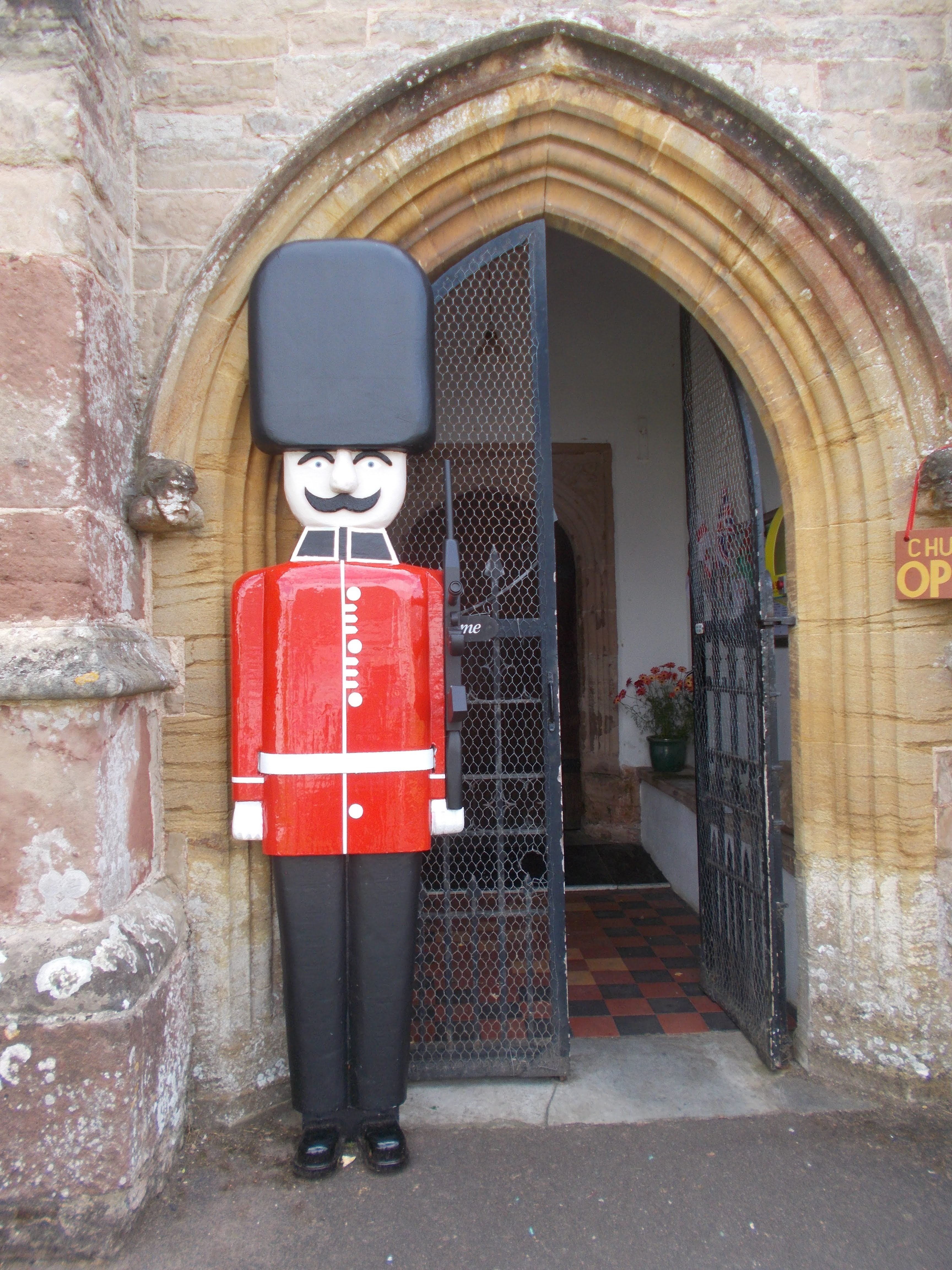
A large ER and 70 made of sewn flowers were mounted on the front of the church, along with a Union Jack made from knitted red, white and blue flowers.  A wooden Grenadier Guard, made by Dave Ockenden was erected at the entrance to the church.   A display of knitted flowers in material vases were placed along the boundary fence of the church. 

Floral Cascade

Floral Cascade on St Mary's Church

Floral Cascade

Floral Cascade

Mauve, purple and blue flowers up close

A Rainbow Cascade

Red and pink flowers and bees up close

Union Jack made from sewn flowers

70 in flowers

EIIR outside St Mary's Church,  Stogumber

The Queen visits St Mary's Church, Stogumber!

Stogumber's own interpretation of the Queen's wedding dress made by ladies from St Mary's Church

Grenadier Guard at the entrance to St Mary's Church

Knitted flowers in vases on the boundary fence

Stogumber decorated for the Platinum Jubilee

Sunday, 29 November 2020

Wellington Park

Wellington Park is one of the town's best kept secrets. It opened in 1903 to celebrate the coronation of King Edward VII.  It is a small formal park and is located at the south western end of Courtland Road.  It can also be accessed via Beech Grove but it is not well signposted. It covers an area of 1.8 hectares.  The site was given to the town by Fox Brothers & Co Ltd (a local clothmaking firm).  They also paid for the buildings and landscaping and provided £100 a year for 5 years to cover the running costs. 

Fox Brothers commissioned the Exeter based company Robert Veitch & Sons to design and build the park.  The park was designed by the German landscape gardener F.W. Meyer, who worked for Robert Veitch & Son for 30 years.  His design included a ha-ha, three Spanish colonial style entrances, a shelter, a rockery, a bandstand and a caretaker's lodge,  Work on laying out the park began in July 1902.  The building work was carried out by Messrs Follett Bros of Wellington. The park was opened to the public on 2nd May 1903. Later the same year the ownership of the park was transferred to Wellington Urban District Council.  In April 1974 the park was transferred to Taunton Deane Borough Council.  On 1st April 2025 it was handed over to Wellington Town Council.

The park, which is Grade II* listed, was restored in 2000 with money from the Heritage Lottery Fund.  The park's current design is largely unchanged from its original layout.

Mature plane trees lining the walk on the north east side of the park

South East entrance on Courtland Road

North entrance on Beech Grove

Floral bedding

Floral bedding

Ornamental pond

Rockery

War Memorial
This was unveiled on 17th June 1921 by F. Hugh Fox.  The names of the 178 local men, who died in the First World War.  After the Second World War the names of a further 58 men and 1 woman were added to it.  It is made from Cornish granite.

Shelter

Bandstand

Caretaker's Lodge

Caretaker's Lodge

Plaque on the Caretaker's Lodge

Drinking fountain

Ha-ha

Grove of lime trees

Floral bedding

Floral bedding

Wednesday, 17 April 2019

A Miscellany of Mosaics

On my travels around Somerset I have come across the following colourful mosaics.  Some of them aren't strictly true mosaics but they have a similar format.

In March 2002, with the help of a youth worker and a professional artist, the West One Youth Club in Crewkerne designed and created a set of mosaics outside what is currently the West One Surgery in West Street, Crewkerne.  The project was funded by the National Lottery and Crimebeat.

West One Mosaic, Crewkerne

West One Mosaic, Crewkerne

West One Mosaic, Crewkerne

Plaque on the West One Mosaic, West Street, Crewkerne

Diamond Jubilee Mosaic, St Thomas Street, Wells

Brick mosaic on the back wall of Taunton Canoe Club in Priory Bridge Road, Taunton
This photo was taken on a very snowy day in March 2018


To celebrate the Millennium, the children of Brookside School in Street created this 140 Smiles "mosaic".  The figures are self-portraits by the children from Years 3 and 4 in 2000.  They were helped by ceramic artist Julia Gatrill.

140 Smiles, High Street, Street

Victoria Park, Taunton

Pastoral scene mosaic on the public toilets, Wheddon Cross public car park

Winsford Village Hall

In October 2001 George Caton and the Osborne family discovered a large  Romano-British mosaic floor at Lopen near Ilminster..  They contacted Somerset County Council's archaeological team and over the next three weeks the mosaic was fully excavated, cleaned, recorded and then covered over again to protect it from the elements.  An 8 roomed villa was revealed, which is thought to date from about 360AD. The mosaic is believed to be the work of the Saltire School, who were based at Corinium (now Cirencester).  The designs used in the mosaic included large squares, saltires, a dolphin, a cantharus (two handled cup), flowers, fish, heart shaped leaves and guilloche (plaits or braids). 

The loose tesserae, which were found in the soil around the mosaic were donated to the village by the land owners and used to recreate a section of the mosaic.  Volunteers washed and sorted the pieces and Nicholas Durnan and Gina Wright placed the 3,000 or so pieces into lime mortar to create a cantharus.  It was completed in 2002 and is now on display on the floor of All Saints Church in Lopen.  The surround is made from Ham Stone.

Cantharus Mosaic, All Saints Church, Lopen

Lopen Church Mosaic

Seasons Mosaic, Grove Park, Weston-super-Mare

Grove Park, Weston-Super-Mare

Wrington 

Aller Dragon on the side of Aller Village Hall

Aller bus shelter
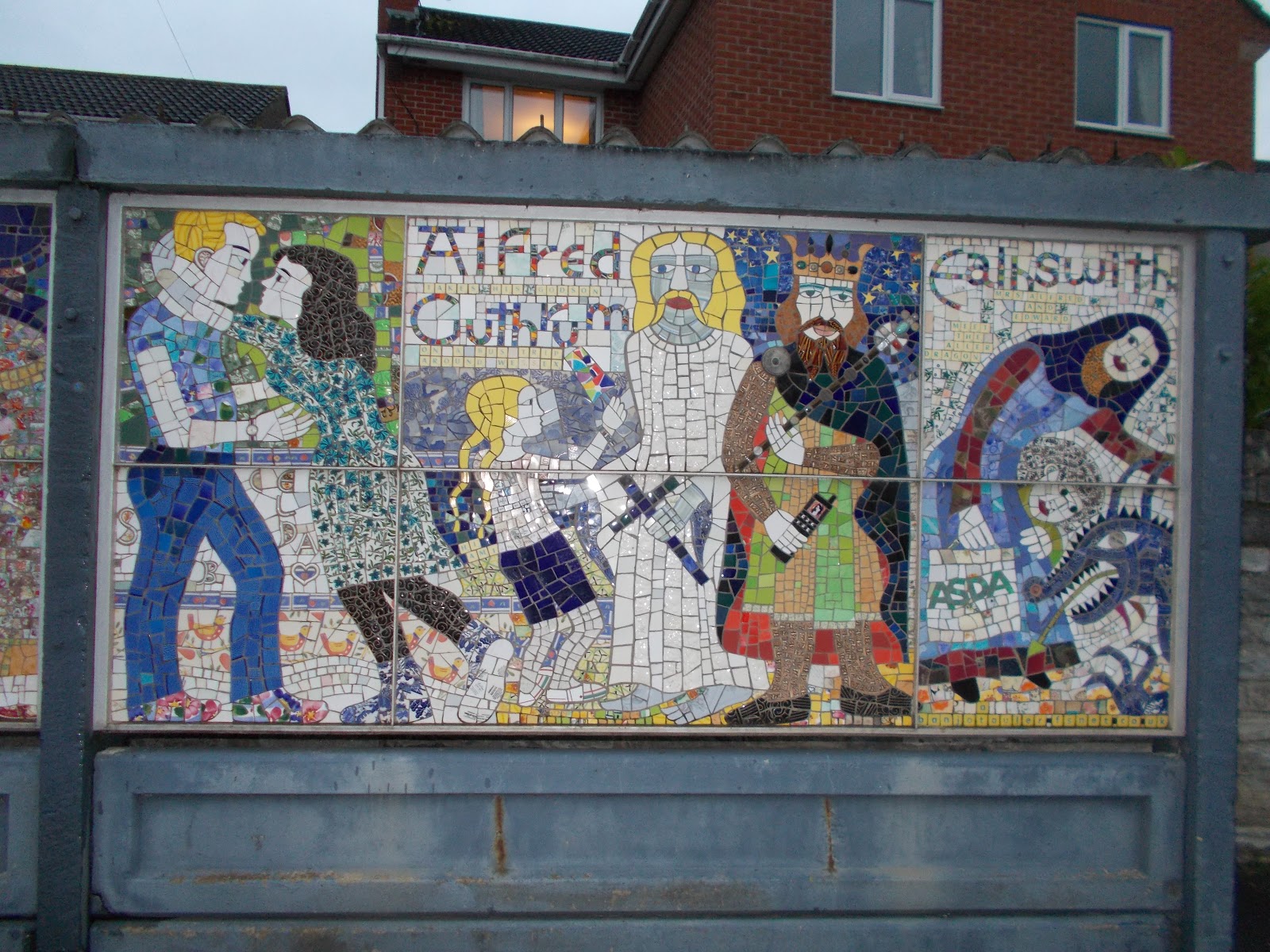
This mosaic includes historic characters from the village's past e.g. King Alfred, his wife Ealhswith, their son Edward, the Viking leader Guthrum and the Aller Dragon.  The mosaic and the one of the Aller Dragon above were apparently made by local potter Bryan Newman but I have not been able to confirm this or find out when they were made.

Aller bus shelter mosaic - right hand panel

Aller bus shelter mosaic - left hand panel

Yin and yang mosaic in the sensory garden at Vivary Park, Taunton

Dragonfly pebble mosaic on the side of the River Tone near Firepool Lock

St Decuman pebble mosaic, Watchet
This pebble mosaic, which is located outside Watchet Library, commemorates the arrival of St Decuman in Watchet by boat from Wales in the late 7th century.  It was created in 1996 by Maggy Howarth of Cobblestone Designs.  St Decuman brought his favourite cow with him, which can be seen in the photo above.  He came to evangelise the people of West Somerset but he wasn't welcomed by everyone and was beheaded.  Being a saint, this wasn't a problem to him, as he washed the blood from it in the waters of a holy well and put it back on his shoulders.

Compass rose in the St Decuman pebble mosaic, Watchet

St Decuman's severed head

Sword used to cut off St Decuman's head

Swan mosaic plaque on the former Swan Inn, 2 Silver Street, Wiveliscombe
Mosaic on the wall of the toilet block of Ilminster Recreation Ground

Heart pebble mosaic dated 1614, 
St Andrew's Church, Old Cleeve

Queen Elizabeth II Diamond Jubilee mosaic, 2012, 
Priorswood, Taunton

Platinum Jubilee mosaic, Priorswood, Taunton

Platinum Jubilee mosaic, Priorswood, Taunton

East Coker Roman mosaic
This is on display in the Museum of Somerset in Taunton.  It shows two hunters returning home with a deer slung on a pole between them.  It probably dates from the 2nd half of the 4th century AD.  A Roman villa was discovered near East Coker in 1753

Low Ham Roman mosaic
This is on display in the Museum of Somerset in Taunton.  It is the oldest object in Britain to tell a complete story and dates from around 350 AD.  It tells the tragic love story of Dido and Aeneas.  This was recorded by the poet Virgil in c25 BC.  The mosaic was found in the bath block of the Roman villa at Low Ham.  It was discovered by a local farmer Herbert Cook in 1938 when he was digging a hole in which to bury some dead sheep.  It was excavated 1946-48 by Lionel Walrond, Steven Dewar and C.A. Ralegh Radford.  The 120,000 tesserae were made from local materials, including lias limestone and fired clay.

Mosaic seat, Minehead Seafront
This is the first of 8 seats spelling out the word Minehead.

Wyvern Mosaic, Magdalen Lane, Taunton

Bird and frog mosaic on the back wall of a shelter in Collett Park, Shepton Mallet

Two agricultural labourers taking a break at harvest time 
Woodborough Road, Winscombe

Pebble flower mosaic in the Four Seasons Garden, The Newt, Hadspen

Dragon of Worminster Sleight mosaic, Wells
This mosaic was created in 2001 as part of the Three Villages Dragon Festival, to commemorate the slaying of the Worminster Dragon by Bishop Jocelyn during the 13th century. It was made by the artist Kate Rattray with the help of 6 local schools and community groups.  It is located at the side of the footpath on the south side of the Bishop's Palace.

Beware! The Dragon of Worminster Sleigh, who returns to Dinder, Dulcote and North Wootton every 50 years.

Watchet Seaspray Gallery 2015
This mosaic was organised by Watchet Arts Group.  It is made up of around 1500 tiles.  The tiles were decorated by local people and visitors.