Thursday, 15 August 2024

Dawe's Twineworks, West Coker

Dawe's Twineworks in the village of West Coker is the only surviving Victorian twineworks with its original working machinery in Britain.  

The bedrock which underlies the West Coker area is Yeovil Sandstone and Lower Oolite Cornbrash, which is a crumbly limestone.  These rocks, which occur in an arc from Bridport to Castle Cary, create brashy, well-drained soils that are ideal for growing flax, hemp and corn.  Flax and hemp, which both have long fibres, are the raw materials for making yarn.  

Yarn is one thin strand of twisted fibre.  Yarn is used to make twine, rope and woven cloth.  Twine is made by twisting together between 2 and 7 strands of yarn.  Twine is less than 3mm in diameter. Rope is much thicker than twine and is made by twisting several bundles of twisted yarn or twine around a central core.  A twineworks produces lengths of twine that are twice the length of the walk.  A ropewalk can only produce lengths of rope the same length of the walk.

From 1830 until 1875 Israel Rendall, who lived at Millbrook House in West Coker, operated one narrow un-powered twine walk in the grounds of his house.  Israel Rendall died in 1877. William John Dawe took over the business and used the existing facilities,  He died in 1894 and his brother Henry took over the business.  

Henry died in 1899 and his son Francis John Dawe took over. He had a purpose-built steam powered twineworks built in 1899.  The twineworks, which is 100 metres long, was built almost entirely of bolted together timbers.  It was roofed in double Roman clay tiles made by A.G. Pitts of Highbridge.  The east end of the walk, where the manager's office and drying area were located, had timber-boarded walls.  The twine walk has open sides. The only solid brick structure was the engine shed, which originally housed a steam engine.

Yarn was twisted into twine on the first floor.  It was then washed in water.  Animal guts, bones and skins were boiled up in an outside boiler to produce size.  The size stopped the twine from rotting.  It was applied to the moving twine by hand with a coconut mat sponge on the ground floor of the twine works.  The twine was polished with a horsehair rope and then circulated to dry it. 

Hanks of twine were then wound into balls and spools ready for sale. The hand powered balling machines were mainly operated by women, who could wind a ball of twine in less than a minute.

In the 1920s an oil engine replaced the steam engine.  In 1937 Francis John Dawe died and his son Henry Stuart Dawe took over the business.  He retired in 1968 and closed the twineworks.  After his death in 1983, the site was bought by a boat and general dealer called Dick Marks, who used it to store his stock.

In 2005 South Somerset District Council compulsorily purchased the twineworks to save it from dereliction.  Scaffolding was erected around the twineworks in 2007 to prevent it from collapsing and the Coker Rope & Sail Trust was formed.  The main walk was lifted and straightened out in 2010 and in 2013 the restoration process began.  In 2015 a 1927 Shanks diesel engine was lent to the twineworks, to replace the oil engine, which had been sold off in 1968.  

Funding from the Heritage Lottery Fund was secured in 2016.  A visitor centre was built in 2019 on the site of a derelict 1930s bungalow.  Dawe's Twineworks is now open to the public on the 4th Saturday of every month.  Enthusiastic volunteers offer guided tours and run the engine.

Twine treatment on the ground floor

Water and size troughs on the ground floor

Twine walk
This is probably the largest roof of Bridgwater Double Roman tiles anywhere in the world.

First floor: twine twisting machines

Spooling, braiding and balling machines

Engine house

Size boiler

Millbrook House

Thursday, 1 August 2024

Monkey Brand Soap: a Crewkerne Connection?

On the west wall of the north aisle of St Bartholomew's Church in Crewkerne is a brass memorial to Adam Martin of Seaborough, who died in December 1678.  Seaborough is a small village located two miles to the south of Crewkerne.  

The memorial shows the coat of arms of Adam Martin.  At top of the coat of arms is a monkey looking at its reflection in a mirror.  This was supposed to have been the inspiration for a late 19th century advert for Monkey Brand scouring soap.  The memorial was moved from its original position in the south transept in 1937. 

Monkey Brand abrasive scouring soap, which was probably made from pumice, was first produced by Benjamin Brooke & Co Ltd in Philadelphia in the 1880s.  In 1899 William Lever of Lever Brothers bought the company and production was transferred to Port Sunlight near Liverpool.  It was sold in an orange paper package, which featured a monkey studying its reflection in a hand-held mirror.  I have not found any explanations as to how and why the Martin coat of arms came to be used to advertise Monkey Brand soap, so maybe it is just a coincidence.

Adam Martin's Memorial Brass

Monkey looking at its reflection in a mirror

Monday, 15 July 2024

West Somerset & Devon Shirt Factory, Abbey Street, Crewkerne

The West Somerset & Devon Shirt Company built a factory in Abbey Street, Crewkerne  c1872-1875.  They moved there from their original premises behind 11 Market Street.  There were two factory buildings with a house built in the 1840s sandwiched between them.  The house was designed and lived in by local architect John Patch.  It was later used as offices.

In 1953 the factories were taken over by Van Heusen.  More recently the factories were occupied by Bonsoir of London, which made pyjamas there until 2004.  The company is currently based elsewhere in the town.  The former factories were then converted into apartments.  The names of the blocks of flats acknowledge the former use of the buildings: The Shirt Factory, The Pyjama Factory and Bonsoir House.

The Shirt Factory

The Pyjama Factory

Plaque on Bonsoir House, 3 Abbey Street

Monday, 1 July 2024

Hugh Trenchard: "Father of the RAF"

Hugh Montague Trenchard is regarded as the "Father of the Royal Air Force".  He was born at Windsor Lodge, Haines Hill, Taunton on 3rd February 1873.  When he was two years old, his family moved to Courtlands near Norton Fitzwarren and he spent the rest of his childhood there.

Hugh Trenchard didn't do well at school but was granted a commission as second lieutenant in the 2nd Battalion of the Royal Scots Fusiliers in September 1893 and was posted to India.  He served in the Boer War 1899-1902 and was promoted to the rank of Captain in February 1900.  He was severely injured at Dwarsvlei in the Transvaal in October 1900 and was invalided back to Britain.  He recovered and returned to South Africa in May 1901.  He then served in Nigeria 1903-1910. He was promoted to major and later to lieutenant colonel. He became seriously ill in 1910 and was sent back to the UK.  After recovering, he served in Ulster until 1912.  

He learnt to fly aircraft in July 1912 at the Sopwith School of Flying at Brooklands in Surrey and was immediately seconded to the newly formed Royal Flying Corps.  In 1913 he was appointed Assistant Commander of the Central Flying School at Upavon in Wiltshire. In August 1915 he was put in charge of the Royal Flying Corps in France.  His policy was to launch persistent attacks in order to establish air supremacy. 

In January 1918 Hugh Trenchard was appointed as the first Chief of the Air Staff, although he resigned from that post in April of the same year.  He was also knighted (KCB).  In May 1918 he returned to France as the head of a small force that was intended to bomb targets in Germany, although only a few raids were carried out.  

In 1919 Winston Churchill, who was Minister of War and Air, persuaded him to resume his post of Chief of the Air Staff.  Hugh Trenchard was created a baronet in October 1919. During the 1920s he founded an apprentice school for ground crews at Halton in Buckinghamshire, a cadet college for career officers at Cranwell in Lincolnshire and a staff college at Andover in Hampshire. He set up University Air Squadrons at Cambridge, Oxford and London in 1925 and introduced short-service commissions.  He was knighted again (GCB) in January 1924 and he became the first Marshal of the RAF in 1927.

In 1920 Hugh Trenchard married Katherine Boyle.  They had two sons together: Hugh (born 1921 and died in North Africa in 1943) and Thomas (1923-1987).

Hugh Trenchard retired from the RAF on 31st December 1929 and was made a baron the following day.  He was Commissioner of the Metropolitan Police 1931-1935, during which time he founded the police college and forensic laboratory at Hendon. He was made a viscount in January 1936.  He was then Chairman of the United Africa Company 1936-1953.

Hugh Trenchard died in London on 10th February 1956 and his funeral took place in Westminster Abbey.  In July 1961 prime minister Harold Macmillan unveiled a bronze statue of of him by William McMillan outside the Ministry of Defence in Embankment Gardens.  A 7-foot high cast bronze statue of him by Vivien Mallock was unveiled at RAF College Cranwell in October 2020 to mark the 100th anniversary of the college.

In 2018 Taunton's new Northern Inner Distributor Road was named Trenchard Way in memory of him.  In June 2018 his grandson, Hugh Trenchard, 3rd Viscount Trenchard, unveiled a memorial on Trenchard Way close to Taunton Station.

Windsor Lodge, Haines Hill, Taunton

Memorial stone on Trenchard Way

Plaque on the memorial stone

Saturday, 15 June 2024

Teddy Bear Crossing on the West Somerset Railway

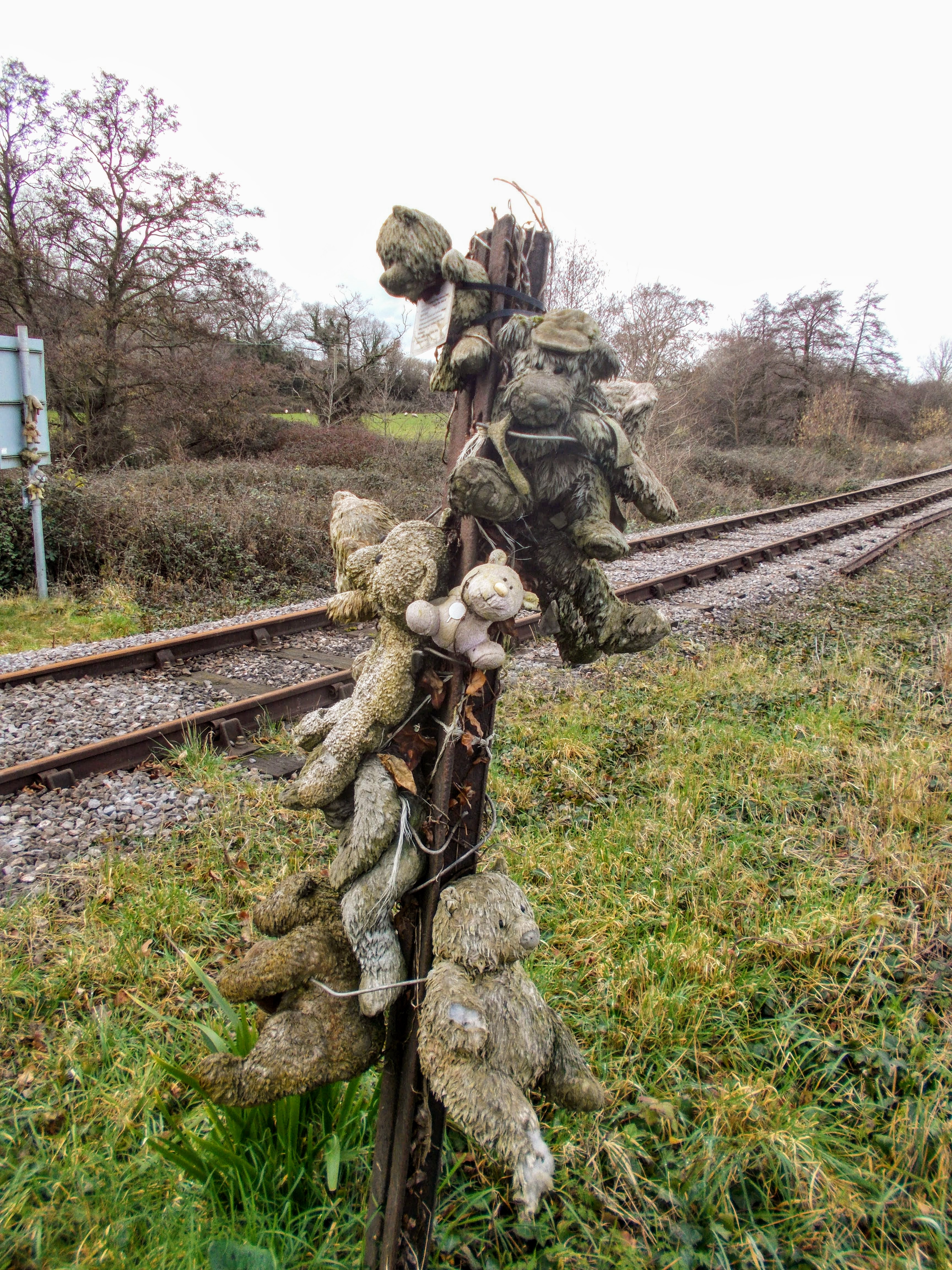
Teddy Bear Crossing is located half a mile east of Williton, where a footpath between Torweston Farm and Sampford Mill Farm crosses the West Somerset Railway.  An assortment of teddy bears have been tied to a metal pole.  They have been there for some years and when I visited in February 2024 they were looking very bedraggled.   No one seems to know who started putting them there or when.  The selection of teddies has varied over the years and I understand that occasionally someone (West Somerset Railway staff or volunteers?) carries out a cull of the most worn out bears.  One of the current bears was put there in memory of steam enthusiast Ray Harvey, who died on 2nd April 2016.

Teddy Bear Crossing, February 2024

Teddy Bear Crossing, February 2024

Teddy Bear in memory of Ray Harvey

Saturday, 1 June 2024

The Tragic Death of Amos Cann of Exford

On the afternoon of 9th March 1891, 24 year old Amos Cann, who lived on at Greenland Farm in Exford with his father Richard Cann, travelled down to Porlock to deliver 2 horses to a purchaser.  When he arrived in Porlock it was snowing, but rather than stay the night in there he decided to walk back to Exford.  He set off from Porlock at around 7.30pm.  He never arrived home.  Once they realised he was missing, local people went out searching for him but his frozen body wasn't found until 26th March, in a snowdrift a mile or so from his home.  His overcoat was found a quarter of a mile from his body.  He was buried in the churchyard of St Mary Magdalene's Church in Exford.  It wasn't known whether he died on 9th or 10th of March, so his tombstone just says he died in March 1891.  

The epitaph on Amos's headstone is as follows:

"You that are young, behold and see                                                                                            How quickly death has conquered me.                                                                                           Its fatal stroke it was too strong.                                                                                                     It cut me off while I was young:                                                                                                      The God above He knows for why                                                                                               That in my youth I was to die."

Amos Cann's gravestone in Exford Churchyard

Wednesday, 15 May 2024

William Smith - Father of English Geology

William Smith was a civil engineer, geologist and a pioneer in the science of stratigraphy.  He drew up the first geological map of England and Wales, which was published in 1815.

William Smith was born in Churchill, Oxfordshire on 23rd March 1769. In 1787 he became assistant to the land surveyor Edward Webb in Stow-on-the-Wold.  In 1791 Webb sent him to survey the land belonging to Lady Elizabeth Jones around Stowey near Bishop Sutton.  He lodged at Rugbourne Farm in High Littleton and from 1798-1810 he lived at Tucking Mill between Midford and Monkton Combe.  He carried out underground surveys of coal mines in the area, which set him thinking about rock strata.  In 1793 he was asked to survey routes for the proposed Somerset Coal Canal.  In 1794 he was sent on a fact finding tour of the canals and mines in the Midlands and the north of England and used his site visits to further his knowledge of rock strata.

Work on the Somerset Coal Canal began in July 1795 and the excavations enabled William Smith to study the local strata.  In 1799 he began to draw up maps and cross-sections of the local strata.  After a disagreement over the construction of a caisson at Combe Hay, he was dismissed from his job as engineer with the canal company in June 1799.  

William Smith then set himself up as a land surveyor in partnership with Jeremiah Cruse at Trim Bridge in Bath.  He undertook land drainage work around Bath and Wiltshire.  From 1801-1812 he travelled all over the country for work as a land & mineral surveyor and land drainer. At the same time he collected more information about rock strata. In 1803 opened an office in London and from 1805 he displayed his fossil collection there.  

In 1812 the London-based map maker John Cary offered to publish Smith's geological map.  The first edition was published in 1815 and updated editions were published until 1819.  Sales of Smith's map dropped when a rival map was published by the Geological Society in 1820.  Smith was in financial difficulty from 1819 and spent 10 weeks in a debtors' prison.  He was forced to sell his fossil collection (to the British Museum) and personal library to pay off some of his debts.

In 1820 William Smith moved to Yorkshire and worked as a geologist with his nephew John Phillips.  In 1828 he became land steward to Sir John Johnstone at Hackness in North Yorkshire.  He produced an accurate and detailed geological map of the Hackness estate, which was published in 1832.  In the same year he was given a government pension of £100 a year and the Geological Society presented him with their first Wollaston medal in 'recognition of his being a great and original discoverer in English Geology'.  In 1834 he moved to Scarborough. He died on 28th August 1839 in Northampton while on his way to a British Association for the Advancement of Science meeting in Birmingham and was buried at St Peter's Church in Northampton.

In 1888 a plaque was erected at Tucking Mill stating that William Smith had lived there.  When the mill was demolished in 1927, the plaque was mislaid.  It was rediscovered in 1932 and re-erected outside Tucking Mill Cottage by the Geological Society and the Bath Royal Literary and Scientific Institution.  However it is now believed that he actually lived in Tucking Mill House, which is 100 metres further east.

In 2006 Sustrans commissioned the sculptor Jerry Ortmans to make a sculpture to commemorate William Smith's achievements.   His work, Stone Column, is on display on the Colliers Way to the east of the village of Wellow.  The layers are (from the top to the bottom) Chalk, Forest Marble (two blocks), Great Oolite, Inferior Oolite, Blue Lias, White Lias (two blocks), and Pennant Stone.

Plaque outside Tucking Mill Cottage

Tucking Mill Cottage

William Smith Memorial in Churchill, Oxfordshire

Stone column, Colliers Way, Wellow

Wednesday, 1 May 2024

St Andrew's Church, Old Cleeve

St Andrew's Church in Old Cleeve is a little gem and contains a great many interesting features.  There has been a church on the same site since 1066, but the current building dates from c1425-1533.

The apostle St Andrew and his brother, Simon Peter, were both fishermen.  This is why the altar frontal and the pulpit fall were both decorated with fish when I visited, although they do vary with the time of year.  The altar frontals and pulpit falls were all designed and made by parishioners.

The font and its cover date from the 15th century.  It is the only medieval font cover in West Somerset. The tiles around the base of the font were probably made by the monks of Cleeve Abbey.  Some more medieval tiles have been mounted on a board, which is hanging on the north wall of the church. The paschal candlestick located next to the font was made locally and donated to the church in the 1990s.

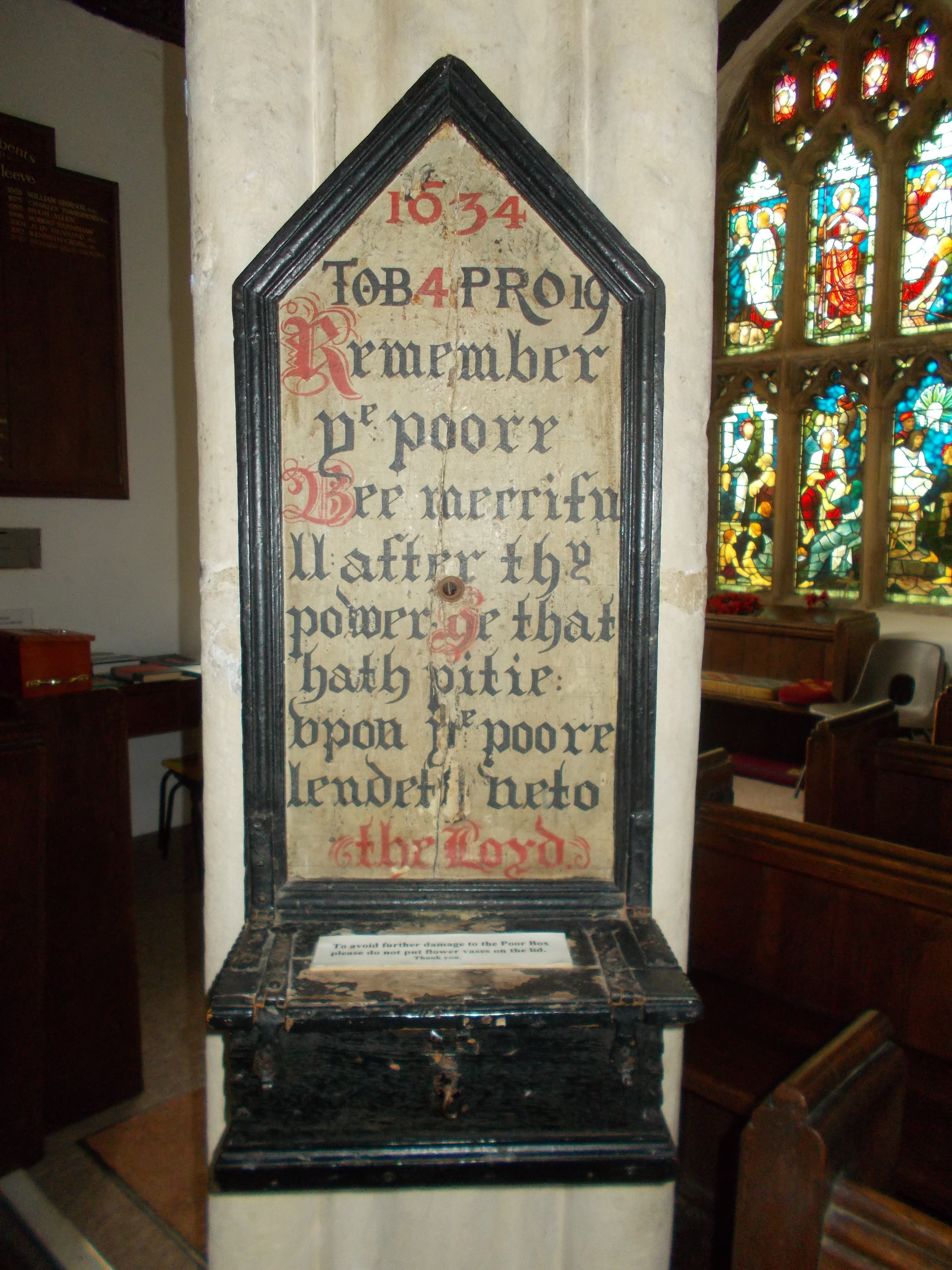
The decorative poor box is dated 1634.  The ancient wooden chest, which is made out of a hollowed tree trunk, has 3 locks on it: one for the rector and one for each of the churchwardens.

The carved bench ends were made by a parish Guild of Woodcarvers in the early 20th century, apart from one which was made by a local artist in 1981.  The nave roof has some fine medieval carved bosses.

The brass eagle lectern was given to the church in 1911 by Count Hochberg, who lived at Croydon Hall. The chandelier in the chancel was made by Thomas Bayley of Bridgwater in 1770.

There is a canopied tomb dated c1420.  It is thought to be the tomb of Sir John Golafre, who was Knight of the King's Chamber to King Richard II.  He was married to Philippa Mohun, who was heiress of Dunster.  Sir John's feet are resting on a cat, which has a rat under one of its paws.

Old Cleeve Parochial Church Council commissioned a new stained glass window to mark the Millennium.  It was designed and made by local artist Frankie Pollak.  It features an eclipse of the sun, ammonites, the churchyard pink sweet pea and the nets and fish of St Andrew.

The east window was made by Sir Ninian Comper in 1951 and was given in memory of members of the Lysaght family of Chapel Cleeve.  The west window was donated by the Vibart family, who lived locally, in memory of several members of their family who died in the Cawnpore Massacre in India in 1857.  The window was restored in 2021.

In 1974 Rachel Reckitt and Jim Horrobin were commissioned to make a tower screen for St Andrew's Church.  Four fibre-glass panels were painted with the patron saints of the churches in the same benefice.  Three large angels are arranged above the screen.

The church currently has a ring of 8 bells.  There were originally 3 bells.  In 1885 the metal from the 3 bells was used to make 6 bells and 2 more bells were added in 1924.  The 8 bells were retuned and rehung in 1994.

The floor of the porch is coated in pebbles with a heart shape in white pebbles.  It is dated 1614.

The original churchyard cross was defaced by the Puritans in the 17th century.  It was restored in 1909.  The lychgate was made in 1892.  There are 4 early 17th century chest tombs in the churchyard.

The roof and tower of the church were restored in the late 20th century and a gargoyle of Hugh Allen, one of the previous rectors, was added to the battlements at this point.

St Andrew's Church

Churchyard Cross

Heart pebble mosaic dated 1614

Chancel, east window and chandelier

Fish themed altar frontal

Poor Box

Ancient Chest

Pulpit

Four fish on a handmade banner

Canopied Tomb

Cat with rat under its paw

Eagle Lectern

Font and Paschal Candlestick

Medieval tiles

Screen designed and made by Rachel Reckitt

Bench End

Bench End

Bird Bench End

Dragon Bench End

Bench end with bishop's mitre and staff

Millennium stained glass window

Lychgate

Monday, 15 April 2024

Minehead's Maritime Heritage Plaques

In 2014, as part of the Minehead Maritime Heritage Project, seven plaques were created and mounted on the harbour wall. They were unveiled by the Les Smith, the Mayor of Minehead on 11th July 2014 at the Minehead Harbour Festival.  The plaques depict the seven eras of maritime heritage in Quay Town, Minehead and the vessels, which would have been in use at the time.

A series of workshops and projects, lead by Halsway Manor with sea shanty specialists Tom & Barbara Brown and storyteller Alex Simson, were held with local residents and schoolchildren to create the artistic brief.    The plaques were then designed and made by artist Sue Webber and author John Gilman.  Sue made 3-dimensional clay panels, which were then cast in resin and bronze powder by local company S&S Exmoor.  

The First Millennium and the Currach

The Celts sailed in light but durable currachs.  These were made of hide and wicker, could be up to 60 feet long and were capable of long voyages across oceans. This scene shows a saint looking for somewhere to live his life in prayer, solitude and learning.  He chose the spot where St Michael's Church now stands.

The 1100s - The Cog and the Carrack

The scene on this plaque is the raiding party of Welsh pirates led by William de Berkley, which arrived off the coast of Minehead on 1st August 1265.  They were defeated and William de Berkley and his crew were captured by Adam Le Gurdon, who was the master of Dunster Castle garrison.  They were executed by public drowning in Minehead Harbour. Cogs were oak planked boats with a single square sail.  They developed from the currachs.  Portuguese and Spanish boatbuilders later developed the carrack, which had 4 sails and fortified forecastles and aftercastles at the bow and stern. 

The 1500s - The Galleon
Galleons evolved from the carracks and were common by the 1500s.  They were fully rigged and had deeper keels that the carracks.  This meant they were capable of long sea voyages but couldn't be sailed in shallow inland waters.


The 1700s - Tops'l Schooner
Ships paid to shelter in Minehead harbour.  A new harbour was built in Minehead.  Fees were levied to pay for the new harbour and for the removal of silt and shingle from the harbour mouth.


The 1800s - Fully Rigged Ships
This plaque shows Minehead Harbour when it was busiest with lots of herring boats.  Supporting industries e.g. ropemaking, sail making and carpentry were located nearby.

First World War - Steamers
Minehead is decorated with bunting and fairy lights during a July Gala Week when Battlecruiser HMS Furious and Destroyer HMS Vega where anchored offshore. On the Saturday night 3,000 people watched a light show.

Second World War - Lifeboats and Convoys
John Slade and Tom Escott are shown in the lifeboat Mouette.  They sailed to Blue Anchor Bay to examine a partially submerged object, which had been spotted.  It turned out to be a mine, which exploded as they approached it and they were both killed.  A minesweeper can be seen in the distance and Spitfires are shown in the sky.  A gasometer stands next to the lifeboat house.