Tuesday, 2 April 2024
Ice Houses
Wednesday, 16 November 2022
Nailsea Glassworks
John Robert Lucas was born in 1754. After his father Robert Lucas died in 1774, he took over his beer and cider works in Bristol and his shares in a glass making business in Limekiln Lane, Bristol. In 1781 John Robert married Anna Adams and they had a son and two daughters. In 1787 he leased a glassworks at Stanton Wick.
John Robert Lucas established a glass works at Nailsea in 1788. He chose Nailsea as the site for his new glassworks because of the abundance of coal produced by the mines around the town and local supplies of sand and limestone. He may also have been influenced by plans for the Grand Western Canal, which would have linked the English and Bristol Channels with a branch to Nailsea. However only the section from Tiverton to Taunton was ever built.
Lucas’s company was called Nailsea Crown Glass and Glass Bottle Manufacturers. Initially one cone shaped kiln and a furnace were built at Nailsea. A second glass furnace was built there in 1790. In 1793 John Robert Lucas went into partnership with William Chance, Edward Homer and William Coathupe. In 1788 William Chance had married John Robert’s sister Sarah and Edward Homer had married John Robert’s sister Mary.
In addition to window glass and bottles, the Nailsea Glassworks also produced domestic ware and novelty items such as flasks, rolling pins, pipes, jugs and walking sticks, which were sometimes decorated with flecks, loops or bands of white or coloured enamel. Most of these items were produced by workers at the end of their shifts using leftover pieces of glass.
In 1811 William and Sarah Chance’s son, Robert Lucas Chance, took over the management of the Nailsea works and married his cousin Louisa, the daughter of Mary and Edward Homer. In 1812 he persuaded John Hartley, the leading crown glass expert in the country, to come and work at Nailsea.
The partnership of Lucas, Chance, Homer and Coathupe lasted until 1821 when William Chance sold all of his shares and Edward Homer sold part of his to William Coathupe. Edward Homer’s son James Edward Homer was taken into the partnership at this time and the company traded as Lucas, Coathupe and Homer.
John Robert Lucas died in 1828 and was buried at Backwell. Most of his estate passed to his grandsons John Rodbard Bean and Henry Lucas Bean.
The New House Cone was built at Nailsea c1828. Experienced sheet glass blowers were recruited from France and Belgium from the 1830s, due a shortage of skilled British glass blowers. By 1835 Nailsea was the fourth largest glassworks in Britain. Bottle making ceased at Nailsea in the 1830s in favour of plate, crown and sheet window glass.
In 1835 a partnership called Lucas, Coathupes, Homer and Cliffe was formed to run the business. In 1844 the company became Coathupes & Co with Charles and Oliver Coathupe, John and Henry Bean and James Edward Homer as shareholders. In the 1840s a new cone known as the Lilly or Lily Cone was built.
In 1848 Charles Coathupe retired and Oliver Coathupe became manager at the Nailsea works. Over the next 25 years there were various changes in the partnership and shareholdings. In 1861 the Nailsea works were closed for a while and the following year they were leased to Samuel Bowen, a glass merchant from West Bromwich, and John Powis of London. They traded as Nailsea Glass Company and made patented ventilating glass, cut glass and coloured glass for stained glass windows. Samuel Bowen became bankrupt in 1869 and he and Powis surrendered their lease. In 1870 the Nailsea works were sold to Chance Bros of Smethwick, together with a coal mine on the same site.
Glass production ceased at Nailsea in 1873, due to competition from cheap Belgian imports and the decline in production from the Nailsea Coalfield, and the works were closed in 1874. The New House Cone was demolished in 1905. Some of the rubble from it was supposedly used to build the extension to the runway at Filton in the late 1940s.
Extensive archaeological excavations began on the glassworks site in 1983 and continued for several years. In 2002 a supermarket was built on part of the site. The only surviving building is one which housed the French kilns, and gas-fired furnaces. This was later converted into the Royal Oak Garage.
A collection of
Nailsea Glass items can be seen at the National Trust’s Clevedon Court. However much
of what is today described as Nailsea Glass was not made at Nailsea but was
made in the same style elsewhere in England e.g. Stourbridge.
Glassworks Cauldron, High Street, Nailsea
This would have
been filled with cold water into which surplus molten glass would have been
ladled. Once the glass had cooled and
solidified it was broken up and used to speed up the melt of the next batch of
sand, limestone and soda.
The Glassblower Sculpture, High Street, Nailsea
This was sculpted by Vanessa Marston and unveiled in 2008
Two glazed ceramic tile panels illustrating the glassworks and its various manufacturing processes. The panels were designed and produced by Ned Heywood of the Workshop Gallery in Chepstow. They incorporate fragments of glass excavated from the site. They are on display on the outside wall of Tesco’s Supermarket.
Drawing showing the layout of Nailsea Glassworks c1873
Saturday, 1 January 2022
Monk's Steps, Kewstoke
Monk’s Steps or St Kew’s Steps, as they are also known, run from Woodspring Avenue near the top of the northern slope of Worlebury Hill in a north westerly direction for about 150 metres down a natural gully to join the bottom end of Monks Hill in Kewstoke.
The origin and original purpose of the steps, which are made of roughly worked stone, is uncertain but they may date back to the early medieval period. At this time there was an Augustinian Priory called Woodspring a mile and a half north at Middle Hope. St Paul’s Church at Kewstoke, which is located at the bottom of Monk’s Steps, was linked to Woodspring Priory for a while during the medieval period, so that may be how they acquired the name.
The freehold of Monk’s Steps was acquired by the National Trust from R.H.C. Butt on 7th July 1936. The grid reference for the top of the steps is ST 337 632 and for the bottom it is ST 336 633.
Monday, 1 April 2019
Dead Poets
- Siegfried Sassoon and T.S. Eliot are buried in Somerset.
- Samuel Taylor Coleridge and William Wordsworth both lived in the county for a few years.
- Alfred Tennyson and William Makepeace Thackeray both visited Clevedon
After the war Sassoon wrote more poetry, but also prose and autobiographies. In 1957 he became a Catholic. He died on 1st September 1967 at his home in Heytesbury near Warminster in Wiltshire. He was buried in the churchyard of St Andrew's Church in Mells, close to the grave of the Roman Catholic priest Father Ronald Knox, who he greatly admired.
Thomas Stearns Eliot (1888-1965) was born in St Louis Missouri but he moved to England in 1917 and became a British citizen in 1927. One of his Eliot ancestors had lived in East Coker before immigrating to America in the 1660s.
T.S. Eliot's best known poetic works include The Lovesong of J. Alfred Prufrock, The Waste Land, Ash Wednesday, The Hollow Men, Old Possum's Book of Practical Cats and Four Quartets. Four Quartets is a set of four long poems, the second of which is entitled East Coker. He also wrote several plays and essays.
T.S. Eliot died of emphysema at his home in London on 4th January 1965. At his request his ashes were interred at St Michael's Church, East Coker. There is a commemorative plaque to him on the wall of the church, which quotes some lines from Four Quartets: "In my beginning is my end" and "In my end is my beginning."
In the mid-18th century the author William Makepeace Thackeray was a frequent visitor of the Elton Family, who lived at Clevedon Court. He is best known as a novelist but he did also write some poetry.
Alfred Tennyson had a close friend at Cambridge University called Arthur Hallam. Arthur’s mother was a member of the Elton family of Clevedon Court. Arthur, who was a poet and essayist, was engaged to marry Tennyson’s sister Emily but he died suddenly in Vienna in 1833 at the age of 22. His body was brought back to England and he was buried in the family vault at St Andrew’s Church in Clevedon. In 1850 Tennyson wrote a poem called In Memorium in tribute to his friend. In the same year he made his first visit to Clevedon. The house on Old Church Road in Clevedon, where he is said to have stayed, is called Tennyson House. A nearby road is called Tennyson Avenue.
Friday, 1 February 2019
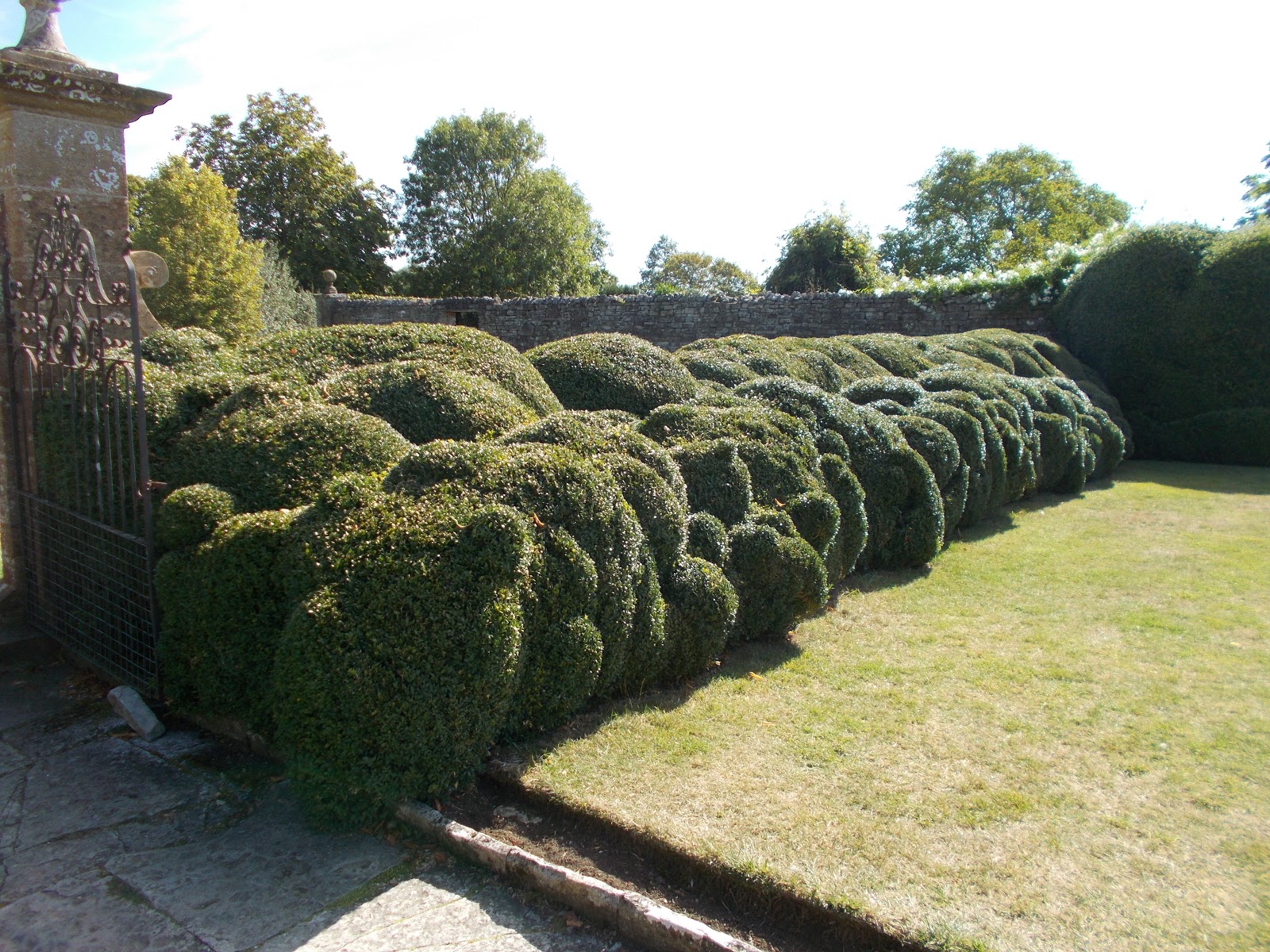
Wibbly-wobbly Hedges, Montacute House
The National Trust's garden at Lytes Cary near Kingsdon has some smaller scale but beautifully clipped box cloud hedges.
A house facing the pebble beach at Porlock Weir has a short section of cloud hedge, although whether it is clipped this way deliberately I don't know.
Sunday, 5 March 2017
Conygar Tower and The Arches, Dunster
Henry Luttrell also created Dunster deer park, planted trees on Conygar Hill and had a Sham Ruin, also designed by Richard Phelps, built 400 metres to the north west of Conygar Tower. It is known locally as 'The Arches'. There are two unroofed turrets either side of one of the arches, with the second arch at right angles to the first. Tracks were created to wind around Conygar Hill, so that the gentry could travel up to the folly via the Sham Ruin in horse drawn carriages.
The name Conygar comes from two medieval words: coney (rabbit) and garth (garden), indicating that the area was once a warren used for breeding rabbits for food.