Tuesday, 16 July 2019

Jack Hammer, St Michael's Church, Minehead

St Michael's Church in Minehead is home to a painted wooden carving of a man dressed in a green jacket and breeches and wearing what looks like a Santa hat.  He is currently located on top of the southern end of the rood loft inside the church.  He is known as Jack Hammer and his original purpose was probably to strike the passing of time on the church clock.  He is first mentioned in the churchwardens' accounts of 1624.

Jack Hammer was originally located on top of the box which contained the workings of the tower clock, which was situated in the west entrance to the church but the workings were moved into the ringing chamber in 1929 and Jack was moved to the top of the rood screen.

The Minehead Jack still has a bell, which is pulled manually to announce the start of the main Sunday morning service.

Other Jack Hammers can be seen at Blythburgh and Southwold in Suffolk.  The Blythburgh Jack dates from 1682. The Southwold Jack, who is wearing armour, dates from 1470.

Close up of Minehead's Jack Hammer
 
Jack Hammer on the rood loft

Monday, 1 July 2019

Stone Circles - Ancient and Modern

The Concise Oxford Dictionary of Archaeology defines a stone circle as "a setting of upright stone pillars forming a ring whose exact ground plan many vary between being almost exactly circular through to elliptical or egg‐shaped".  Ancient stone circles date from the late Neolithic through to the early Bronze Age and many of them are the final phase in the development of a monument, which started as a timber circle.  They are located in western parts of the British Isles, northern France and Scandinavia.

Ancient stone circles are not common in Somerset (e.g. Withypool Hill and Stanton Drew).  However there are several modern ones e.g. at Ham Hill, Pilton (Glastonbury Festival site) and Ashill.

Stanton Drew
The three stone circles and three stone "cove" at Stanton Drew to the east of Chew Magna, make up the third largest complex of prehistoric standing stones in England.  The Great Circle, which is 113 metres in diameter and has 26 surviving upright stones, is one of the largest stone circles in England.  There are two smaller stone circles: to the south west and north east of the Great Circle.  The Cove, which consists of three large stones, is located in the garden of the Druid's Arms pub.  Across the River Chew to the north of the stone circles is a single standing stone known as Hautville's Quoit.  The Cove, stone circles and Hautville's Quoit were almost certainly parts of a single complex.

According to legend, the Stanton Drew Stone Circles are the petrified remains of a group of wedding guests and the musicians who were entertaining them: they were lured by the devil into celebrating on a Sunday and they were punished for doing so by being turned into stone.

Withypool Hill
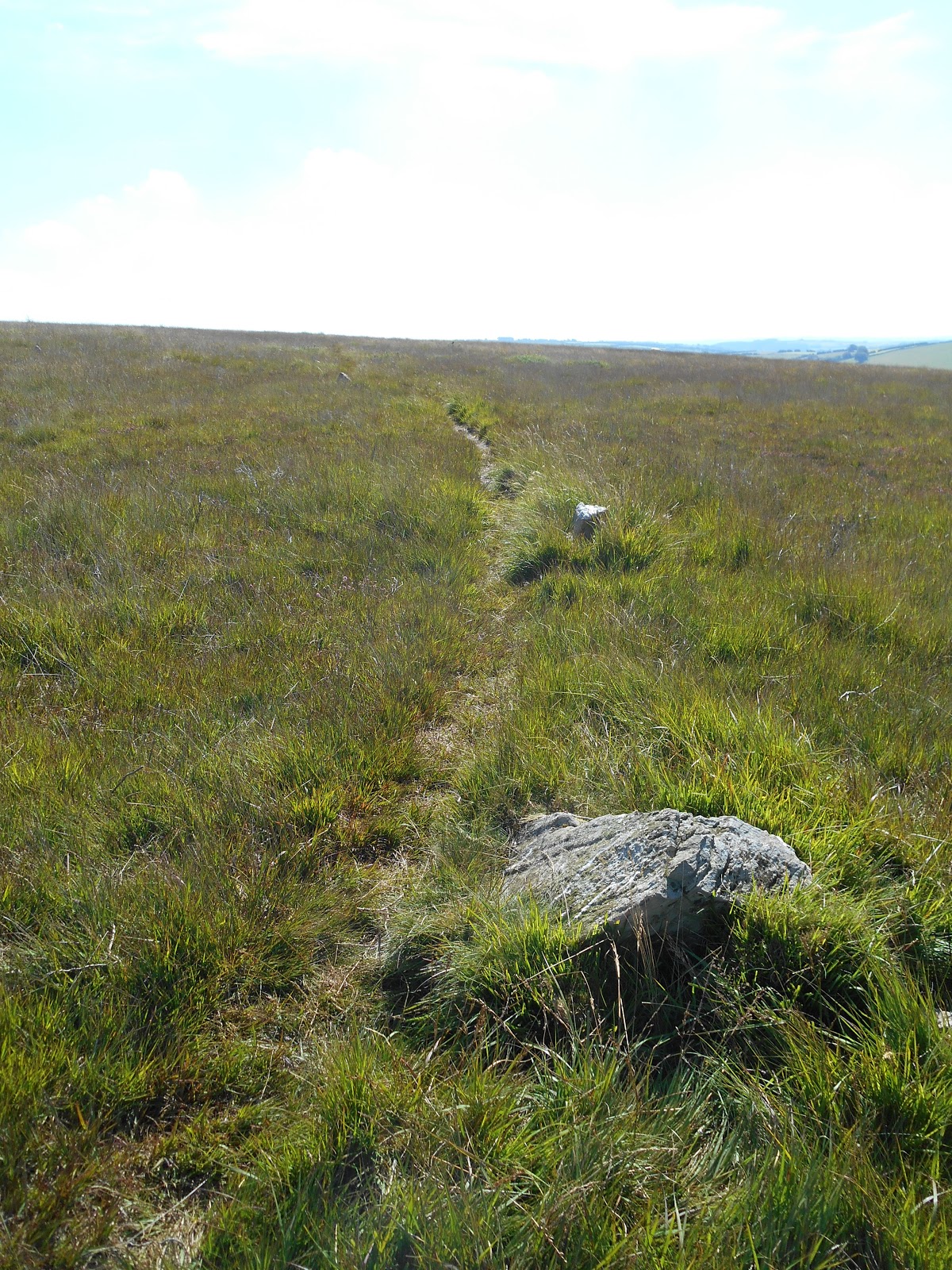
The stone circle on the south west side of Withypool Hill is visually underwhelming, as the stones are not very large (the tallest one is only 50cm high).  There are 27 surviving stones and 3 fallen ones and the diameter of the circle is 36 metres.  The circle may originally have consisted of up to 100 stones.  It was first identified in 1898 and was recorded in 1906 by Harold St George Gray.  Grid reference:  SS 838 343.

Ham Hill
This modern stone circle consists of 15 standing stones made of the local Hamstone.  It was erected as a Millennium project to commemorate the many centuries of quarrying that have gone on at Ham Hill and all the men who have worked there.   Pieces of shell and other small fossils can be seen in the stones.  Grid reference: ST 478 171.

Glastonbury Festival, Worthy Farm, Pilton
This stone circle is located in King's Meadow on the southern edge of the Glastonbury Festival site at Worthy Farm, Pilton.  It consists of 20 large stones and was erected in 6 weeks in 1992.  It is known as the Swan Circle, after the constellation Cygnus (it is egg shaped).  Ivan McBeth constructed it using local limestone quarried from the nearby Torr Works Quarry.  Each stone was individually chosen by Ivan and Michael Eavis.  Ivan McBeth, who was a Druid, later constructed a number of other stone circles for private clients at various locations across England and also in the USA, Canada and Australia before his death in 2016.  The Swan Circle is located on private land and is normally only accessible during the Glastonbury Festival.  We were given permission to walk around the empty site in February 2019.  The grid reference for the Swan Circle is ST590 397.

Glastonbury - Street Road
As you drive into Glastonbury on the A39 coming from the south, there is a small modern stone circle in what may be a private garden but it is clearly visible on the right hand side of the road opposite the Red Brick Building.

Ashill
There is a small stone circle located on a public footpath, 400 metres west of the parish church.  It is in a field, which also has 5 life size white statues of ladies in various states of undress, so I presume they all belong to the same person.

Ham Hill

Ham Hill

Withypool Hill

Withypool Hill

 Withypool Hill

The Great Circle, Stanton Drew

The Great Circle, Stanton Drew

The Cove, Stanton Drew

The Cove, Stanton Drew

Ashill

Ashill

Swan Circle, Glastonbury Festival Site

Swan, Circle, Glastonbury Festival Site

Glastonbury Festival Site

Centre of the Swan Circle, Pilton

Stone Circle, Street Road, Glastonbury

Stone Circle, Glastonbury

Stone Circle, A39 Glastonbury

Wednesday, 19 June 2019

Taunton's Blue and then White Royal Mail Postbox - ICC Cricket World Cup 2019

In May 2019 the Royal Mail postbox in North Street, Taunton (outside what used to be the Post Office) was painted royal blue to celebrate the ICC Cricket World Cup 2019.  Taunton's County Ground was the venue for 3 matches:
  • Afghanistan v New Zealand, Saturday June 8th (New Zealand won)
  • Pakistan v Australia, Wednesday June 12th (Australia won)
  • West Indies v Bangladesh, Monday June 17th (Bangladesh won)
One Royal Mail postbox was also painted blue in each of the other towns and cities whose cricket grounds were hosting matches - Southampton, Leeds, Cardiff, Chester-le-Street, Bristol, London, Manchester, Birmingham and Nottingham. I'm not sure why blue was chosen as the colour for this occasion.

Unlike the gold post boxes, which were painted to commemorate local winners of gold medals at the 2012 Olympics and Paralympics, the blue post boxes were due to be painted red again after the end of the 2019 Cricket World Cup.  However after the England team won the Cricket World Cup, Royal Mail decided to paint the postboxes white and gold.  I understand that after three months they will be painted red again. 


Update, November 2019 - the Taunton postbox has now been painted red once more.

Back of the post box in North Street, Taunton

Front of the postbox in North Street, Taunton


White postbox in North Street, Taunton

Back of the white postbox in North Street, Taunton

Gold plaque on the North Street postbox

Friday, 14 June 2019

The White Ladies of Ashill

The White Ladies of Ashill are located in a large field to the west of the church in the village of Ashill near Ilminster.  There are five white life size statues but only two of them are located adjacent to a public footpath: one of these is a lady sitting looking into a stream and the other is standing in someone's garden.  I presume they belong to whoever owns the field.  There is also a small modern stone circle in the same field. I realise now that I wandered off the public footpath when I went to look at two of the other statues.  The one I didn't go and see was the one in the far north-west corner of the field.  I have not been able to find out anything about them and do not know how long they have been there.

White Lady looking into the stream

Seated White Lady 1

White Lady 2

White Lady 3

White Lady 4 - in someone's garden

Stone Circle at Ashill

Saturday, 1 June 2019

Robin Hood's Butts

Robin Hood's Butts are a group of 9 Bronze Age barrows located on the top of the Blackdown Hills at Brown Down.  Five of the bowl barrows are arranged together on a north/south alignment to the south of School Farm between the hamlets of Fyfett and Otterford.  Four of them have a diameter of c20 metres and are 2.2 metres in height.  The fifth one has a diameter of c28 metres and is 2.5 metres high.  The grid reference is ST 230 143.  The other four barrows are located at different points up to a mile to the south of the group of 5.

Legend has it that Robin Hood used the barrows to support the targets for his archery practice or that Robin Hood and Little John threw their quoits from one barrow to another, thus creating bowl shaped indentations on the top of them.  An alternative story is that they were created by giants throwing earth at each other.

Bowl barrows to the south of School Farm

Robin Hood's Butts, School Farm

Robin Hood's Butts

Robin Hood's Butts, School Farm

Robin Hood's Butts, School Farm

Tuesday, 21 May 2019

Waterfalls

A waterfall is the place where a stream or river flows over the edge of a steep or vertical cliff and falls into a pool below.   Waterfalls often occur where a horizontal band of resistant rock lies over softer rock.  The soft rock erodes more quickly forming a step.  The harder rock is then undercut by hydraulic and abrasive forces, forming an overhang, which eventually collapses. The fallen rocks drop into the plunge pool and as they are moved around by the force of the water, they cause more erosion of the river bed and banks and another overhang is formed, which also eventually collapses  Thus the waterfall gradually recedes upstream, forming a steep sided gorge downstream.  Waterfalls can also occur at the edges of plateaus, at sea cliffs, where a hanging valley meets a steep sided valley created by a glacier and where rivers cross faults caused by earthquakes. Some waterfalls are ephemeral and only flow during times of high rainfall or snowmelt.  Waterfalls can also be created artificially as garden features.

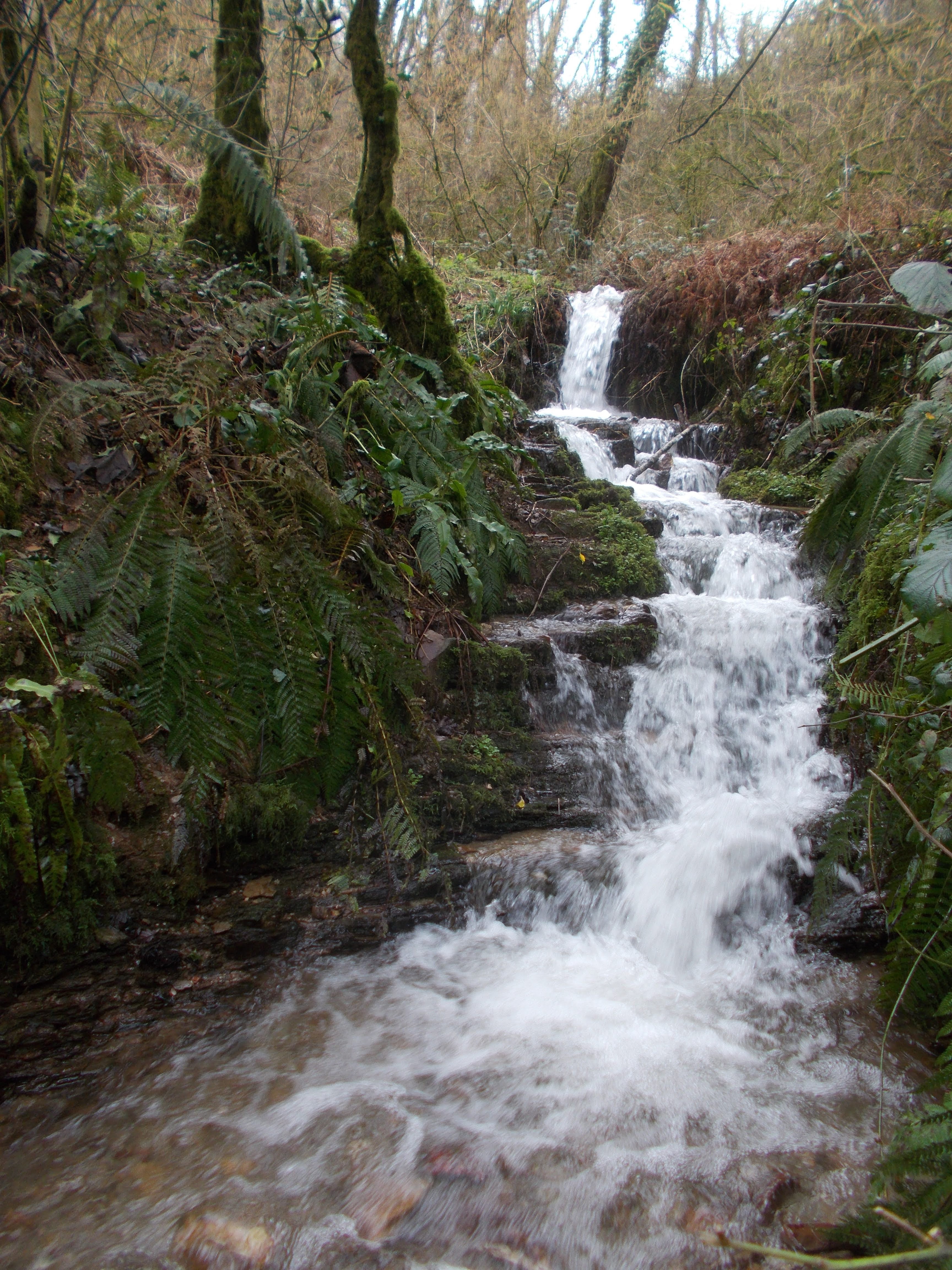
Waterfalls are few and far between in Somerset.  The most dramatic ones I have found are located in the Brendon Hills near Comberow, where an unnamed tributary of the Washford River drops over a near vertical cliff and at St Audrie's Bay, where an unnamed stream falls over a sea cliff onto the beach.  The Great Cascade at Hestercombe is manmade waterfall, which is supplied with water by a purpose built leat.


Western Cliff Wood, Comberow, Brendon Hills
 
Western Cliff Wood, Comberow, Brendon Hills


Western Cliff Wood, Comberow, Brendon Hills
 
Small waterfall, Horner Water, Exmoor
 
Sherford Stream, Trull - near Staplehay
 
St Audrie's Bay
 
St Audrie's Bay
 
Cam Brook Waterfall, Highbury Hill, High Littleton
 
 
Great Cascade, Hestercombe Gardens
 
Great Cascade, Hestercombe Gardens

Water cascading over Wimbleball Reservoir dam

Cascade at Wimbleball Reservoir

Temporary small waterfall by the entrance to Snowdrop Valley, Wheddon Cross

Glenthorne Beach