On my travels around Somerset I have come across the following colourful mosaics. Some of them aren't strictly true mosaics but they have a similar format.
In March 2002, with the help of a youth worker and a professional artist, the West One Youth Club in Crewkerne designed and created a set of mosaics outside what is currently the West One Surgery in West Street, Crewkerne. The project was funded by the National Lottery and Crimebeat.
West One Mosaic, Crewkerne
West One Mosaic, Crewkerne
West One Mosaic, Crewkerne
Plaque on the West One Mosaic, West Street, Crewkerne
Diamond Jubilee Mosaic, St Thomas Street, Wells
Brick mosaic on the back wall of Taunton Canoe Club in Priory Bridge Road, Taunton
This photo was taken on a very snowy day in March 2018
To celebrate the Millennium, the children of Brookside School in Street created this 140 Smiles "mosaic". The figures are self-portraits by the children from Years 3 and 4 in 2000. They were helped by ceramic artist Julia Gatrill.
140 Smiles, High Street, Street
Victoria Park, Taunton
Pastoral scene mosaic on the public toilets, Wheddon Cross public car park
Winsford Village Hall
In October 2001 George Caton and the Osborne family discovered a large Romano-British mosaic floor at Lopen near Ilminster.. They contacted Somerset County Council's archaeological team and over the next three weeks the mosaic was fully excavated, cleaned, recorded and then covered over again to protect it from the elements. An 8 roomed villa was revealed, which is thought to date from about 360AD. The mosaic is believed to be the work of the Saltire School, who were based at Corinium (now Cirencester). The designs used in the mosaic included large squares, saltires, a dolphin, a cantharus (two handled cup), flowers, fish, heart shaped leaves and guilloche (plaits or braids).
The loose tesserae, which were found in the soil around the mosaic were donated to the village by the land owners and used to recreate a section of the mosaic. Volunteers washed and sorted the pieces and Nicholas Durnan and Gina Wright placed the 3,000 or so pieces into lime mortar to create a cantharus. It was completed in 2002 and is now on display on the floor of All Saints Church in Lopen. The surround is made from Ham Stone.

Cantharus Mosaic, All Saints Church, Lopen
Lopen Church Mosaic
Seasons Mosaic, Grove Park, Weston-super-Mare
Grove Park, Weston-Super-Mare
Wrington
Aller Dragon on the side of Aller Village Hall
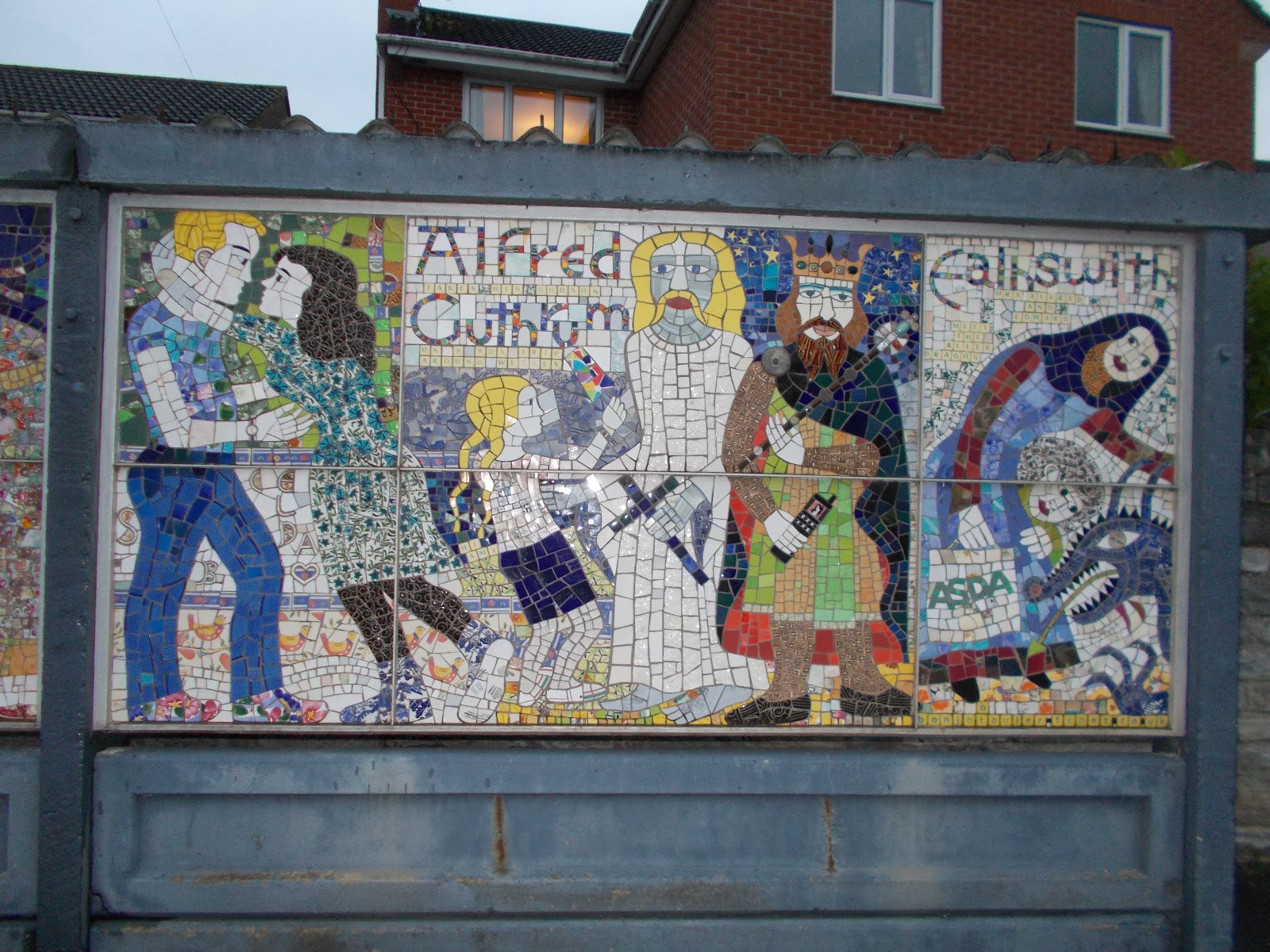
Aller bus shelter
This mosaic includes historic characters from the village's past e.g. King Alfred, his wife Ealhswith, their son Edward, the Viking leader Guthrum and the Aller Dragon. The mosaic and the one of the Aller Dragon above were apparently made by local potter Bryan Newman but I have not been able to confirm this or find out when they were made.
Aller bus shelter mosaic - right hand panel
Aller bus shelter mosaic - left hand panel
Yin and yang mosaic in the sensory garden at Vivary Park, Taunton
Dragonfly pebble mosaic on the side of the River Tone near Firepool Lock
St Decuman pebble mosaic, Watchet
This pebble mosaic, which is located outside Watchet Library, commemorates the arrival of St Decuman in Watchet by boat from Wales in the late 7th century. It was created in 1996 by Maggy Howarth of Cobblestone Designs. St Decuman brought his favourite cow with him, which can be seen in the photo above. He came to evangelise the people of West Somerset but he wasn't welcomed by everyone and was beheaded. Being a saint, this wasn't a problem to him, as he washed the blood from it in the waters of a holy well and put it back on his shoulders.
Compass rose in the St Decuman pebble mosaic, Watchet
St Decuman's severed head
Sword used to cut off St Decuman's head
Swan mosaic plaque on the former Swan Inn, 2 Silver Street, Wiveliscombe
Mosaic on the wall of the toilet block of Ilminster Recreation Ground
Heart pebble mosaic dated 1614,
St Andrew's Church, Old Cleeve
Queen Elizabeth II Diamond Jubilee mosaic, 2012, Priorswood, Taunton
Platinum Jubilee mosaic, Priorswood, Taunton Platinum Jubilee mosaic, Priorswood, Taunton
East Coker Roman mosaic
This is on display in the Museum of Somerset in Taunton. It shows two hunters returning home with a deer slung on a pole between them. It probably dates from the 2nd half of the 4th century AD. A Roman villa was discovered near East Coker in 1753
Low Ham Roman mosaic
This is on display in the Museum of Somerset in Taunton. It is the oldest object in Britain to tell a complete story and dates from around 350 AD. It tells the tragic love story of Dido and Aeneas. This was recorded by the poet Virgil in c25 BC. The mosaic was found in the bath block of the Roman villa at Low Ham. It was discovered by a local farmer Herbert Cook in 1938 when he was digging a hole in which to bury some dead sheep. It was excavated 1946-48 by Lionel Walrond, Steven Dewar and C.A. Ralegh Radford. The 120,000 tesserae were made from local materials, including lias limestone and fired clay.
Mosaic seat, Minehead Seafront
This is the first of 8 seats spelling out the word Minehead.
Wyvern Mosaic, Magdalen Lane, Taunton
Bird and frog mosaic on the back wall of a shelter in Collett Park, Shepton Mallet
Two agricultural labourers taking a break at harvest time Woodborough Road, Winscombe
Pebble flower mosaic in the Four Seasons Garden, The Newt, Hadspen
Dragon of Worminster Sleight mosaic, Wells
This mosaic was created in 2001 as part of the Three Villages Dragon Festival, to commemorate the slaying of the Worminster Dragon by Bishop Jocelyn during the 13th century. It was made by the artist Kate Rattray with the help of 6 local schools and community groups. It is located at the side of the footpath on the south side of the Bishop's Palace.
Beware! The Dragon of Worminster Sleigh, who returns to Dinder, Dulcote and North Wootton every 50 years.
Watchet Seaspray Gallery 2015
This mosaic was organised by Watchet Arts Group. It is made up of around 1500 tiles. The tiles were decorated by local people and visitors.