Friday, 1 December 2017

Somerset Space Walk

The Somerset Space Walk is a true scale model of the Solar System with the planets placed at their correct intervals along the towpath of the Bridgwater and Taunton Canal.  The sun at the centre of the Solar System is located at Higher Maunsel Lock, which is halfway along the 22 kilometre canal, which as its name suggests runs between Bridgwater and Taunton.  The canal is open to walkers, boats and, for most of its length, cyclists.

The Bridgwater and Taunton Canal was constructed by engineer James Hollinsworth between 1824 and 1827.  It was extended into Bridgwater by engineer Thomas Maddicks 1839 to 1841.

Each of the planets has a concrete pillar with a plaque with information about that planet and a scale model of the planet above it.  At the bottom is a label showing how many kilometres it is to Bridgwater and Taunton.  There are two sets of planets, one heading north from the sun towards Bridgwater and the other heading south towards Taunton. Mercury, Venus, Earth and Mars are all very close to the sun model with Jupiter a short distance away.  The Moon is a small dot on the Earth's pillar.

The plaque on Venus reads as follows:

“A strange place, the day longer than the year. Under a vast, dense atmosphere of carbon dioxide laced with clouds of sulphuric acid there lies a scorching desert. No air, no growth, no seas. Earth’s nearest neighbour and size-twin… and yet, so different.”

Pip Youngman, a local astronomer and inventor, conceived the idea for the space walk and designed and built the pillars.  It was officially opened on 9th August 1997 by British astronomer Heather Couper.  It was a joint venture between the Taunton Solar Model Group (Pip, Trevor Hill, a local physics teacher and David Applegate, a former Mayor of Taunton) and the British Waterways Board. It was funded by COPUS (Committee on the Public Understanding of Science) with a small grant from Sustrans. The planet models were refurbished by Somerset County Council in 2007.

The plaque on the sun says this:

"The Somerset Space Walk is built on a scale of 1:530,000,000.  On this scale Pluto is almost too small to model and yet it is 11 kms away. The average adult pace equal 400,000 kms.  To include the nearest star we would need another 75,000 kms of canal. The full distance from Taunton to Bridgwater represents the full disc of the Solar System, the planets being shown twice. Whichever way you walk you will find the planets at their proper distances and sizes."

Philip Robert Vassar (Pip) Youngman died in 2007 aged 83 but what a wonderful legacy he has left behind.

Mars
 
Venus
 
Earth
 
Maunsel Lock
 
The Sun at Maunsel
 
Mercury
 
Uranus
 
Saturn near Cogload Junction
 
Plaque on the Sun
 
Explanation on the Sun at Higher Maunsel Lock
 
Information Board at the Sun
 
Neptune, Maidenbrook, Taunton
 
Jupiter
 

Saturday, 4 November 2017

Handsome Horses and Posing Ponies

These handsome horses and posing ponies are located around Somerset.  As I come across more of them, I will add to this post. 

Mells Church
Mells Church has the only equestrian monument inside a church in England.  The statue of Edward Horner, who was killed at Noyelles in France in 1917 aged 28, was designed by Sir Alfred Munnings.  The plinth on which it stands was designed by Sir Edwin Lutyens.

Exmoor ponies are a native British moorland and mountain breed, which has adapted to live on low quality moorland grazing.  They have roamed wild across Exmoor for thousands of years.  Ponies are mentioned of Exmoor in the Domesday Book of 1086.   In 1818 when Exmoor was sold to the industrialist John Knight, Sir Richard Acland took 30 ponies off Exmoor and founded the Acland Herd and other local farmers also bought ponies and founded separate herds.  The Exmoor Pony Society was founded in 1921 to preserve the breed.  However by the late 1940s there were as few as 50 of them left, as many had been used by soldiers as target practice during the Second World War and others had been eaten by hungry city dwellers. 

Numbers have increased significantly since then but they are still considered to be endangered by the Rare Breeds Survival Trust, as there are less than 500 of them.  Herds of semi-feral Exmoor ponies graze on the open moorland of Exmoor today.  Normally they take no notice when people walk by them.  However a couple we met on the Mendip Hills above Cheddar in January 2016 came over to check us out and I was able to take some close up photos of them in their winter coats.

Exmoor ponies are always a shade of brown, bay or dun with black points. They have paler (mealy or pangarĂ©) markings around their eyes, muzzle, flanks and underbelly.  This mealy colouring is typical of primitive breeds of pony.  They are usually 11-12 hands high.
Exmoor Ponies on the Mendips

Posing Ponies

Exmoor pony at Clayhidon Turbary on the Blackdown Hills

Exmoor pony at Clayhidon Turbary on the Blackdown Hills

Exmoor ponies at Clayhidon Turbary on the Blackdown Hills
They seemed very happy to pose for a photograph

Nettlecombe Court Gatepost

Willow Horse, Rodney Stoke
This is located in a private garden but is visible from the main road through the village

War horse
This horse is part of a Gallipoli memorial art installation, just across the border in the woods of the Stourhead Estate in Wiltshire

Packhorse on a bench end at St Michael's Church, North Cadbury

Slightly strange and not terribly handsome horse and rider outside Maw Agri, Lower Weare

This magnificent white horse and his thoughtful giant friend are located at the entrance of Wells Reclamation on the A39 between Coxley and Wells

White Horse at Wells Reclamation

Prancing horse logo on a Starkey, Knight & Ford pub on West Quay, Bridgwater
Local brewery company Starkey, Knight and Ford was taken over by Whitbread in 1962 and they closed down the Northgate Brewery in Bridgwater.  The prancing horse logo ceased to be used in 1970.

Prancing horse logo on the former Starkey, Knight and Ford pub, West Quay, Bridgwater 

White horse weather vane on the roof of the White Horse Inn, Exford

Horse's head above the door of a house opposite the Youth Hostel in Exford

Copenhagen, Wellington
Copenhagen currently lives in a narrow strip of garden on Champford Lane in Wellington called Ivy's Patch.  He is named after the horse that the Duke of Wellington rode at the Battle of Waterloo and is made of teak.  The garden was created by local resident John McCarten and named in honour of his mother.

Copenhagen rugged up for the winter

Copenhagen decorated with poppies for Remembrance Day

Plaque on the former White Horse Inn, North Street, Wiveliscombe

Horse on one of the gates in the village garden at Dunster

Globe Inn, Cannington
The prancing horse trademark of Starkey, Knight & Ford

War Memorial bench, Somerton

Donkey and upturned cart sculpture, Worle

Lloyds Bank, Ilminster
On this occasion, the black horse symbol is shown in white! Sadly this branch will be closing in August 2024.

Punch, Somerset Rural Life Museum, Glastonbury
This sculpture was made by Harriet Mead from old tools and agricultural scrap metal in 2017.

Punch

Little Jessie:  A Horse for Bridgwater    
St Matthew's Field, Bridgwater
Little Jessie is a life size steel scultpure of a Gypsy Cob horse.  He was made by Romani blacksmith artist Jake Bowers and was installed for the opening of the Bridgwater St Matthew's Fair on 25th September 2025.  The horse was named after 'Little Jessie' Smith, who died in a caravan accident in the 1950s at the age of 7.


Thursday, 2 November 2017

Taunton's Willow Cathedral

Taunton's Willow Cathedral is located in Longrun Meadow, a public open space to the west of the town centre and close to the River Tone.  It was designed and made by local artist Stefan Jennings and Sophie Courtiour for Project Taunton.   It is made of living willow, sourced from the Somerset Levels and was officially opened on 24th June 2011.

Inside the Willow Cathedral, May 2017
 
Willow Cathedral, May 2017

Monday, 23 October 2017

Escape from Quantock House, Taunton

One of my colleagues spotted this shape in one of the broken windows of the former office block called Quantock House in Paul Street, Taunton.  It looks remarkably like the shape of a running man.  As the building is in the process of being demolished, I presume that he was running away from the big crane that is being used for the demolition.  He got away just in time, as 24 hours after I took this photo on 18th September 2017 his part of the building was gone forever.  The building is apparently going to be replaced by a care home.

The Running Man
 
Farewell Quantock House
The running man window is the second window from the right hand end of the building and the second level up that is visible over the security fence

Friday, 6 October 2017

St Mary's Church, Nettlecombe

There is no village of Nettlecombe today, just a cluster of buildings around Nettlecombe CourtThe parish church of St Mary the Virgin is situated adjacent to Nettlecombe Court and both lie in a beautiful tranquil valley in the Brendon Hills.  Nettlecombe Court will always have a special place in my heart, as it was where I fell in love with the county of Somerset when I stayed there for a week on a geography field trip in early spring 1984.

Nettlecombe Court was originally a medieval manor house.  It was enlarged and altered in Tudor, Elizabethan and Georgian times.   It was used by two schools from 1945 until 1965.   In 1967 it was leased to the Field Studies Council who converted to its present use as a field centre. 

Nettlecombe is mentioned in the Domesday Book.  In 1160 the estate was granted by the king to Hugh de Ralegh.  In 1440 Simon de Ralegh died childless and the estate passed to his nephew, Thomas Whalesborough.  It was then inherited by Thomas's daughter Elizabeth who was married to John Trevelyan.  

In the late 1700s the village of Nettlecombe, which had been located close to the court and church, was removed when the parkland was landscaped.  Some people moved to the nearby villages of Torre and Yarde and the hamlet of Woodford, half a mile to the north east of the court was built in the 19th century to house estate workers. 


Nettlecombe Court stayed in the Trevelyan family until 1931 when Sir Walter Trevelyan died and left Nettlecombe to his daughter Joan who was married to Garnet Wolsey, a noted artist.  Much of the estate was sold off after 1945 but Nettlecombe Court has never been bought or sold.

Nettlecombe Court

Nettlecombe Church dates back to the 13th century and in 1440 the church was dedicated to St Mary the Virgin.  It was restored c1820 and again in 1858 and 1870.

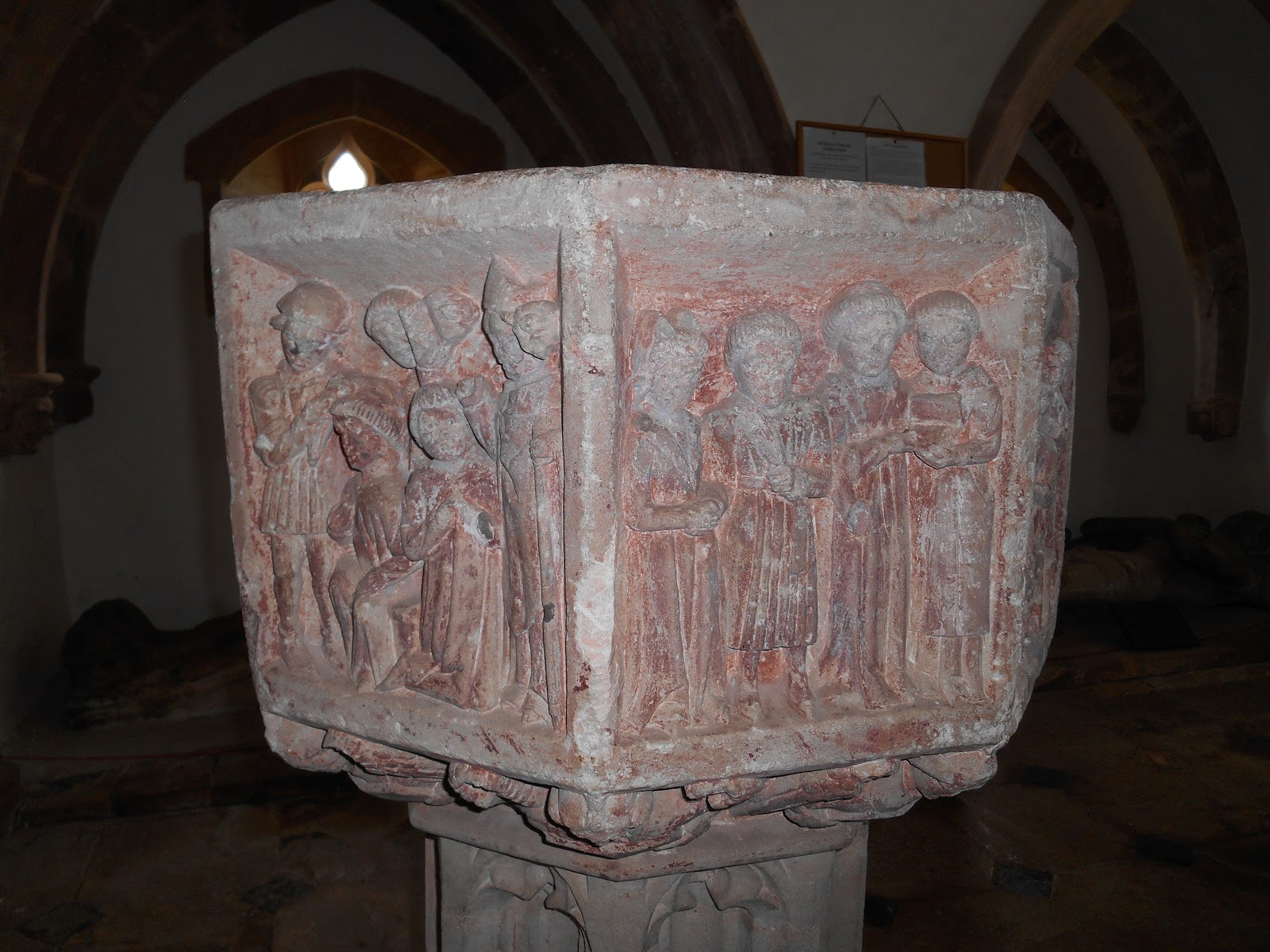
The interior of St Mary's Church contains some very interesting tombs and memorials, a fine pulpit and a beautifully carved rare seven sacrament font.

The Church of England observes two sacraments (baptism and communion) but the Catholic church recognises seven:
  • Baptism
  • Confirmation
  • Penance
  • Communion
  • Ordination
  • Matrimony
  • Extreme Unction (last rites)
There are 39 seven sacrament fonts in churches in England but the one in Nettlecombe and one at Farningham in Kent are the only ones located outside Norfolk and Suffolk.  The Nettlecombe font has been dated to 1465-70.  It is mounted on a much more recent base made of Ham Stone.

St Mary's Church, Nettlecombe
 
Font
 
Ordination and Matrimony
 
Font
 
Penance and Communion
 
Extreme Unction and Christ in Glory
 
Baptism and Confirmation
 
Carved Bench End
 
Effigy of Sir John Ralegh and his first wife Maud
Maud died  c1360 but Sir John remarried and died in 1372
 
Effigy of Sir Simon de Ralegh, who died c1284-1288
 
Wineglass Pulpit
This is made of oak and dates from the 18th century

East window
 - in the bottom right and left hand corners are images of St Mary's Church and Nettlecombe Court respectively

St Mary's Church depicted in stained glass

Nettlecombe Court depicted in stained glass


Memorial to Joan Alys Wolseley (nee Trevelyan) 1904-1943

Embroidered altar front

Elaborate memorial to Urith, Lady Trevelyan

Brass memorial in memory of Harriet Louise Trevelyan

Horse on Gatepost