Tuesday, 2 August 2016

Wheal Eliza and the Murder of Anna Maria Burgess

Wheal Eliza was a copper mine on the banks of the River Barle about a mile downstream from Simonsbath.  It opened in 1845 and was initially called Wheal Maria.  It had two leats and a large water wheel by 1846.  The entrance was a stone lined adit, which led to a 300 foot shaft.  By 1851 9 miners were employed at the site.  6 of them lived in a cottage on the site.  Little copper was produced and the mine closed in around 1857.  The remains of the workers' cottage, one of the leats, the space where the water wheel was once located and the mine shaft can still be seen. 

In the 1850s William Burgess lived with his wife and three children in a cottage in White Water Combe just over half a mile to the east of Wheal Eliza.  Then in 1857 Mrs Burgess died.  The two oldest children went into service at local farms but the Burgess's youngest child Anna Maria was only 6, so she went with her father into lodgings at Galleon House in Simonsbath.  However William Burgess resented having to pay a local woman 2s 6d to look after Anna.  He would rather have spent the money on alcohol.  William killed Anna in July 1858 to save the money and told everyone she had gone to live with relatives in Porlock.  

However the local vicar William Thornton and others didn't believe him and made checks in Porlock.  Reports of a blue light seen above Wheal Eliza led William Thornton to suspect that was where Anna's body had been dumped.  The mine was pumped out and after a few weeks Anna's body was found.  William Burgess had fled to South Wales but was captured there and brought back to Exmoor.    He admitted the murder of his daughter and was convicted and sentenced on 20th December 1858.  He was hanged on 7th January 1859.  Anna was buried in an unmarked grave in St Luke's Churchyard in Simonsbath.  The Exmoor Society later erected a headstone but as the location of the actual grave is unknown, they chose a suitable spot.


The water wheel was located in this space on the opposite side of the River Barle to the mine

Remains of the leat leading to the water wheel

Remains of Wheel Eliza and its spoil heaps from across the River Barle
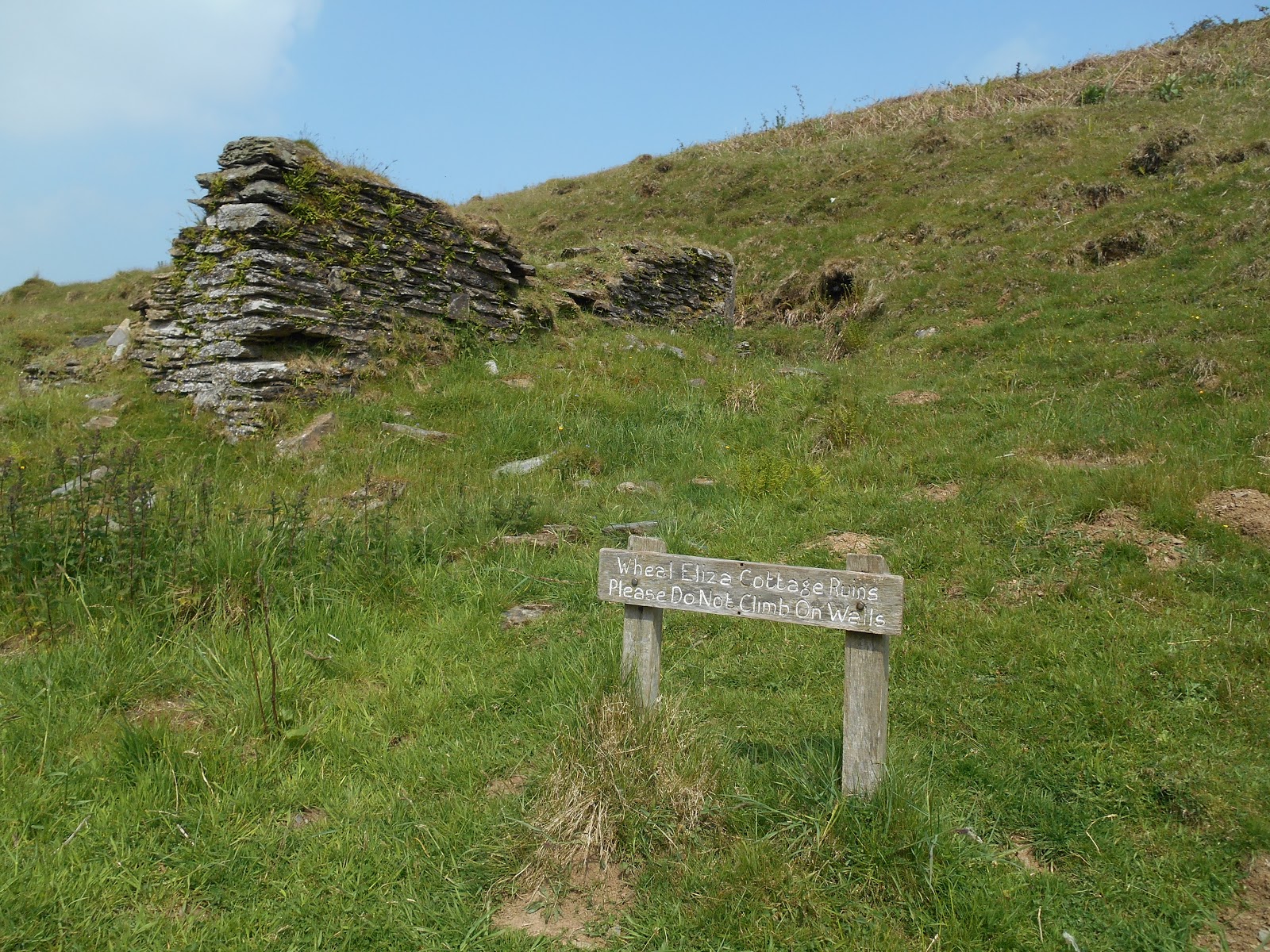
Ruined Cottage at Wheal Eliza

Workers' Cottage ruins

Fenced off mine shaft.  The leat can be seen on the far bank

The Burgess's cottage in White Water Combe was located around here.  There are a few heaps of stones but no sign of a cottage.

Approximate location of the Burgess's cottage in White Water Combe

Anna Maria Burgess's headstone in St Luke's Churchyard, Simonsbath
The inscription reads "Anna Maria Burgess. Died in tragic circumstances, July 1858.  Aged 6 years." 

Further reading: The Murder of Anna Maria: The True story of William Burgess and the Wheal Eliza Mine by Gail Crane, Aller Books, 2023

Sunday, 31 July 2016

West Doors at St Mary's Church, Norton-sub-Hamdon

The doors at the west end of St Mary's Church in the South Somerset village of Norton-sub-Hamdon are beautifully carved and painted.  Apparently the tower of the church was struck by lightning on 29th July 1894 and badly damaged by the fire that followed.   The church was restored within a year but the new west doors were only meant to be temporary.  Finally in 1909 a local craftsman called Arthur Parkin made the permanent replacements.  

The carvings are of small native creatures e.g. a squirrel, rabbit, hedgehog, mouse, fox, fish, frog and several different birds including an owl, .  There are 4 brightly coats of arms of people associated with the church in some way at the top of the doors.  From left to right these are Cardinal Wolsey, Bishop Kennion, Henry VII (the church was built while he was on the throne) and Edward VII (the new doors were installed during his reign). There is a blue ribbon, which twines across the doors and which is inscribed with the phrase "The door of life is death, and life a long returning".  No one seems to know why this phrase was chosen and I'm not sure that I know what it means.

The west doors were restored in the 1980s by a sign painter from Street called Andrew Goldworthy (not the famous sculptor Andy Goldsworthy).
 
West doors
 

Owl and Squirrel

Hedgehog? and fish

Mouse


Bird in a nest and rabbit?

Monday, 27 June 2016

Liberator Crash Memorial - Porlock Marsh

On 29th October 1942 a US Air Force Liberator plane crashed on Porlock Marsh having clipped the top of Bossington Hill in poor weather conditions: rain and low cloud.  There were 12 crew men on board but was only one survivor: Staff Sergeant H B Thorpe. The Liberator, which was working for RAF Coastal Command,  had taken off at 7.20 am from Holmsley in Hampshire on a routine U-boat patrol mission over the Bay of Biscay.  On its return journey, at about 3.30 pm, it crashed in West Somerset.  The memorial was erected by the British Legion in 1945 and was originally situated on the coast at the back of the shingle ridge but was moved inland in 2006, so that people could access it more easily.  It is now located on the South West Coast Path at grid reference SS 881 476.  

My thanks to Stan for taking the photos below for me.

 Memorial and plaque

 Liberator Memorial on Porlock Marsh

 Memorial Plaque listing the names of those who died

Memorial, 2023

Sunday, 5 June 2016

Burton Pynsent Monument, Curry Rivel

The Burton Pynsent Monument stands on Troy Hill at the top of a steep slope overlooking the levels of West Sedgemoor to the north.  The monument, which is 42 metres high, was designed by Capability Brown for William Pitt the Elder and built by local builder Philip Pear in 1767.  It commemorates Sir William Pynsent, who died in 1765.  Sir William Pynsent, whose only son had predeceased him, left his Burton estates to William Pitt in his will in gratitude for Pitt's opposition to a government tax on cider in 1763. There is no record of Sir William Pynsent ever having actually met William Pitt. 

The monument, which is located 700 metres to the north west of Burton Pynsent House, is also known as the Cider Monument Parkfield Monument; Burton Steeple or Tower; Pynsent Steeple, Column or Tower.  It was built mainly with local stone but was faced with Portland stone. It was restored in the 1990s by the John Paul Getty Trust and English Heritage.

There is a possibly apocryphal story about a cow who walked up the stairs on the inside of the tower three times.  On the first two occasions she was coaxed back down but on the third occasion she fell off the viewing platform and was killed. Another version of the story says that the cow only ascended the tower once but it proved impossible to turn her round at the top, so she was killed and decapitated, so she could be brought down in pieces.

Grid reference:
ST 376 252

Burton Pynsent Monument overlooking West Sedgemoor

Burton Pynsent Monument


 Looking upwards

Wednesday, 1 June 2016

Hungerford Colston Memorial, Great Breach Wood

Hungerford Colston (what a wonderful name!) was out shooting with a group of his friends in Great Breach Wood/New Hill Wood near the village of Butleigh on October 30th 1852 when he was accidentally shot and killed by one of them.  Hungerford Colston was the only son of the Rev William Colston, Rector of West Lydford from 1797 until his death in 1855. A memorial obelisk was erected to Hungerford at the place where he was shot.  The inscription on it reads:

"Here fell mortally wounded by the accidental discharge of a gun whilst shooting with some friends 30th October 1852 Hungerford Colston DCL only son of William Hungerford Colston DD Rector of West Lydford.  This obelisk is erected by his only sister."

A report of an inquest into Hungerford Colston's death was covered by The Times newspaper on November 8th 1852.  He was accidentally shot in the knee by Mr Tudway, who was the MP for Wells, and who had just shot a woodcock and was looking for the dead bird.  He did not die immediately but was taken to a nearby house where his leg was amputated by a Mr W.E. Miller of Castle Cary.  Hungerford died of blood loss during the operation. Before he did so he absolved Mr Tudway of any blame.  The verdict of the inquest was "accidental death".

According to the West Lydford parish register Hungerford Colston's full name was William Hungerford Morris Colston.  He was baptised at St Mary's Church in West Lydford in 1817 and was buried there on 5th November 1852 aged 34.

The memorial is deep in the wood but it is adjacent to a public footpath.  It was first brought to my attention by a geocache placed close by.   The memorial is now part of the Somerset Wildlife Trust's Discovery Trail in Great Breach Wood.  When I first visited 12 years ago I think there was more of a clearing around the obelisk.  

Great Breach Wood was given to the Somerset Wildlife Trust by its previous owner Colin Trapnell in 1972.  On sunny days in the summer butterflies, including silver washed fritillaries, speckled woods, meadow browns, purple hairstreaks and marbled whites, can be seen in the glades and along the rides.  Roe deer are present in the wood and more than 600 types of fungi have been recorded. Most of the oak and ash trees in the wood were planted in the 1830s.  Copley House once stood in the wood but was demolished at some time before 1900.  The wood was also used as an army training camp in the Second World War.

 Hungerford Colston's Memorial Obelisk

 The Obelisk in Great Breach Wood

 Hungerford Colston's Obelisk

 Somerset Wildlife Trust's Discovery Trail

Shot at Dawn - Somerset Light Infantry

In 2006 the 306 British and Commonwealth soldiers who were executed mainly for desertion during the First World War were finally pardoned by the British government.  The men who were executed for murder were not pardoned.

In all 3,080 men were sentenced to death under the British Army Act between 4th August 1914 and 31st March 1920.  The rationale behind the execution was that it would deter other soldiers from deserting, mutiny, disobedience etc.  The first execution by firing squad to be carried out by the British Army in the First World War was on 8th September 1914. 90% of the death sentences were not carried out but 346 men were executed by firing squads. 

Before their trials soldiers were offered the assistance of an officer to act as their defending counsel.  Not all soldiers accepted the help offered and those that did were assigned officers who were rarely legally qualified or skilled in advocacy work. There were plenty of qualified solicitors and articled clerks in the army but they were rarely called upon to defend the accused soldiers.  In many cases the soldiers were clearly suffering from mental collapse or shell shock.  Today we would call it post-traumatic stress disorder. However there was an absence of informed medical opinions at the courts martial.  Therefore the soldiers cannot be considered to have had fair trials.

The reasons for the death penalty were as follows:

268 for desertion
18 for cowardice
7 for quitting their post
5 for striking a superior officer
5 for disobedience
4 for mutiny
2 for sleeping at their post
2 for casting away arms 
At least 37 for murder

Military capital punishment was abolished in 1930 for all offences except mutiny and treachery.

There is a poignant memorial to the soldiers at the National Memorial Arboretum near Alrewas in Staffordshire.  There is a post with a name label for each of the 306 executed soldiers arranged in a semi-circle behind the statue of a blindfolded young soldier. The semi-circle is in the style of a Greek theatre and symbolises "tragedy".

The 10ft-high figure is modelled on Private Herbert Burden, of the Northumberland Fusiliers. He lied about his age in order to be allowed to join up and was executed for desertion, aged 17 on 21st July 1915.  The memorial was created by Birmingham artist Andy de Comyn and it was unveiled in 2001.

Two members of the Somerset Light Infantry were executed, although neither of them actually came from Somerset:

Private Louis R Phillips
Louis Phillips lived in London but chose to serve with the Somerset Light Infantry. He was sent to France in April 1915 and served near Ypres, where there was heavy fighting.  He went missing for 4 days in July the same year. He was sentenced to death by a court martial and was executed in Ypres at 4.20am on 19th August 1915

Private Alfred Leonard Jeffries
Alfred Jeffries, who lived in the St Philip's area of Bristol, enlisted on the outbreak of war in 1914.  He was sent to France in May 1915 but was injured shortly afterwards. He was hospitalised in November 1915 suffering from a nervous breakdown. He returned to his regiment in early 1916 but he deserted in August 1916 because he was unable to stand the strain. He was arrested in Le Havre while trying to catch a ferry back to England. His brother Arthur, who was serving in the same battalion, was killed in action in September 1916.  Alfred was executed near the village of Penin at 6.10am on 1st November 1916.

Further Reading:

Shot at Dawn: Executions in World War One by authority of the British Army Act: Julian Putkowski and Julian Sykes.  Wharncliffe Publishing, 1989


 Shot At Dawn Memorial


 Louis Phillips's post
 Alfred L Jeffries's Post

Tuesday, 17 May 2016

Pumping Station, Firepool, Taunton

This pumping station is located between the railway and the Bridgwater and Taunton Canal at Firepool Lock in Taunton. Its purpose was to pump water from the canal into steam trains.  It was built on top of two lime kilns.  The lime kilns were built of grey lias stone and can clearly be seen underneath the pumping house. The red brick pumping house was built by Thomas Poole of Wellington sometime after 1866 when the canal and limekilns were bought by the Bristol and Exeter Railway Company. In 1877 a steel water tank with a capacity of 63,400 gallons was built on top of it.  

The pumping station became disused with the transition to diesel power in the 1960s.   There used to be additional railway lines much closer to it but I understand that these were removed in the 1980s.  The Northern Inner Distributor Road now separates the pumping station from the railway.  The road, which took four years to complete, finally opened to traffic in the summer of 2017.

As part of the redevelopment of the Firepool Lock area, there are plans to convert the pumping station into a café and restaurant.  I'll believe it when I see it!  It is a listed building, which has presumably saved it from demolition.

Update May 2020 - the pumping station is still derelict but it now has blocks of flats on either side of it.  A new cycle and footpath has been built on the northern side of the Bridgwater and Taunton Canal, so it is now possible to get closer to the pumping station.

Firepool Pumping Station from the canal

Firepool Pumping House from the railway side
 
The wording which can still be seen on the side of the pumping house says "British Railways.  Taunton Freight Concentration Depot."  I'm not entirely sure what a freight concentration depot is but I presume today it would probably be described as "logistics".  Taunton was designated a freight concentration depot in 1963 and remained one until 1972 when it was closed due to competition from road transport.

Pumping Station, May 2020

Pumping Station, May 2020

Monday, 16 May 2016

Routes to the River Tone - North Taunton Murals

The North Taunton Art Trail consists of 4 very large murals of 4 native wild animals, all of which are currently declining in numbers: bees, water voles, bats and hedgehogs.  All 4 murals were painted in August 2015 by Brazilian artist Louis Masai.  They are part of Somerset Wildlife Trust's Routes to the River Tone Project and were done in conjunction with Somerset Art Works.

Two water voles are located on the side of the Priorswood Co-operative store in Eastwick Road; the bees are on the side wall of the fish and chip shop on the corner of Cheddon Road and Wedlands; the bat is on the side of a house in Grange Drive (the Lyngford Road end) and the hedgehog is on the side of a bungalow down a service road where Wedlands meets Grange Drive.

I don't think the North Taunton Art Trail has been particularly well publicised, as I live in the same part of Taunton and had not heard any mention of it, until a chance comment by a colleague a few days ago. Admittedly I am not an avid reader of the Somerset County Gazette.

More information about the Routes to the River Tone Project, which has the aim of "connecting local people with the amazing wildlife of Taunton's waterways" can be found here:
http://www.somersetwildlife.org/routestotherivertone


Fish and Chip Shop, Cheddon Road


 No food for bees, no food for humans

 Hedgehog
"Hedgehog decline. 36 million to less than 2 in 60 years."

Hedgehog Close-Up
 I think this is the least realistic of the murals but I do like the flowers in his/her ears!
 
 Water vole no 1, Priorswood Co-op, Eastwick Road
It may look like he has been covered with graffiti but I think it was painted like this. The writing says "9 out of 10 water voles have disappeared in my lifetime."

 Water vole 2

 Bat
I'm not sure what kind of bat this is.  
The writing says "50 million years alive, now endangered."

Monday, 9 May 2016

Woodland Play Zone, Yeovil Country Park

This lovely Woodland Play Zone is located in Yeovil Country Park. It was vandalised in 2013 and 2014 but since I took these photos in October 2015 it has been repaired. There are plenty of benches and some slightly disturbing carved wooden creatures.

 Welcome sign

 This chap didn't look overly pleased to see us!
 A fairy grotto?

 This long necked creature  doesn't look to be too friendly either

 Seating Area

 I think this is meant to be a fish of some sort