Monday, 31 August 2020

Thomas Poole of Nether Stowey

Thomas Poole was born in Nether Stowey on 14th November 1766.  His father Thomas was a tanner and farmer.  He wanted his son to carry on his tanning business when he died, so he denied him a proper education and sent him to work as an apprentice in the tanyard from an early age.  Thomas junior educated himself and taught himself Latin and French.  In 1791 he represented the west country at a tanners meeting in London and was elected by them to speak to William Pitt about the distressed state of the tanning industry.  He returned from London as a supporter of the French Revolution. 

In 1793 Poole established the Nether Stowey Book Society. The members of the group met at The Globe Inn and bought books and exchanged books.

Thomas Poole was introduced to Samuel Taylor Coleridge for the first time in August 1794 by his relative Henry Poole of Stogursey, who brought him to Thomas's house in Castle Street.  Coleridge was on a walking tour of Somerset with the poet Robert Southey.  Thomas and Coleridge became great friends.

In 1795 there was hardship in Nether Stowey when the price of wheat increased rapidly due to the war with France.  Poole, his mother and aunt created new recipes for cheaper loaves of bread e.g. using a mixture of wheat, barley, beans and potatoes or turnips.  In 1796 Poole built a new barkhouse in Tanyard Lane.

Coleridge asked Poole to find him a house in Nether Stowey and on 1st January 1797 he moved into a house on Lime Street in Nether Stowey with his wife Sara and their baby son Hartley. In July 1797 Poole arranged for William and Dorothy Wordsworth to rent Alfoxton House on the edge of Holford.   Also in 1797 Poole met the Staffordshire potters Josiah and Tom Wedgwood and he and Josiah became lifelong friends.  Through his friendship with Coleridge and Wordsworth, Poole met several other influential people of his day: the essayist and poet Charles Lamb; the radical speaker, writer, poet, painter and political reformer John Thelwell; the essayist, critic and philosopher William Hazlitt.

Poole met the scientist and inventor of the miners' safety lamp, Humphry Davy in 1799 and Davy later became a regular visitor to Nether Stowey.

Poole went on a tour of Europe in 1802.  In Paris he met the revolutionary and writer Thomas Paine (author of The Rights of Man) and was also presented to Napoleon Bonaparte. In the same year he met the civil servant John Rickman in London and in 1804 he compiled statistics for Rickman that were to be used to implement the poor laws.

In 1806 Poole founded the Nether Stowey Female Friendly Society.  Members paid what they could afford and in return they received financial support when they were sick, gave birth, were widowed or in their old age. Poole met the essayist Thomas de Quincey in 1807.

In 1807 Thomas tried unsuccessfully to reopen the Dodington copper mine, which had closed down in 1891.  He tried again in 1816 and built two new engine houses but the mine closed for the last time in 1821.

Poole donated a piece of land and paid for the building of a village school in Nether Stowey in 1812-13.  The school was large enough to educate up to 200 local children.  It was used as a school until 1979 when a new one was built and the building now houses the public library.

From 1814 until his death, Poole was a justice of the peace for Somerset.  

To encourage local people to save money and give them access to banking services, Thomas founded the Quantock Savings Bank in Lime Street, Nether Stowey in 1817.  The bank was in business until 1884.

Thomas Poole never married.  He lived in a house now called Poole House in Castle Street, Nether Stowey until 1802 when he gave the house to Thomas Ward, who was his partner in the tanning business.  Poole bought another house in St Mary Street, now called The Old House.  He lived there until his death.  He amassed a large library of books. Many people in the Nether Stowey area were suspicious of his radical views.  Although he was a great philanthropist and had many friends, he had a short temper and could sometimes be abrupt and overbearing.

Thomas Poole died of pleurisy in Nether Stowey on 8th September 1837 aged 72.  He was buried in the churchyard of St Mary's Church in the village.

Portrait of Thomas Poole in the Museum of Somerset in Taunton

Poole House in Castle Street, Nether Stowey

The Old House, St Mary Street, Nether Stowey

Quantock Savings Bank, Lime Street, Nether Stowey

Quantock Savings Bank, Lime Street, Nether Stowey

Old School, Nether Stowey (now the public library)

Thomas Poole's gravestone in St Mary's churchyard

Thomas Poole's Memorial inside St Mary's church

Saturday, 15 August 2020

Maclaren Memorial Stone, Brendon Common

There is a tall grey granite memorial stone located on Brendon Common 500 metres to the east of the B3223 and 500 metres from the Somerset/Devon border on the Devon side (grid reference SS 767 438).  The inscription on the stone reads as follows:

In memory of Colonel R.H. Maclaren OBE
MC Commander CW Troops
Royal Engineer who was
killed on duty on this spot
May 20th 1941
This stone was erected
by his brother officers

Robert (Bobby) Hillhouse Maclaren was born in 1902.  In May 1941 he was in charge of a team of Royal Engineers who were testing a new rocket delivery system for gas warheads on Exmoor.  On 20th May he was observing a demonstration firing of five inch rockets on Brendon Common.  According to Brigadier Lloyd, who was also present at the demonstration, there was a fault with the launching equipment, which caused some of the rockets to be fired in the wrong direction. One of the rockets landed behind the onlookers and exploded. A sliver from the rocket's metal casing hit Colonel Maclaren and penetrated his chest.  He died shortly afterwards.  He is buried at Tidworth Military Cemetery in Wiltshire.

There is a path of sorts that starts to the south west of the memorial and heads towards it in a north easterly direction.  There are adders on Brendon Common and so stick to the path, unless you want to have my experience of only just avoiding stepping on a black adder on a pathless section just to the north of the memorial stone!

Colonel Maclaren's memorial stone, Brendon Common

Colonel Maclaren's Memorial Stone

Inscription on the memorial stone

Saturday, 1 August 2020

Simonsbath Tower

Simonsbath Tower is located in a field on the west side of the B3223, a mile to the north of Simonsbath at Great Ashcombe.  It is on the eastern side of the field close to the hedge but is all but invisible from the road. It is located on private land but a friend gained permission from the landowner for us to enter the field and take some photos of it.   Its grid reference is SS 770 404.

Simonsbath Tower is a circular stone building with a diameter of about 4 metres.  It has a Victorian Gothic doorway on the eastern side with a slate doorstep.  It stands to a height of 3.2 metres on the eastern side but only 1.1 metres on the western side.  It is believed to have been built c1825 by John Knight (who bought the former Royal Forest of Exmoor in 1818) but its original function is unclear.  The following have all been suggested as possible purposes for the tower:
  • Corn store
  • Toll house
  • Game larder
  • Shooting tower from which deer were killed
  • Explosives store
  • Lime kiln
  • Storehouse for surveying equipment used by engineers working on the proposed Pinkery Canal and inclined plane/railway
  • Folly

Doorway of Simonsbath Tower

Simonsbath Tower

Simonsbath Tower

Back of Simonsbath Tower

Wednesday, 15 July 2020

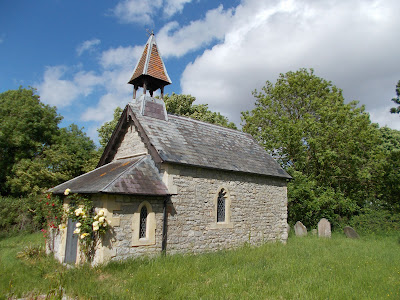
St Andrew's Church, Lilstock

The chancel is all that remains of St Andrew's Church in Lilstock.  The first church on the site was built before the Norman conquest.  In the 12th century the right to appoint a priest was held by the monks of Lonlay in Normandy.  In the 15th century this right passed to Eton College.  The present church was built in 1532.  It consisted of a chancel, nave and tower.  By 1554 the chancel was in need of repair and the nave windows were "greatly ruined".  In 1557 there was no priest.  

The population of Lilstock consisted of 11 households in 1563, 65 taxpayers in 1667, 12 inhabited houses at the end of the 18th century, 56 people in 1801, 91 in 1811, 48 in 1841, 94 in 1881, 58 in 1901 and 5 inhabited houses in 1977.  

During the 19th century services were held at St Andrew's Church every Sunday and communion services were held there 4 times a year. The church tower housed 4 bells in 1791 but only 2 by 1881, by which time the church was derelict.  In 1881, when the parish of Lilstock was merged with Kilton, the Acland-Hood family had the nave and tower demolished.  They had the chancel repaired to serve as a mortuary chapel and a porch and bell-cote added.  

The church was declared redundant in 1980 and once again it fell into ruin and was threatened with demolition. The Reverend Rex Hancock, who was the Rector of the United Benefice of Quantoxhead from 1983-93 (which included Lilstock), personally paid for the repair and restoration of St Andrew's Church.  The building work was carried out by Arthur Booker, his wife Tilly and his son David and was completed by 1993.  Arthur Booker died in 2004 and his ashes are buried in Lilstock churchyard.  Rex Hancock died in 2012 aged 84 and is buried at Porlock.

The only 14th century feature still to be seen in the church is the chancel arch, which is just inside the present church doorway.  The 12th century font was moved to St Andrew's Church at Stogursey at some point.  Sarah Perrett, who was a lady-in-waiting to Queen Victoria and who came from Lilstock, is buried in the churchyard.


The entrance door of St Andrew's Church, Lilstock

St Andrew's Church, Lilstock

The chancel of St Andrew's Church

Sarah Perrett's gravestone

Entrance gate

Odd little face at the base of a wall memorial

Poem on the wall of St Andrew's Church

East window

Lilstock's font in St Andrew's Church at Stogursey

Wednesday, 1 July 2020

The Walford Murder, Dodington, July 1789

John Walford was born in Over Stowey in 1762.  His parents were William and Ann Walford and they lived in Bincombe.  His father was a self-employed charcoal burner and John followed in his father's footsteps.  John worked alone in the woods six days of the week and slept in a small wooden hut close to the charcoal burner.  During the winter of 1784 he was visited by local girl Jane Shorney and she became pregnant by him.

Illegitimate pregnancies were considered a disgrace at this time. Parishes wanted to avoid illegitimate children becoming a burden on the poor rates.  Therefore if expectant mothers named the father of their child on oath before a Justice of the Peace, the Overseers of the Poor were given the power to apprehend him and imprison him, unless he agreed either to pay for the upbringing of the child or to marry the mother. On 7th February 1785 Jane Shorney was brought before the local Justice, James Bernard of Crowcombe Court and she declared that she was pregnant with an illegitimate child by John Walford.  He was arrested but released when his mother agreed to pay to support the child.  A son was born a few months later.

In 1786 Jane Shorney got pregnant again - this time the father was John's brother William.  William agreed to pay for the upbringing of his daughter, who was called Betty.  

In 1787 John became engaged to Ann Rice, who lived with her parents at Adscombe Mill but the engagement was broken off after a few weeks and Ann went into service.  However she and John continued to meet and she became pregnant.  Jane Shorney resumed her visits to John in the woods and became pregnant again.  John was arrested again but could not pay to support the child and he was therefore obliged to marry Jane.  

Jane Shorney and John Walford married on 10th June 1789.  However John arranged with Jane's mother that Jane and the two children would live with her and that Jane would only join John in his rented cottage at Bincombe at night.

On 27th June 1789 John met his friend William Bishop at the Dial Inn in Aley Green and asked him if he would go to London with him but William said he didn't have enough money to do this.  John admitted to William that he did not like his wife and said he would either have to murder her or leave the area.

On 4th July 1789 John Walford returned home from work at about 8pm.  He ate his supper with his neighbours - the Rich family.  He returned to his own cottage at about 10.30pm and shortly after Jane arrived.  She wanted to go to the Castle of Comfort inn at Dodington for some cider. John gave her a shilling and as it was dark and Jane didn't want to walk there on her own, he accompanied her.  As they approached the Counting House at Dodington they argued and John hit Jane, firstly with his fist and then he beat her with a post and fractured her skull.  He then attempted to drag her unconscious body, possibly to the shaft of the nearby copper mine, but she was too heavy, so he cut her throat with a pocket knife.  He returned home after midnight and went to sleep.

The following morning two children saw blood running under a gate on Dodington Common and told their neighbours John Mogg and William Sellick about this.  Mogg and Sellick discovered Jane's body.  Sellick went to John Walford's cottage to tell him the news.  Walford said that Jane had gone out to buy some cider the previous night but had not returned home and he had assumed that she had gone to her mother's house.  Walford set off to go to his mother-in-law's house to tell her that Jane was dead.  On the way he met Sarah Phillips and told her that he wished that he had never married Jane and that he also wished he had left the area.  He then accompanied his mother-in-law to see Jane's body.  When he arrived he spoke to Thomas Chidgey.

John Walford was interrogated by Thomas Poole (a tanner and farmer who lived in Nether Stowey).  He asked Walford why he had not gone out to look for his wife and queried why the shilling he had given her to pay for the cider was not found on her body.   Thomas Poole, Richard Briffet and Thomas Mogg then accompanied John Walford to his cottage where they found bloodstains on the clothes that John had been wearing the previous day.  His shoes were very dirty and the missing shilling was found in the pocket of his trousers.  Thomas Poole asked Walford where his knife was and Walford first of all claimed that he had lent it to Thomas Ware and then later that he had given it to his brother William.  A few days later Thomas Mogg returned to the cottage and found the knife under a window seat.  It had blood on it.

John Walford was arrested and taken to the Globe Inn in Nether Stowey to wait for the results of the inquest into Jane's death.  The inquest was held the following day and the coroner, William Blake pronounced a verdict of wilful murder by John Walford.  Walford was taken to the county gaol at Ilchester to wait for the summer assizes at Bridgwater.  Jane Walford's body was buried at Over Stowey.

On 18th August 1789 John Walford was escorted to the courtroom in Bridgwater.  The judge that day was the Lord Chief Justice, Lord Kenyon.  The court listened to the testimonies of Joan Rich and her daughter (Walford's neighbours); John Mogg; William Sellick; Sarah Phillips; Thomas Chidgey; Thomas Poole; Thomas Mogg; Thomas Ware; Richard Briffet; James Shorney (publican of the Castle of Comfort who said that Jane had not visited his inn on the night in question) and William Bishop.  The jury retired briefly before returning a verdict of guilty.  Lord Kenyon sentenced John Walford to death by hanging the following Thursday.  Walford then confessed to the murder but said it was not premeditated.

On Thursday 20th August 1789 Walford was taken by cart to the Globe Inn in Nether Stowey to wait while the final preparations were made for the execution on the hill above Dodington.  Ann Rice appeared and spoke to John Walford for several minutes.  The cart then moved on to the execution site where he again spoke to Ann Rice before he was hanged on a gallows.  When he was dead his body was put into an iron cage and this was hoisted on to a gibbet.  It stayed there for a year until the iron cage fell to the ground and John Walford's body was buried below the gibbet.  The site is now known as Walford's Gibbet.

In November 1789 Ann Rice gave birth in Stogursey to a daughter who she called Sarah.  Ann died in Nether Stowey in February 1790.

Site of the murder near the Counting House at Dodington

View of Walford's Gibbet from the murder site

The former Globe Inn in Nether Stowey
It has been greatly altered since 1789 and is now called The Clock House.

Castle of Comfort on the A39

Over Stowey Church

Walford's Gibbet

Walford's Gibbet

View from Walford's Gibbet

Walford's Gibbet

Signpost at Walford's Gibbet

Wednesday, 17 June 2020

Norma Huxtable: Exmoor author

Norma May Huxtable (nee Devereux) lived at Lower Chilcott Farm near Dulverton with her farmer husband Arthur and ran a bed and breakfast at their farmhouse for over 35 years. She wrote three humorous books about running a B&B, life on Exmoor and local characters:
  • The Last Word on Exmoor - published 2001
  • Positively the Last Word on Exmoor - published 2002
  • Norma Huxtable's Exmoor Exposed - published 2007
She was also an after dinner speaker at local events.  

Norma Huxtable died on 17th January 2012, aged 85.  There is a wooden cross with a memorial plaque dedicated to her located by the side of a public footpath, which runs from Higher and Lower Chilcott to Willway.  It is much closer to Chilcott than Willway. 


Norma's memorial cross

Plaque on the cross

Lower Chilcott Farm

Monday, 1 June 2020

Ball Cottages, Buncombe Wood, Broomfield

The ruins of a deserted farmstead called Ball or Ball's Cottages are located at head of an unnamed combe deep in Buncombe Wood, half a mile ESE of Cothelstone Hill and 150 metres below it.  The ruins are comprised of a farmhouse and an outbuilding, both built from the local slatey sandstone.  The west gable end wall of the farmhouse still stands to its original height and the chimney can be seen.  On the inside you can see where the fireplaces on the ground and first floors once were.  The east gable end is more ruined but may contain a bread oven.  Both the farmhouse and the outbuilding, which is located to the north west of the farmhouse across a forestry track, were probably built in the late 18th or early 19th centuries.  The ruins are located by the side of a public footpath at ST 198 324 and close to the Kingston Stream.

The farmstead may have been a tenement of Buckland Priory, which was located at Durston.  It was known as Buncombe Farm in 1801 but had changed its name to Ball's Cottages by 1888.  It looks on the 25" scale Ordnance Survey map as though it might have been divided into 2 cottages at some point.

West end of Ball Cottages

West gable end wall of Ball Cottages

West end gable wall from inside

Remains of the fireplaces on the ground and first floors 

Inside of the west gable end wall 

Remains of the outbuilding

West gable end

Sunday, 17 May 2020

The Port of Lilstock

In around 1820 Sir John Acland of Fairfield House near Stogursey built a boathouse on the beach at Lilstock where boats from South Wales could beach to bring in coal for domestic use on his estate and to burn in his lime kilns.  Pit props and lime were exported in return.  A few years later Sir John had a wooden house built at Lilstock, for his granddaughter Isabel to use, as her health was poor and her doctor prescribed sea air and light exercise.  He also built a promenade where she could walk or drive in her carriage.  

At around the same time the unnamed stream that entered the sea at Lilstock was diverted eastwards through an excavated stone lined channel with a lock gate at its seaward end, so water could be impounded.  This meant that boats could berth at high tide and be unloaded in a sheltered dock at all states of the tide.  When no boats were inside the dock, the lock gates could be opened quickly and the subsequent rush of water cleared the entrance of pebbles.

Trade increased and by 1848 a coastguard was living at Lilstock.  By 1855 the harbour also had its own customs officer.  Warehouses, a couple of houses and lime kilns were constructed on the landward side of the harbour and in 1860 a stone pier was built to protect the mouth of the harbour.  A small pavilion was built and in the 1860s and 1870s pleasure paddle steamers made regular stops at Lilstock.  There was a public house at Lilstock called the Limpet Shell.

Trade declined at the end of the 19th century and it was always a struggle to keep the harbour entrance clear of pebbles.  On 28th/29th December 1900 there was a big storm in the Bristol Channel, which badly damaged the pier and the shape of the beach was altered.  By the end of the First World War Lilstock Harbour had been abandoned.

The remains of the dock are still clearly visible, as are the ruins of the lime kilns and warehouses, although you have to battle through the undergrowth to reach them.  At low tide the remains of the pier and the stone breakwater beyond it can still be seen.


Pebble beach at Lilstock

The dock at Lilstock Harbour

Ruined warehouse at the back of the beach

Ruined warehouse at Lilstock Harbour

Ruined warehouse

Ruined warehouses

Remains of the pier at Lilstock Harbour at high tide

Remains of the pier at low tide

Pebbles across the entrance to the dock

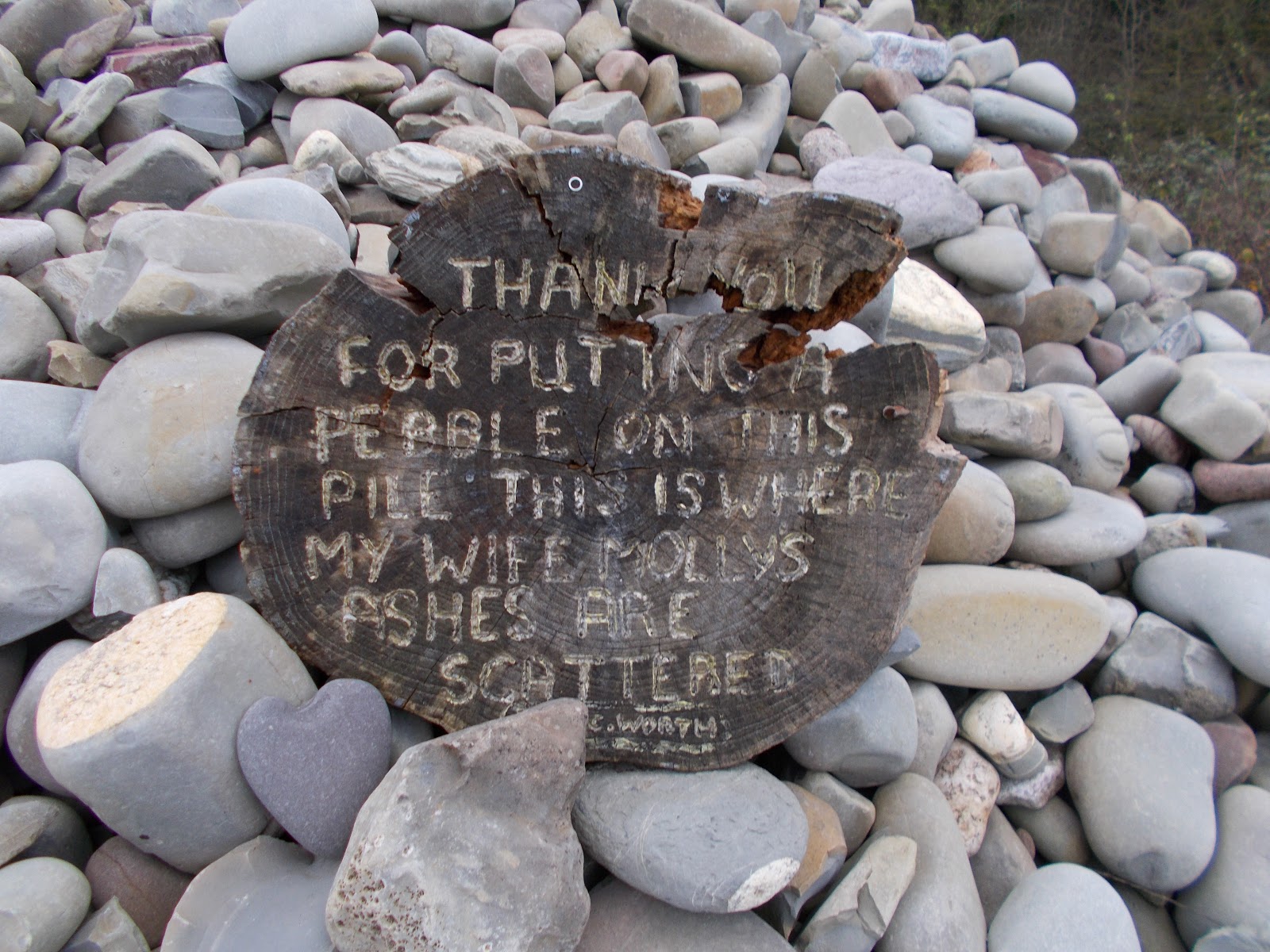
Modern personal memorial cairn on the beach at Lilstock

Notice on the memorial cairn at Lilstock