Monday, 1 March 2021

Hans Price, Architect

Hans Fowler Price was born in Bristol in 1835.  He studied architecture under Thomas Denville Barry in the Liverpool area from c1850.  He moved to Weston-super-Mare in 1860 and set up in business as an architect and surveyor.  He had offices at 5 High Street (1860-61), 1 Sydenham Terrace (1861-74) and 28 Waterloo Street (from 1874 - he designed this building himself).

Hans Price married Jane Plaister Baker in Churchill on 17th September 1862.  Hans and Jane had eight children: 6 daughters (Louisa, Minnie, Emily, Harriet, Winifred and Marion) and two sons (George and Hans), all of whom were born in Weston-super-Mare.  They first lived at Tyn-y-Coed in Hill Road (now demolished) and from 1898 onwards at 7 Trewartha Park.

Hans Price was the architect who was responsible for the design of many houses and most public buildings in Weston-super-Mare from the 1860s to the early 20th century.  He became the consulting architect and surveyor to the Smyth Pigott Estates and designed many villas for them.  He mixed and matched architectural styles, including Gothic, Tudor, Classical, Italianate, Renaissance and Moorish. He used locally sourced stone: carboniferous limestone from the Town Quarry and oolitic limestone from Dundry.  

Hans Price worked in partnership with several other architects, including Matthias Grosholz (1873-77), Walter Hernaman Wooler (1877-1900) and William Jane (1902-12).  He took foreign holidays in several European countries and used these to study various architectural styles and to pick up ideas for future building projects. 

The public buildings he designed in Weston-super-Mare and Clevedon included:

  • Alterations to Wadham Street Baptist Church (1862-4). This building is now home to the Blakehay Theatre. This was Hans Price's first public commission in Weston.
  • Weston-super-Mare and East Somerset Hospital (1865) in Alfred Street.  This was his first major public building.   It has been converted into flats more recently.
  • Birnbeck Pier Toll House and Pier Master's House (1867) and Birnbeck Pierhead buildings (1897)
  • Clevedon Pier Toll House (1867-9)
  • Bristol Road Baptist Church (1866). 
  • Sanatorium (1871).  This is located in Uphill Road North and has now been converted into flats. 
  • Church Institute (1881) in The Boulevard
  • Masonic Lodge of St Kew (1881) in The Boulevard.  This is currently occupied by the Constitutional Club
  • The Weston Mercury newspaper office (1885) in the Boulevard
  • Somerset House (1897-9) in the High Street.  This is a terrace of shops.  The central part, which housed a market hall burnt down in 1964.  The Playhouse Theatre was constructed in its place.
  • The School of Science and Art (1892) in Lower Church Road.  This is now used as a conference centre by Weston College. 
  • Enlargement of the Town Hall (1897) in Walliscote Grove Road
  • Walliscote Road School (1897)
  • Locking Road Schools. These have now been converted to flats.
  • Public Library (1899) at the eastern end of The Boulevard
  • Quaker Meeting House, 15 Albert Street, Clevedon (1868)
  • Expansion of the Royal Pier Hotel, Clevedon (1868)
  • Weston-super-Mare Gaslight Company Workshop and Stores (1912) in Burlington Street.  The workshop now houses Weston Museum.  This was probably the last project Hans Price completed.

Hans Price laid out the Upper Worthy Estate for the Smyth-Pigott family (1862-3). He was also involved in the design and layout of the Milton Park, Montpelier, Sunnyside, Shrubbery, Whitecross, Coombe Bank, National Freehold Land Society and Swiss Villa Estates.  In 1863-4 he designed 54 houses in Woolcott Park, Redland, Bristol with local architect James Adams Clark. He also designed buildings in Shropshire, Herefordshire, Pembrokeshire, Gloucestershire and Sussex.

Hans Price held numerous official posts in Weston-super-Mare, including Town Commissioner (1884-7), chairman of the Weston-super-Mare Gaslight Company's board of directors, vice-president of the Hospital Committee, trustee of the School of Science and Art and director of the Weston-super-Mare Pier Company.

Jane Price died in 1889. Hans Price worked for over 50 years, never retired and died on 27th November 1912.  He was buried at Milton Road Cemetery in Weston-super-Mare.

Walliscote Road Board Schools

Bristol Road Baptist Church

Blakehay Theatre, formerly Wadham Street Baptist Church

School of Science and Art

Former Weston-super-Mare Gaslight Company Workshop and Stores


Former Hospital in Alfred Street

Hans Price Close, Weston-super-Mare

Former Weston-super-Mare Public Library

Somerset House

Weston Mercury Offices, The Boulevard

Toll House, Clevedon Pier

Town Hall, Walliscote Grove Road

Former Masonic Lodge of St Kew in The Boulevard
The tower originally had a timber framed turret on top of it.

Blue plaque on School of Science & Art, Lower Church Road

Monday, 15 February 2021

Littleton Gunpowder Works

Gunpowder was the only explosive available for military use and for blasting in mines and quarries until the mid-19th century.

Production of gunpowder is thought to have begun at Littleton between Winford and Chew Magna in around 1650. The production of gunpowder was hazardous, so the site chosen was away from existing towns and villages but reasonably close to the port of Bristol, to enable the export of the finished product.  The Winford Brook, a tributary of the River Chew, provided a source of power for watermills. There were two other gunpowder mills in Somerset: one at Woolley to the north of Bath and one at Moreton, which now lies beneath Chew Valley Lake.

Gunpowder was produced by mixing saltpetre (potassium nitrate) with sulphur and charcoal.  The saltpetre, which was imported from India by the East India Company, was boiled, drained, washed and crystallised to refine it.  The charcoal and sulphur were boiled and sieved.  Once prepared the three ingredients were mixed, moistened, glazed, pressed and heat dried.  The gunpowder was then packed into 100lb barrels. Most of the gunpowder produced at Littleton was sold in Bristol to merchant and privateer ships or exported via Bristol to Africa and America.  The remainder was sold for use in local mines and quarries and for private uses such as hunting.

At the height of production in the mid-18th century Littleton was the largest gunpowder producer in the South West of England. It had three watermills located in a row between the Winford Brook and a 250 metre long clay lined mill pond, which had been constructed to provide a head of water for the mills.  The three mills were used for different processes: 

1. Crushing - preparing the raw materials

2. Incorporating - mixing the ingredients

3. Corning - forming the gunpowder into pellets 

A house was built to house the manager of the mill, a terrace of three cottages was built to house the millworkers, a clock tower was erected and other buildings were constructed to store and dry the gunpowder.  There was also a cooperage on site.

In the 1750s the mill at Littleton was owned and operated by five Bristol merchants led by Jeremiah Ames.  In 1755 a fire at the Littleton Gunpowder Mill destroyed most of the buildings but they were later rebuilt. The site was owned by the Strachey family in the second half of the eighteenth century.  

Production of gunpowder at Littleton ceased in the 1820s after the end of the Napoleonic Wars.  The site then became a farm: the manager’s house became the farmhouse, the storage facilities were used as a barn and the watermills fell into ruin. The farmhouse, which is still called Powdermill Farm, barn and the millworkers’ cottages are on private land but can be viewed from the public road to Upper Littleton.

The barn formerly used for gunpowder storage is on the left of the photograph

Powdermill Farm, Littleton

Former Millworkers’ Cottages


Monday, 1 February 2021

Alfred Leete, graphic artist

Alfred Ambrose Chew Leete was born in Thorpe Achurch in Northamptonshire on 28th August 1882.  His parents, John and Harriet, were farmers.  John Leete gave up farming, due to ill health, in 1893 and the family moved to Weston-super-Mare, where Harriet ran a series of boarding houses/hotels, including Claremont House in Claremont Crescent and the Addington Hotel in Madeira Road.  

Alfred attended Kingsholme School and the School of Science and Art (now Weston College).  At the age of 12 he was apprenticed to a surveyor in Bristol.  He loved drawing and was a self-taught artist.  In 1897 the Daily Graphic paid him for a drawing and he went on to make regular contributions to the Bristol Magpie.

In 1899 Alfred Leete moved to London to work as an artist for a printer.  He went freelance in 1905, when the magazine Punch published one of his drawings.  Over the next few years he contributed cartoons and drawings to the comic Ally Sloper’s Half Holiday, the Pall Mall Gazette, Strand Magazine, Tatler, Sketch, The Bystander, Punch and the London Opinion.  He specialised in comic illustration, cartoons, posters and advertisements. 

In November 1909 Alfred married Edith Jane Webb.  Their first child, a daughter called Betty, was born in 1910 but died a few weeks later. Their son Alfred John was born in 1914. 

Britain declared war on Germany on 4th August 1914.  On 5th September 1914 Alfred’s drawing of the Secretary of State for War, Field Marshal Lord Kitchener, pointing his finger, featured on the front cover of the London Opinion, with the words “Your Country Needs YOU” beneath the picture.  The image was later used by the magazine as an unofficial recruitment poster with the words “Britons [Kitchener] “Wants YOU”, Join Your Country’s Army!”.  The magazine also had this image displayed on advertising hoardings in London in the autumn of 1914. 

Alfred Leete's iconic drawing of Lord Kitchener

In 1917 the American artist James Montgomery Flagg adapted Alfred’s drawing by substituting Uncle Sam for Lord Kitchener and using the slogan “I Want YOU for U.S. Army”.  It also inspired similar posters, which were produced in Australia, Canada, South Africa, India, Italy, Austria, Germany and Russia.  In the Second World War Kitchener’s face was replaced by Churchill’s on a recruitment poster for the Australian Imperial Force.  Although Alfred Leete’s drawing of Lord Kitchener was never used as an official recruitment poster, it has become one of the most iconic and enduring images of the First World War.

During the First World War Alfred produced several comic cartoons, which made fun of the Germans. In 1916 he joined the Artists’ Rifles. He served with them on the Western Front in France and produced a series of drawings of his experiences there.

In the 1920s Alfred produced illustrations for successful advertising campaigns for companies such as Guinness, Bovril, London Underground, Younger’s Ales and Rowntree’s.  He often visited Weston-super-Mare and produced advertisements for local businesses and cartoons about local issues. In 1925 he designed the cover for the Weston-super-Mare Official Guide, which was entitled “Atlantic Breezes”.

“Atlantic Breezes” by Alfred Leete, 
cover of the 1925 Official Guide to Weston-super-Mare

Alfred Leete was taken ill on a trip to Italy and he died of a brain haemorrhage at his home in Kensington, London on 17th June 1933.  He was buried in Milton Road Cemetery in Weston-super-Mare.

Alfred Leete's grave in Milton Road Cemetery, Weston-super-Mare

Blue plaque, Addington Court, Madeira Road

Addington Court, Madeira Road

Alfred's brother, Sidney Tebbutt Leete (1889-1924), who was an architect, designed the Central Picture House in Oxford Street, Weston-super-Mare in partnership with R.I. Smith.  This opened in 1921, was renamed the Central Cinema in the mid-1950s and was demolished in 1964.

Monday, 18 January 2021

The Kenn Hangings of 1830

A very ordinary looking field in the village of Kenn near Clevedon was the site of what was possibly the last public hanging in England to take place at the scene of the crime.  On 8th September 1830 35 year old William Wall, 30 year old John Rowley and 19 year old Richard Clarke were hanged for setting fire to three wheat stacks belonging to a local farmer called Benjamin Poole on 31st October 1829.

William Wall had operated an unlicensed cider house on Duck Lane, Kenn and some of those who had frequented it had committed many crimes in the area.  Wall had been fined for selling cider without a licence and it is thought that he believed that it was Benjamin Poole who had informed on him. Wall and his accomplices set fire to the ricks as an act of revenge after a night of drinking.

Husband and wife William and Mary Wall, brothers John & James Rowley, Richard Clarke and John Old were tried at the Somerset Assizes in Wells in August 1830.  Isaac Old (brother of John Old) had also been one of the accused but he saved himself by giving evidence against the others. William Wall, John Rowley and Richard Clarke were found guilty and sentenced to death.  John Old, James Rowley and Mary Wall were convicted of arson but were sentenced to transportation.

It was estimated that over 12,000 people turned up to witness the execution.  The men had been held at Ilchester Gaol and were transported on a prison cart the 40 or so miles from there to Kenn.

William and Mary Wall had 7 children at the time of his execution and Mary gave birth to an 8th child while she was held in Ilchester Gaol.  The older children were subsequently brought up by various relatives in the Kenn area and the youngest child (a son called David) travelled to Tasmania with Mary but died in Hobart aged 2. John Rowley and Richard Clarke were not married.

A fuller account of the case written by Derek and Jane Lilly can be found on the Kenn Village website: http://kennvillage.co.uk/home-2/history-project/kenn-hangings/

Hanging Field, Kenn Street, Kenn

Friday, 1 January 2021

Ashcombe Gardens, Simonsbath

Ashcombe Gardens were laid out by John Knight in around 1820 to the north of Simonsbath House and up the valley of the Ashcombe Stream. Deciduous trees and conifers were planted and terraced paths were constructed but the gardens were never completed.  They were designed using "picturesque" principles.  The Oxford English Dictionary defines picturesque gardening as "the arrangement of a garden so as to make it resemble a picture: a romantic style of gardening, aiming at irregular and rugged beauty".

The Fortescue family bought the Simonsbath estate from Sir Frederick Knight in 1879 to use mainly for stag hunting.  Their main house was Castle Hill at Filleigh and they only used Simonsbath House for holidays and hunting parties until 1934 when Castle Hill was damaged in a fire. They moved to Simonsbath House for 2 years while Castle Hill was being repaired.  They planted up Ashcombe Gardens.  The Fortescues then rented out Simonsbath House to 4 different tenants from 1940-68 and the gardens became neglected and overgrown.  They sold Simonsbath House in 1969 and it has been run as a hotel ever since.  

Most of the trees in Ashcombe Gardens were felled in the 1940s but since then a wood of mainly oak, ash and sycamore has replaced them.  The gardens are currently being restored by a group of volunteers.

Entrance to Ashcombe Gardens

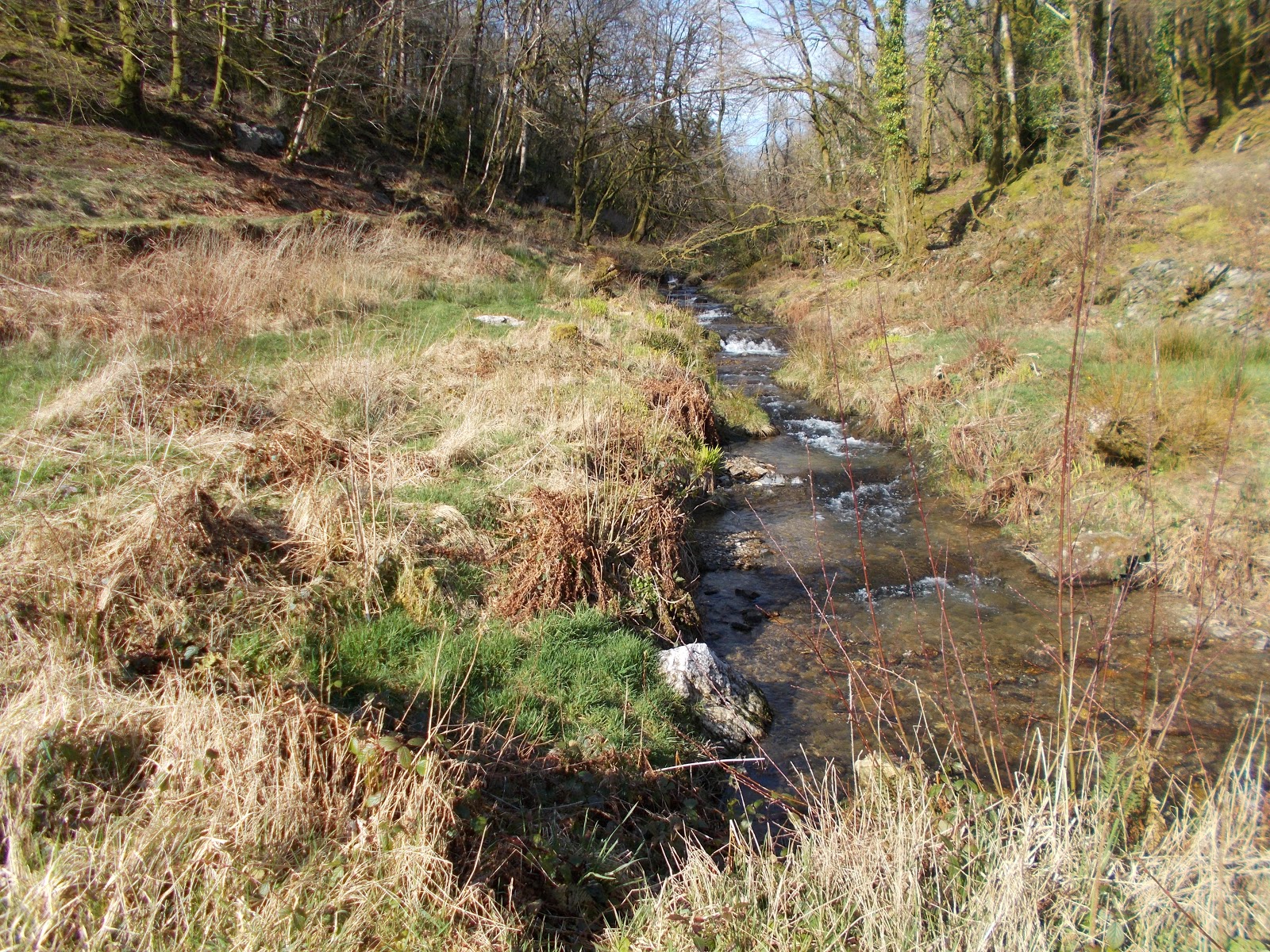
Ashcombe Stream

Large quartz boulders, 
These were deliberately exposed as a design feature

Old slate quarry
This was possibly laid out as a dell or fernery

Garden path

Ashcombe Gardens

Ashcombe Gardens

White Rock Cottage and Simonsbath Old School

White Rock Cottage and Simonsbath Old School

Simonsbath House

Monday, 14 December 2020

Lynch Chapel of Ease, West Lynch

Lynch Chapel of Ease in the hamlet of West Lynch near the village of Bossington, was built c1530.  It was probably the chapel for the Manor of Bossington, which had been owned by Athelney Abbey since 920AD.  After the Dissolution of the Monasteries in 1536-41 it was used as a barn until 1884-5, when it was restored by Sir Thomas Dyke Acland (11th Baronet and owner of the Holnicote Estate).  The chapel has a wagon roof and 11 of the original bosses remain. The windows on the north and south sides of the chapel are original but the east window was rebuilt in the 1880s. A porch was added c1904 in memory of Henry Goddard.

By 1930 Lynch Chapel was again in need of refurbishment.  Rev J.N. Wallis, who was Rector of Selworthy, decided to raise money to fund the refurbishment by writing The Lorna Doone Pageant.  The pageant was performed by 60-70 local adults and children on Selworthy Green on 3 consecutive days in July 1930.  Some horses also took part.  The pageant was directed by Major Trevilian.  3,000 people came to watch it and £500 was raised from ticket sales.  The restoration was led by Mr W.H.R. Blacking.  He built an organ gallery at the west end using wood from the old box pews, which had been removed from Selworthy Church in 1875.  The wood was also used for the panelling around the walls of the chapel.

Grid reference SS 900 476

Lynch Chapel of Ease

Interior of Lynch Chapel

East window of Lynch Chapel

Plaque in memory of John Allan Pilcher
He was an Officer Cadet in the Grenadier Guards.  He was killed by enemy action at the Royal Military College, Sandhurst on 29th January 1941.

Sunday, 29 November 2020

Wellington Park

Wellington Park is one of the town's best kept secrets. It opened in 1903 to celebrate the coronation of King Edward VII.  It is a small formal park and is located at the south western end of Courtland Road.  It can also be accessed via Beech Grove but it is not well signposted. It covers an area of 1.8 hectares.  The site was given to the town by Fox Brothers & Co Ltd (a local clothmaking firm).  They also paid for the buildings and landscaping and provided £100 a year for 5 years to cover the running costs. 

Fox Brothers commissioned the Exeter based company Robert Veitch & Sons to design and build the park.  The park was designed by the German landscape gardener F.W. Meyer, who worked for Robert Veitch & Son for 30 years.  His design included a ha-ha, three Spanish colonial style entrances, a shelter, a rockery, a bandstand and a caretaker's lodge,  Work on laying out the park began in July 1902.  The building work was carried out by Messrs Follett Bros of Wellington. The park was opened to the public on 2nd May 1903. Later the same year the ownership of the park was transferred to Wellington Urban District Council.  In April 1974 the park was transferred to Taunton Deane Borough Council.  On 1st April 2025 it was handed over to Wellington Town Council.

The park, which is Grade II* listed, was restored in 2000 with money from the Heritage Lottery Fund.  The park's current design is largely unchanged from its original layout.

Mature plane trees lining the walk on the north east side of the park

South East entrance on Courtland Road

North entrance on Beech Grove

Floral bedding

Floral bedding

Ornamental pond

Rockery

War Memorial
This was unveiled on 17th June 1921 by F. Hugh Fox.  The names of the 178 local men, who died in the First World War.  After the Second World War the names of a further 58 men and 1 woman were added to it.  It is made from Cornish granite.

Shelter

Bandstand

Caretaker's Lodge

Caretaker's Lodge

Plaque on the Caretaker's Lodge

Drinking fountain

Ha-ha

Grove of lime trees

Floral bedding

Floral bedding