Showing posts with label Caves. Show all posts

Friday, 4 October 2019

Beard’s Stone, Banwell Hill

In 1842 a skeleton was discovered close to Bishop’s Cottage at Banwell Caves.  A local amateur archaeologist called William Beard had the bones reburied at the eastern end of Banwell Hill.  He had a large stone placed at the spot with the following poem inscribed on it:

Beard with his kindness brought me to this spot 
As one unknown and long forgot 
He made my grave and buried me here 
When there was no kind friend to shed a tear 
My bones are here, my spirit is fled 
And for years unknown numbered with the dead 
Reader as I am so shall you be 
Prepare for death and follow me.”

The stone is located on a public footpath at grid reference ST 394 587.

William Beard was born in 1772 at Woolvershill, Banwell.  His father was a farmer and he too became one.  He purchased a small farm at Wints Hill, Banwell.  A cave had been discovered by accident by some ochre miners on the west side of Banwell Hill c1757.  In 1824 Francis Randolph, Vicar of Banwell from 1808 until his death in 1831, took the initiative in exploring the same cave.  This became known as the Stalactite Cave.  He hoped to attract fee paying visitors and thus to raise funds for the local school.  

During an unsuccessful attempt to create a more convenient entrance to the cave, a second cave was discovered.  This cave contained a large number of animal bones and became known as the Bone Cave.  The bones were identified as belonging to bear, bison, reindeer, and wolf.  The Banwell caves were located on land which was owned by the Lord of the Manor of Banwell, who was also the Bishop of Bath and Wells.  The Bishop of Bath and Wells at this time was George Henry Law.  He believed that the bones were the remains of animals that had drowned during Noah’s flood.

William Beard began giving guided tours around the caves and collected donations for the school on behalf of George Law.  He renamed his house Bone Cottage.  He let out his land and concentrated on the guided tours and on exploring and collecting bones and other items from caves at Hutton, Bleadon, Sandford and Uphill with other local enthusiasts.  Bishop Law nicknamed him “Professor” and this nickname remained with him until the end of his life.  He continued to give guided tours at Banwell Caves until shortly before his death in 1868 at the age of 95.  His collection of bones was bought by the Somerset Archaeological and Natural History Society.

Inscription on Beard's Stone

Beard's Stone, Banwell Hill

Beard's Stone, Banwell Hill

Beard's Stone, Banwell Hill

Tuesday, 14 August 2018

Swildon's Hole, Priddy

Swildon's Hole is the longest cave on the Mendips, both in terms of total passage length (c.9,144 metres) and the distance from the entrance to the farthest point reached (Sump 12 at c.2,400 metres).  Its alternative name is St Swithin's Hole and the word Swildon may be a corruption of Swithun, who was Bishop of Winchester from 853 until his death in 862 or 865.  Land in the Priddy area was once owned by the Priory of Winchester.  Swildon's Hole extends under the central part of the village of Priddy.

Swildon's Hole was first explored in August 1901 by members of the Wells Natural History and Archaeological Society.  Exploration of the cave system continued and by 1936 about 20% of the extent which is known today, had been discovered.  Since then 11 sumps have been passed, allowing access to much more of the system.  Sump 12 has so far proved to be impassable.

Swildon's Hole is connected to the Priddy Green Sink (also known as Cowdung Swallet - sounds lovely!), which as its name suggests is located close to Priddy Green.  This was first dug in 1959 and 1964 by a consortium of Mendip Caving Clubs.  It was re-opened in 1993 by Bristol Exploration Club and in 1996 it was linked to Swildon's Hole at Cowsh Avens. 

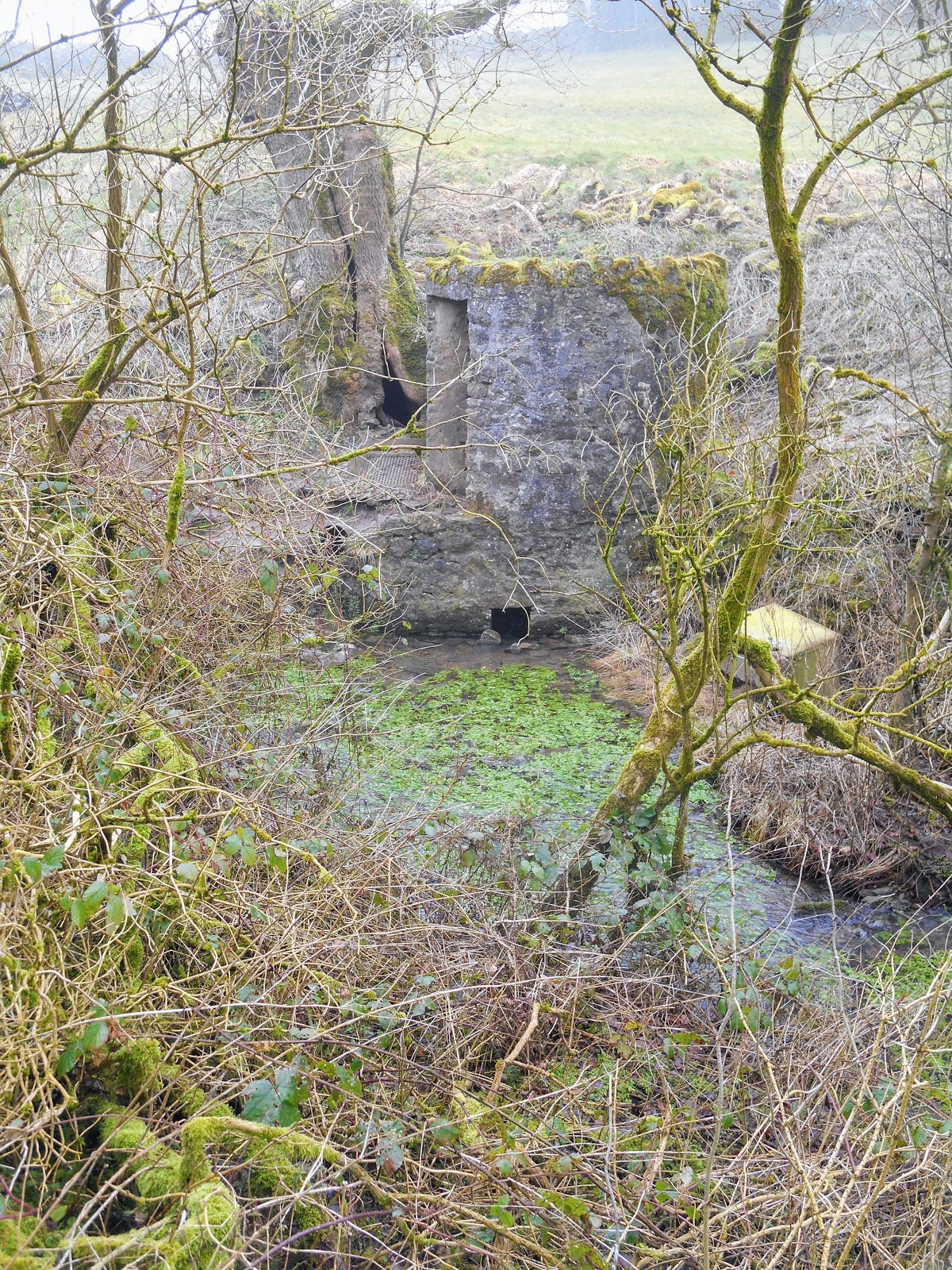
The entrance to Swildon's Hole is a small triangular shaped opening in the floor of a stone blockhouse.  When we visited in February 2018 there was no door on the blockhouse and the hatch was open, presumably because there were people down in the cave.  The water from the stream, which disappears into the ground at Swildon's Hole, reappears at Wookey Hole.

Blockhouse above entrance to Swildon's Hole
 
Entrance to Swildon's Hole
 
Two cavers prepare to enter Swildon's Hole
 
Mendip Cave Rescue Notice on Swildon's Hole Blockhouse
 
Stream entering Swildon's Hole underneath the blockhouse
Blockhouse in the summer - June 2018
 
Entrance hatch to Priddy Green Sink - obviously not used very often
 
Map of Swildon's Hole on display at Priddy Green
 
Notice about the changing barn at Manor Barn, Priddy Green