Showing posts with label Statues. Show all posts

Wednesday, 16 November 2022

Nailsea Glassworks

John Robert Lucas was born in 1754. After his father Robert Lucas died in 1774, he took over his beer and cider works in Bristol and his shares in a glass making business in Limekiln Lane, Bristol.  In 1781 John Robert married Anna Adams and they had a son and two daughters.   In 1787 he leased a glassworks at Stanton Wick. 

John Robert Lucas established a glass works at Nailsea in 1788.  He chose Nailsea as the site for his new glassworks because of the abundance of coal produced by the mines around the town and local supplies of sand and limestone.  He may also have been influenced by plans for the Grand Western Canal, which would have linked the English and Bristol Channels with a branch to Nailsea.  However only the section from Tiverton to Taunton was ever built.   

Lucas’s company was called Nailsea Crown Glass and Glass Bottle Manufacturers.  Initially one cone shaped kiln and a furnace were built at Nailsea.  A second glass furnace was built there in 1790.  In 1793 John Robert Lucas went into partnership with William Chance, Edward Homer and William Coathupe.  In 1788 William Chance had married John Robert’s sister Sarah and Edward Homer had married John Robert’s sister Mary.

In addition to window glass and bottles, the Nailsea Glassworks also produced domestic ware and novelty items such as flasks, rolling pins, pipes, jugs and walking sticks, which were sometimes decorated with flecks, loops or bands of white or coloured enamel.  Most of these items were produced by workers at the end of their shifts using leftover pieces of glass.

In 1811 William and Sarah Chance’s son, Robert Lucas Chance, took over the management of the Nailsea works and married his cousin Louisa, the daughter of Mary and Edward Homer.  In 1812 he persuaded John Hartley, the leading crown glass expert in the country, to come and work at Nailsea.

The partnership of Lucas, Chance, Homer and Coathupe lasted until 1821 when William Chance sold all of his shares and Edward Homer sold part of his to William Coathupe.  Edward Homer’s son James Edward Homer was taken into the partnership at this time and the company traded as Lucas, Coathupe and Homer. 

John Robert Lucas died in 1828 and was buried at Backwell. Most of his estate passed to his grandsons John Rodbard Bean and Henry Lucas Bean.

The New House Cone was built at Nailsea c1828.  Experienced sheet glass blowers were recruited from France and Belgium from the 1830s, due a shortage of skilled British glass blowers. By 1835 Nailsea was the fourth largest glassworks in Britain.  Bottle making ceased at Nailsea in the 1830s in favour of plate, crown and sheet window glass.

In 1835 a partnership called Lucas, Coathupes, Homer and Cliffe was formed to run the business. In 1844 the company became Coathupes & Co with Charles and Oliver Coathupe, John and Henry Bean and James Edward Homer as shareholders. In the 1840s a new cone known as the Lilly or Lily Cone was built.

In 1848 Charles Coathupe retired and Oliver Coathupe became manager at the Nailsea works.  Over the next 25 years there were various changes in the partnership and shareholdings.  In 1861 the Nailsea works were closed for a while and the following year they were leased to Samuel Bowen, a glass merchant from West Bromwich, and John Powis of London.  They traded as Nailsea Glass Company and made patented ventilating glass, cut glass and coloured glass for stained glass windows.  Samuel Bowen became bankrupt in 1869 and he and Powis surrendered their lease.  In 1870 the Nailsea works were sold to Chance Bros of Smethwick, together with a coal mine on the same site.

Glass production ceased at Nailsea in 1873, due to competition from cheap Belgian imports and the decline in production from the Nailsea Coalfield, and the works were closed in 1874.  The New House Cone was demolished in 1905.  Some of the rubble from it was supposedly used to build the extension to the runway at Filton in the late 1940s.

Extensive archaeological excavations began on the glassworks site in 1983 and continued for several years.  In 2002 a supermarket was built on part of the site.  The only surviving building is one which housed the French kilns, and gas-fired furnaces.  This was later converted into the Royal Oak Garage. 

A collection of Nailsea Glass items can be seen at the National Trust’s Clevedon Court.  However much of what is today described as Nailsea Glass was not made at Nailsea but was made in the same style elsewhere in England e.g. Stourbridge.

Glassworks Cauldron, High Street, Nailsea

This would have been filled with cold water into which surplus molten glass would have been ladled.  Once the glass had cooled and solidified it was broken up and used to speed up the melt of the next batch of sand, limestone and soda.


The Glassblower Sculpture, High Street, Nailsea

This was sculpted by Vanessa Marston and unveiled in 2008

Former Glassworks building, later the Royal Oak Garage, High Street, Nailsea


Two glazed ceramic tile panels illustrating the glassworks and its various manufacturing processes. The panels were designed and produced by Ned Heywood of the Workshop Gallery in Chepstow.  They incorporate fragments of glass excavated from the site.  They are on display on the outside wall of Tesco’s Supermarket.

Drawing showing the layout of Nailsea Glassworks c1873

Thursday, 4 August 2022

St John the Baptist Church, Frome

St John the Baptist Church in Frome is well worth a visit, as it contains a large number of interesting features.

The first church on the site was a Saxon one made of wood and founded by St Aldhelm in 685AD.  His mission was to bring Christianity to the wild and barbaric tribes who inhabited Selwood Forest. His church was replaced by a stone one, which was then in turn replaced by a Norman church in the 12th century. The Norman church was extended several times until it reached its current footprint in around 1420.  

By the mid 1800s the church had become very dilapidated and it was extensively modernised in the Anglo-Catholic style in the Victorian period by WJE Bennett, who was Vicar of St John's from 1852 to 1886.  The stained glass windows in the Lady Chapel and the north and south aisles date from this time and were the work of C.E. Kempe & Co.

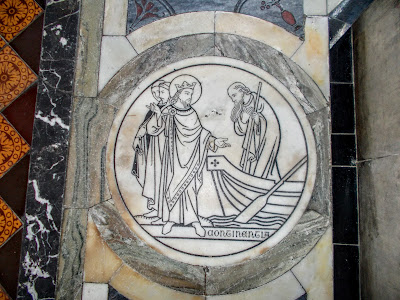
The St Nicholas Chapel was built in 1408 as a Chantry Chapel.  It is now the baptistry.  The font dates from the 13th century and the tall wooden cover was made for it in 1884. The Seven Virtues and Seven Deadly sins are depicted in marble on the floor around the font.

A Via Crucis (Way of the Cross) was designed and sculpted by James Forsyth as a processional way from the street up to the north porch of St John's Church.  It was erected in 1866 and features scenes from the trial and crucifixion of Jesus.

Thomas Ken was appointed Bishop of Bath and Wells by King Charles II in 1684.  He lived a holy and austere life and wrote manuals of prayers and several hymns.  He cared for the poor and regularly shared his Sunday lunch with 12 poor men and women. After the death of Charles II, Bishop Ken swore allegiance to James II.  He then set up charity schools in the larger towns in the diocese with Lord Weymouth.  After the Monmouth Rebellion he remonstrated with Judge Jeffries about the treatment of the captured rebels.  He was sent to the Tower of London in 1688 for seditious libel because he had preached against James II's Declaration of Indulgence, which suspended the laws against Roman Catholics and Protestant dissenters. When James II fled from England, Bishop Ken refused to swear an oath of allegiance to William, as he felt that he could not break his existing oath to James II.  He had to leave his job and spent the rest of his life living at Longleat with Lord Weymouth.  He was buried at St John's Church in Frome because at that time it was the closest parish church to Longleat that was in the Diocese of Bath and Wells.

Font with the Seven Virtues around it

Zeal - the Wise Virgins

Contentment - Barzillai & David

Greed - the Rich Man

St John the Baptist Church, Frome

St John the Baptist Church, Frome

Lamb and Flag: a symbol of John the Baptist

In 1990 stained glass artist, Mark Angus was commissioned to make a stained-glass window of a historical timeline commemorating important events in Britain since 597. The events illustrated are from bottom to top:

  • 597 St Augustine lands in Kent
  • 685 St Aldhelm establishes the first church in Frome (the town is depicted with as a red heart with the River Frome running through it).
  • 1066 Norman Conquest of Britain
  • 1349 The Black Death
  • 1536 Dissolution of the Monasteries by Henry VIII
  • 1914-1918 First World War
  • 1939-1945 Second World War
  • 1945 The Atom Bomb (mushroom cloud)
  • 1985  After 1300 years St Aldhelm's Church is still shining the light of the Gospel
It was manufactured by Derix Studios in London and Taunusstein in Germany.  It is stunning.

 
Frome 1300 Window


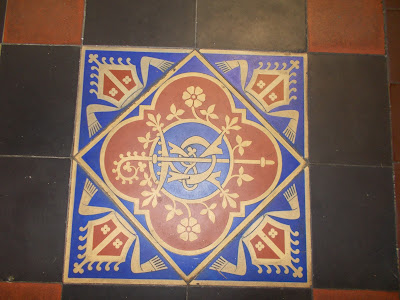
Decorative floor tile


Saxon stones built into the wall of the tower
The upper stone is believed to be part of the shaft of a Saxon cross. The lower stone is of an animal.  They are made of different rocks and in a different style, so probably weren't originally together.  The upper stone probably dates from the 8th century and the lower one from the 9th century.  It is possible that the upper stone was originally part of a cross, which was erected to mark a place where St Aldhelm's body rested for a night on its way from Doulting, where he died in 709, to Malmesbury, where he was buried.  He was Abbot of Malmesbury and Bishop of Sherborne.

High altar and reredos
The reredos was carved by James Forsyth

Medallion - Man healed at the Pool of Bethesda
There are 18 medallions high up on the walls of the nave.  17 of them were given to the church at the time of the Victorian restoration and were carved by James Forsyth.  The 18th one was given in memory of George Ashby (Sacristan) in 1903. The depict the miracles and parables of Jesus and were meant to be teaching aids.

Font cover

Ken Window in St Andrew's Chapel

Bishop Ken seated at table with the poor of the city

Steps up to the North Porch

Statues of St Adhelm (left) and St Alban (right)
These were carved by James Forsyth c1866-1876


O God, make the door of
this church wide enough to
receive all who need human 
love and fellowship and
narrow enough to shut out
all envy, pride and strife.
Make its threshold smooth
 enough to be no stumbling 
block to children, nor to
straying feet, but rugged
and strong enough to turn
back the tempter's power.
God - make the door of this
church the gateway to your eternal kingdom.

Nave

Grave of Thomas Ken, Bishop of Bath and Wells

Plaque on Bishop Ken's grave

Pulpit
The pulpit is decorated with sculptures of The Eight Preachers - Noah, Moses, Elijah, St John the Baptist, St Peter, St Paul, St Chrysostom and St Ambrose.

Nave altar and rood screen
The rood screen was erected in 1892.  It was designed by the Kempe company.  The cross and figures were made by Holzmeister Zwink of Oberammergau and the screen was made by Norman & Burt of Burgess Hill.

Lady Chapel
This contains a reredos, statue of Madonna and Child, a Pieta, Norman piscina, Norman doorway, 14th century table tomb of the Leversedge family, roof bosses with images of the crucifixion of Jesus and stained glass windows by Kempe and  O'Connor Jr.

Via Crucis

Via Crucis

Thursday, 25 November 2021

Edith Cavell

Edith Louisa Cavell was born on December 4th 1865 in the village of Swardeston in Norfolk, where her father Frederick was the vicar for 45 years. After being educated at home for several years, Edith boarded at Belgrave House School in Elton Road, Clevedon from 1883-84. She then attended schools in London and Peterborough. In 1889 she became governess to a family in Brussels and she remained in this post for six years. She returned to England in 1895 to nurse her seriously ill father and she then decided to train as a nurse. She trained at the Royal London Hospital and then worked at various hospitals in London and Manchester.

In 1907 Edith was appointed as director of a new nurses’ training school in Brussels, which had just been set up by Dr Antoine De Page. She successfully persuaded potential recruits and members of her committee that nursing was a respectable profession and one which required professional training.

After the German occupation of Belgium in late 1914, Edith became involved in an underground group formed to help British, French, and Belgian soldiers reach the Netherlands, which was a neutral country. The soldiers were sheltered at the Berkendael Institute, which had become a Red Cross hospital.  They were provided with money and guides by a Belgian called Philippe Baucq.  About 200 men had been helped before Edith and several others were arrested by the Germans on 5th August 1915.

The group of nine people was brought before a court martial on October 7th, 1915, accused of assisting the enemy and of trying to damage the German war effort. Edith Cavell made a full confession and was sentenced to death on October 9th, along with four others. The remaining four were sentenced to hard labour.  Edith Cavell and Philippe Baucq were executed by a firing squad on October 12th 1915 in Brussels, despite the efforts of the American and Spanish ministers to secure a reprieve. Edith’s execution on a charge, which did not include espionage, was considered outrageous and was widely publicised by the Allies.

After the war there was a funeral service for Edith Cavell at Westminster Abbey and on 15th May 1919 her body was reburied on the outside of the south east corner of Norwich Cathedral.  She is commemorated on the Swardeston village sign and by a statue in St Martin’s Place in London. There are busts of her at the London Hospital Museum; in Brussels; Melbourne in Australia and Norwich.  She also has many streets in the UK and across the world named after her and a bar in Tombland, Norwich There is a blue plaque on 1 Elton Road, Clevedon, commemorating the time she spent at school in Clevedon.

There is another Somerset connection to Edith Cavell - Sister Elizabeth Bastable Wilkins worked with her at the Red Cross Hospital in Brussels.  On one occasion the Germans raided the hospital looking for British soldiers.  Sister Wilkins warned the ward nurse and 4 British soldiers were hidden away, while Sister Wilkins hid their documents.  She was arrested, but released after 3 hours.  On 5th August 1915 she was arrested again, at the same time as Edith Cavell.  However, she was released.  She visited Edith Cavell while she was in prison and looked after her dog.  Elizabeth Wilkins later became Matron of Chard Hospital, a position she held for over 30 years.  

Further Reading:

Edith Cavell: Faith before the Firing Squad: Catherine Butcher.  Monarch Books, 2015

Edith Cavell: Nurse, Martyr, Heroine: Diana Souhami.  Quercus Publishing, 2015

Blue plaque outside 1 Elton Road, Clevedon

1 Elton Road, Clevedon

Edith Cavell's memorial outside Norwich Cathedral

Bust of Edith Cavell, Norwich

Cavell’s Bar with a stained glass window of Edith, Tombland, Norwich

Edith Cavell's grave, Norwich Cathedral

Plaque adjacent to Edith Cavell's grave, Norwich Cathedral

Swardeston war memorial
Edith Cavell's name is at the top.

Edith Cavell on the Swardeston village sign

Edith Cavell stained glass window in St Mary's Church, Swardeston

Portrait of Edith Cavell in St Mary's Church, Swardeston

Iron silhouette of Edith Cavell close to Norwich Railway Station

V - Blast
14 paintings of the Passion of Edith Cavell by Brian Whelan were commissioned by Norwich Cathedral in 2015. 

IX - Trust

Friday, 1 November 2019

The Herbert Memorial Chapel, Church of St Nicholas, Brushford

Aubrey Nigel Henry Molyneux Herbert, who was born on 3rd April 1880 at Highclere Castle in Hampshire, was the son of Henry, 4th Earl of Carnarvon and his second wife Elizabeth Howard.  George Herbert, the 5th Earl of Carnarvon, who discovered the tomb of Tutankhamun, was his half brother.  In 1910 Aubrey Herbert married Mary Vesey, daughter of Ivo, 4th Viscount de Vexi.  They had a son and three daughters.  At the time of his marriage his mother gave him the estate of Pixton Park near Brushford, as well as a property in Portofino, Italy.

Aubrey Herbert was the Conservative (and later independent) MP for South Somerset from 1911-1918 and for Yeovil from 1918 until his death. He spoke several European languages fluently and travelled extensively in Turkey and the Balkans.  He advocated Albanian independence and was partly responsible for the creation of the independent state of Albania after the First World War.  He was twice offered the throne of Albania but declined it on both occasions.

Despite having very poor eyesight Aubrey Herbert joined the Irish Guards in 1914 and served with them in France.  He later worked in intelligence in Italy, Greece, Turkey, Egypt and Mesopotamia. He was a friend and ally of T.E. Lawrence.   He was also a friend of the author John Buchan, who based the hero in his novel Greenmantle on Aubrey Herbert.  

Aubrey Herbert died in London from blood poisoning on 26th September 1923.  Sir Edwin Lutyens was a friend of the Herbert family.  He designed a chapel as a memorial to Aubrey Herbert, which was built on to the north side of St Nicholas's Church in Brushford in 1926.  It has a cross shaped stained glass window at its east end.  

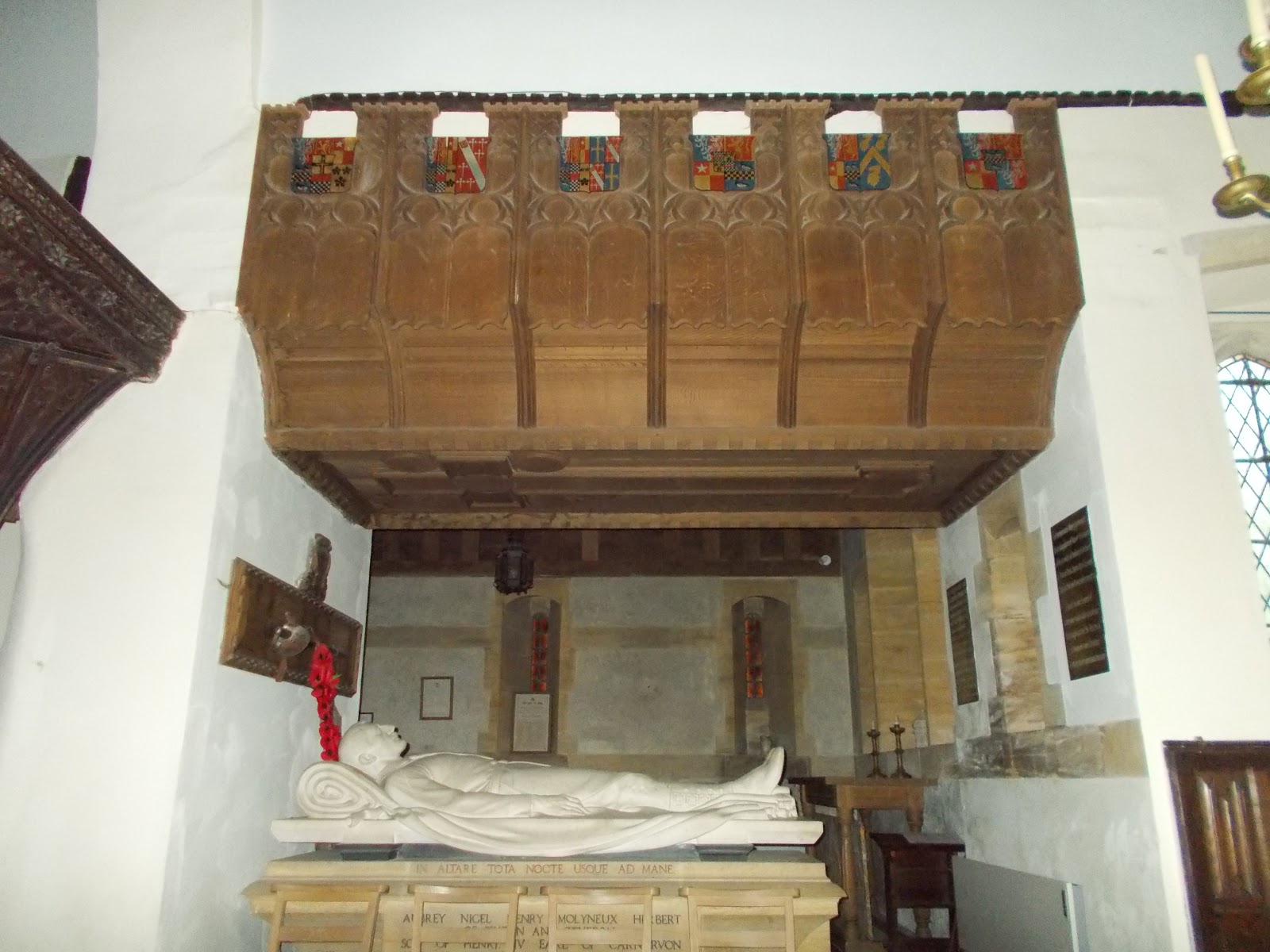
An effigy of Aubrey Herbert was made by Cecil de Banqueire (or de Blaquiere) Howard, an American sculptor who worked in Paris.  It is located at the south side of the Herbert Memorial Chapel.  It is hollow inside.

Cross window in the Herbert Memorial Chapel

Effigy of Aubrey Herbert in St Nicholas's Church, with a ceremonial sword above his head

Effigy of Aubrey Herbert

Effigy of Aubrey Herbert

Wooden canopy over Aubrey Herbert's effigy 
- this was also designed by Sir Edwin Lutyens

St Nicholas's Church, Brushford

12th century parish chest hollowed out of a single piece of oak.  It is now located in the corner of the Herbert Memorial Chapel. King Henry II (1154-1189) decreed that every parish should have a chest to collect contributions to pay for the Crusades.  These chests were later used for keeping books, documents and vestments safe.

Exterior of the Herbert Memorial Chapel

East end of the exterior of the Herbert Memorial Chapel showing the cross window