Saturday, 17 August 2019

Lonely Chimney Stack at Leigh Hill on the Blackdown Hills

There is a red brick chimney stack standing alone in a field at Leigh Hill on the top of the Blackdown Hills.  It can be seen from the road as you drive east from Forches Corner to Holman Clavel.  It is just under half a mile east of Forches Corner.  It is all that remains above ground of a Victorian military encampment and rifle range, which was used by the Somersetshire Militia as a summer training ground.  Most of the encampment consisted of tents and wooden cabins. The 1889 edition of the 25" Ordnance Survey map shows that the chimney was part of one of two sergeants' messes.  There were also two officers' messes (one of which had a tennis court adjacent to it), two canteens, a swimming bath, a drill ground and a mission hall.  

The restoration of the chimney stack c2009 was funded by the Neroche Community History Fund.  It is on private land but can be seen from the road.  The grid reference is ST189 170.

Lonely chimney stack

Chimney Stack

Rubble and Chimney Stack

Chimney Stack

Thursday, 1 August 2019

Lime Kilns

Lime kilns are structures, which were formerly used to manufacture lime (calcium oxide) by burning calcium carbonate at temperatures of more than 900°C. The calcium carbonate that was burned (or calcined) was usually limestone or chalk. Lime is also known as quicklime, unslaked lime, burnt lime or lump lime.  

The majority of the quicklime that was produced was mixed with water to produce hydrated lime or slaked lime (calcium hydroxide).  Calcium oxide is chemically unstable in normal atmospheric conditions but the chemical reaction, which turns calcium oxide into calcium hydroxide releases heat and results in a stable white powder. This was a key ingredient in plasters, renders, mortar and concrete. It was also used in lime-wash to waterproof walls and lighten the interiors of buildings; to bleach paper; by tanners to prepare animal hides for tanning and as a disinfectant in medicine. 

The production of lime was introduced to Britain by the Romans. Demand for lime increased in the medieval period when more buildings were built from stone and large quantities of lime were needed for mortar, which was used in the construction of castles, city walls and religious buildings.  In parts of Britain lime was also used to neutralise acidic soils to improve their fertility and to improve the structure of heavy clay soils from the late medieval period onwards.

There were three types of lime kilns:

  • Clamp kilns. This was the earliest design of kiln to be used. Layers of coal or wood and limestone were stacked together in a mound.  This was then covered with clay or turf and slowly burned in a method similar to that used in charcoal burning.
  • Flare kilns. These were also known as intermittent or periodic kilns. This type of kiln was used in the Roman and medieval periods.  The limestone was stacked on top of the fuel but separated from it by stone blocks, so that the lime was not contaminated with ash. After burning for several days, the kiln had to be cooled down completely before the lime could be removed and the kiln could be re-loaded for the next firing.
  • Draw kilns.  These were also called perpetual or running kilns and they were in use more recently than flare kilns. This type of kiln was kept burning continuously.  There was a permanent grate above the hearth.  Fuel and limestone were stack in alternate layers above the grate.  The calcined limestone dropped down through the grate and could be raked out, while new layers were added at the top of the kiln.
Flare and draw kilns had the same basic structure, consisting of a wide stone chamber with a hearth at the base and one or two drawholes, stoke holes, eyes or flues at the base.

Until the mid-18th century most lime kilns were built to produce lime used in the construction of buildings and they were therefore located a short distance from those buildings but away from inhabited areas, as they produced noxious fumes and smoke.  Lime kilns were usually located in sheltered locations close to a source of limestone or chalk and where sufficient firewood was also available.  They are also often found in coastal locations where limestone/chalk and/or coal could be delivered by sea.  Sometimes a single kiln was built but it is not usual for there to be two or more in the same location.  Some kilns were built into banks of rising ground.

By the end of the 19th century industrial kilns were mass producing lime at lower prices and an improved transport network allowed the lime produced to be distributed across the country. Improvements in artificial fertilisers diminished the role of lime in improving the fertility of the soil.  Small limekilns became redundant and were abandoned.

Some of the lime kilns still standing today in Britain date from the 16th and 17th centuries but most are from the 18th and 19th centuries.  They are a relatively common sight in Somerset.


Lime kiln south of Rich's Holford

Porlock Weir

Porlock Weir

Bishopswood Meadows

Information board at Bishopswood Meadows Lime Kiln

On the coast to the west of Watchet
This complex of three lime kilns was leased from the Luttrell Estate by the Gooding family from 1863 until c1913. They also operated a small industrial complex at Colling's Mill, Washford where they produced artificial manure, plaster of Paris and hydraulic cement.  Local lias limestone was burned using coal imported from Wales. 

Wiseburrow Farm, Greenham

Wiseburrow Farm, Greenham

Langford Heathfield

On the coast at East Quantoxhead

Staple Fitzpaine

Daws Castle, Watchet

Whitley Brake, South of Bilbrook

Kilve

Quarry Road, Sandford Batch

Plaque on the Sandford Batch lime kilns

South Landing, Steep Holm

Near Fitzhead

Black Rock Drove
This lime kiln at Black Rock Drove in the Mendip Hills was built in 1936 but became disused when the adjacent quarry, which had only opened in 1930, was sold and closed down in around 1940.

Lime kiln close to Doniford Beach

Lime kiln in Thurlbear Wood

Lime kiln on Bossington Beach

Huish Barton near Nettlecombe

Hawkridge Lime Kiln, Quantock Hills

Diagram showing how Hawkridge Lime Kiln was used
It is a mixed-feed vertical continuous draw kiln.  This design of kiln was common in Somerset.

Aisholt Lime Kiln
Aisholt lime kiln dates back to the mid 17th century.  It is a mixed feed continuous draw kiln.  It was probably in use until the early 20th century. In the late 1960s a Jersey cow fell into the pot of the disused kiln.  The only way the farmer could get her out was to smash a hole through the wall at the front of the kiln above the draw hole.  The cow survived. The lime kiln is on private land (Durborough Farm).  The land owner initiated the preservation project as part of the Farming in Protected Landscapes Programme.  Tree roots had caused considerable damage to the masonry.  The lime kiln was repaired and made safe 2022-2023.   Access to the top of the kiln is now permitted.  A steel capping grid has been placed over the top of the kiln pot hole, so there is no danger of falling in to it.  There are two information boards to read.

Diagram of Aisholt Lime Kiln

Cross section through Aisholt Lime Kiln

Ham Hill
This lime kiln was probably built in the early 20th century.  It is faced with Portland stone and was used to produce lime from the Ham stone which was extracted from the adjacent quarry, but which wasn't good enough to use as building stone.

Tuesday, 16 July 2019

Jack Hammer, St Michael's Church, Minehead

St Michael's Church in Minehead is home to a painted wooden carving of a man dressed in a green jacket and breeches and wearing what looks like a Santa hat.  He is currently located on top of the southern end of the rood loft inside the church.  He is known as Jack Hammer and his original purpose was probably to strike the passing of time on the church clock.  He is first mentioned in the churchwardens' accounts of 1624.

Jack Hammer was originally located on top of the box which contained the workings of the tower clock, which was situated in the west entrance to the church but the workings were moved into the ringing chamber in 1929 and Jack was moved to the top of the rood screen.

The Minehead Jack still has a bell, which is pulled manually to announce the start of the main Sunday morning service.

Other Jack Hammers can be seen at Blythburgh and Southwold in Suffolk.  The Blythburgh Jack dates from 1682. The Southwold Jack, who is wearing armour, dates from 1470.

Close up of Minehead's Jack Hammer
 
Jack Hammer on the rood loft

Monday, 1 July 2019

Stone Circles - Ancient and Modern

The Concise Oxford Dictionary of Archaeology defines a stone circle as "a setting of upright stone pillars forming a ring whose exact ground plan many vary between being almost exactly circular through to elliptical or egg‐shaped".  Ancient stone circles date from the late Neolithic through to the early Bronze Age and many of them are the final phase in the development of a monument, which started as a timber circle.  They are located in western parts of the British Isles, northern France and Scandinavia.

Ancient stone circles are not common in Somerset (e.g. Withypool Hill and Stanton Drew).  However there are several modern ones e.g. at Ham Hill, Pilton (Glastonbury Festival site) and Ashill.

Stanton Drew
The three stone circles and three stone "cove" at Stanton Drew to the east of Chew Magna, make up the third largest complex of prehistoric standing stones in England.  The Great Circle, which is 113 metres in diameter and has 26 surviving upright stones, is one of the largest stone circles in England.  There are two smaller stone circles: to the south west and north east of the Great Circle.  The Cove, which consists of three large stones, is located in the garden of the Druid's Arms pub.  Across the River Chew to the north of the stone circles is a single standing stone known as Hautville's Quoit.  The Cove, stone circles and Hautville's Quoit were almost certainly parts of a single complex.

According to legend, the Stanton Drew Stone Circles are the petrified remains of a group of wedding guests and the musicians who were entertaining them: they were lured by the devil into celebrating on a Sunday and they were punished for doing so by being turned into stone.

Withypool Hill
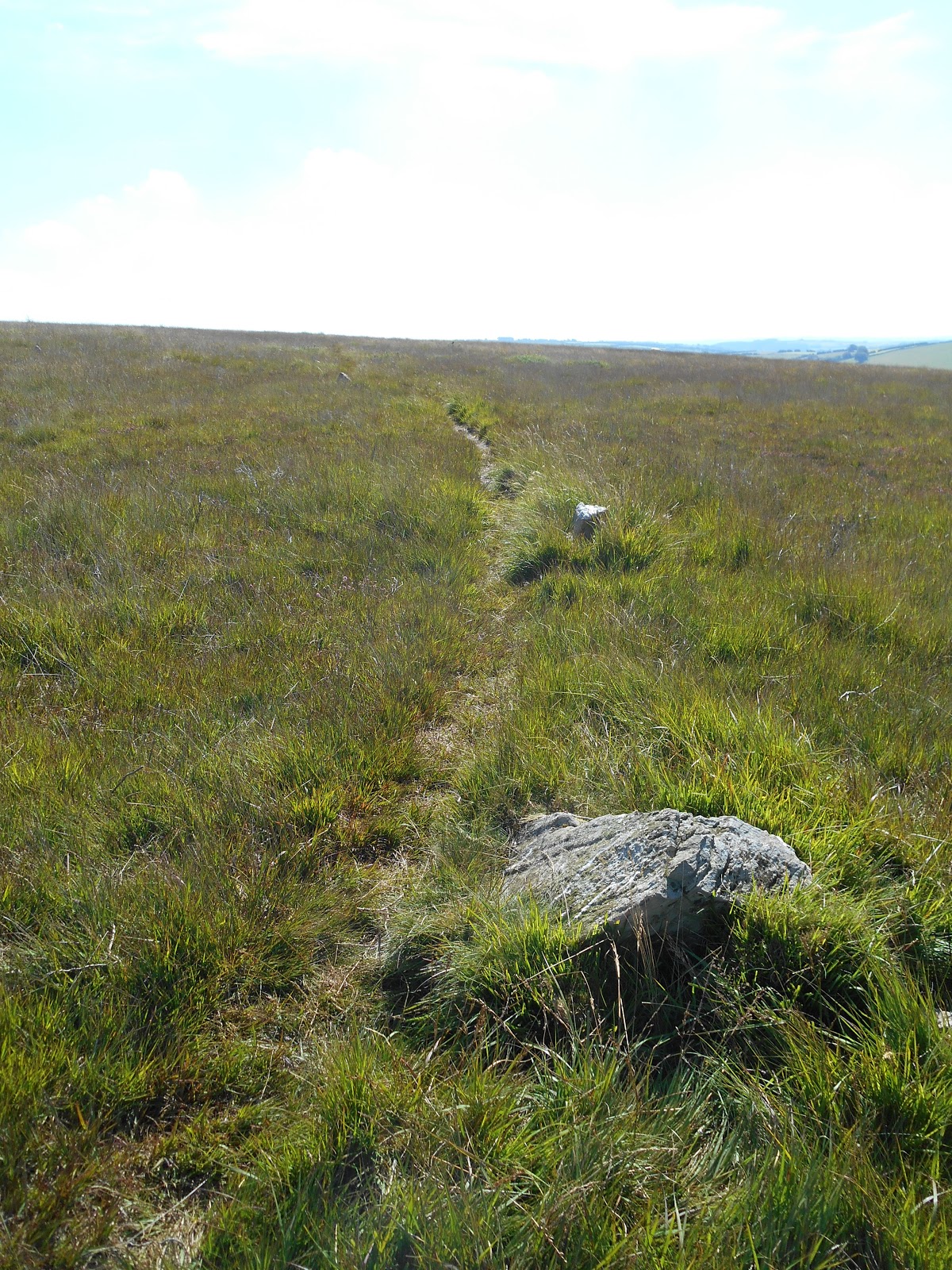
The stone circle on the south west side of Withypool Hill is visually underwhelming, as the stones are not very large (the tallest one is only 50cm high).  There are 27 surviving stones and 3 fallen ones and the diameter of the circle is 36 metres.  The circle may originally have consisted of up to 100 stones.  It was first identified in 1898 and was recorded in 1906 by Harold St George Gray.  Grid reference:  SS 838 343.

Ham Hill
This modern stone circle consists of 15 standing stones made of the local Hamstone.  It was erected as a Millennium project to commemorate the many centuries of quarrying that have gone on at Ham Hill and all the men who have worked there.   Pieces of shell and other small fossils can be seen in the stones.  Grid reference: ST 478 171.

Glastonbury Festival, Worthy Farm, Pilton
This stone circle is located in King's Meadow on the southern edge of the Glastonbury Festival site at Worthy Farm, Pilton.  It consists of 20 large stones and was erected in 6 weeks in 1992.  It is known as the Swan Circle, after the constellation Cygnus (it is egg shaped).  Ivan McBeth constructed it using local limestone quarried from the nearby Torr Works Quarry.  Each stone was individually chosen by Ivan and Michael Eavis.  Ivan McBeth, who was a Druid, later constructed a number of other stone circles for private clients at various locations across England and also in the USA, Canada and Australia before his death in 2016.  The Swan Circle is located on private land and is normally only accessible during the Glastonbury Festival.  We were given permission to walk around the empty site in February 2019.  The grid reference for the Swan Circle is ST590 397.

Glastonbury - Street Road
As you drive into Glastonbury on the A39 coming from the south, there is a small modern stone circle in what may be a private garden but it is clearly visible on the right hand side of the road opposite the Red Brick Building.

Ashill
There is a small stone circle located on a public footpath, 400 metres west of the parish church.  It is in a field, which also has 5 life size white statues of ladies in various states of undress, so I presume they all belong to the same person.

Ham Hill

Ham Hill

Withypool Hill

Withypool Hill

 Withypool Hill

The Great Circle, Stanton Drew

The Great Circle, Stanton Drew

The Cove, Stanton Drew

The Cove, Stanton Drew

Ashill

Ashill

Swan Circle, Glastonbury Festival Site

Swan, Circle, Glastonbury Festival Site

Glastonbury Festival Site

Centre of the Swan Circle, Pilton

Stone Circle, Street Road, Glastonbury

Stone Circle, Glastonbury

Stone Circle, A39 Glastonbury