Monday, 1 January 2024

Church Bench Ends

Most of the surviving medieval bench ends in Somerset churches date from the 15th and 16th centuries.  During this period seating was provided in churches: previously the congregations had stood for the duration of the services.  Each church commissioned the carving of its own bench ends. The majority of bench ends were made of oak.

Very little is known about the people who carved bench ends in Somerset in the 15th and 16th centuries.  The names of only two carvers are known: Simon Warman/Werman and Glosse.  Simon Warman's name or initials appear on bench ends in several churches in the Taunton area.  He was probably responsible for carving bench ends in the churches in East Quantoxhead, Monksilver, Bicknoller, Cothelstone, Bishop's Hull, Broomfield & Bishops Lydeard.  Glosse is referred to in Stogursey's church records for 1524/5.

Bench ends can have poppyhead or horizontal tops.  The bench end carvers may not have been the people who made and fitted the seats.  Money from the wool trade probably paid for many of the carved bench ends.

There are 7 main types of carved bench ends:

  • Symbols
  • Birds
  • Pelicans
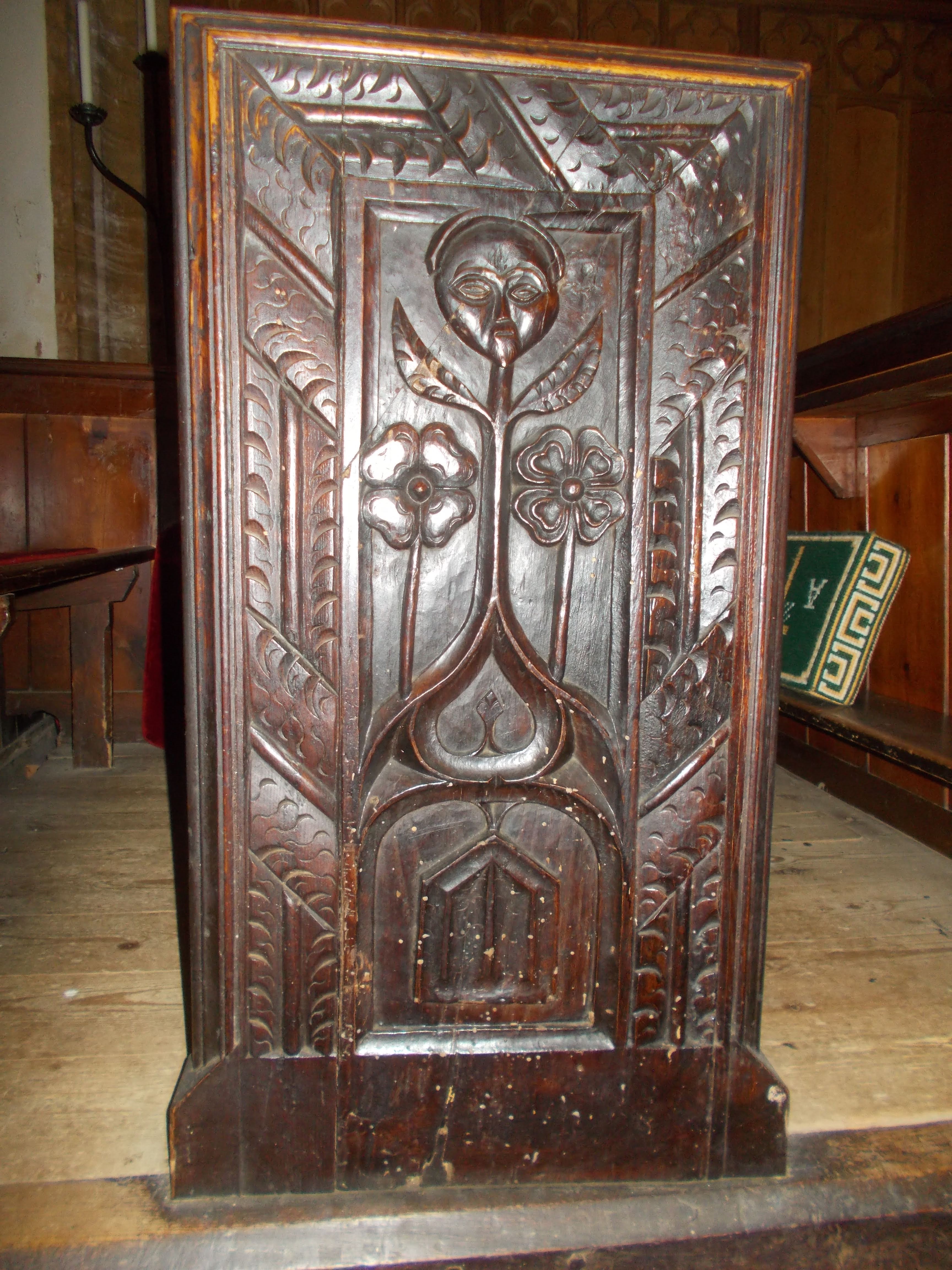
  • Green Men
  • Quadrupeds
  • People
  • Plants
Symbols are usually either associated with the church or depictions of contemporary trades and crafts.  

Church symbols, which appear on bench ends include

  • Signs of the passion (e.g. a cockerel)
  • IHS (these are the 1st three letters of the name Jesus in Greek) or IHC (I & H are the 1st and 2nd letters of Jesus in Greek and C stands for Christus in Latin)
  • The rosary
  • Star of David
  • Sacred Heart
  • Holy water aspersorium and sprinkler
  • Mitre and crosier
Symbols of trades and crafts include:

  • Windmills
  • Farm equipment
  • Weaving and clothmaking equipment
  • Ships - wool trading vessels
  • Woodworking tools
Birds which appear on Somerset bench ends include those depicted as pests (e.g. doves or pigeons eating grapes), doves with olive twigs returning to Noah's ark or representing the holy spirit, storks, spoonbills, game birds and numerous unidentified birds sitting in trees.

Pelicans are symbols of piety and the eucharist.  Pelicans are often depicted on bench ends feeding their own young with their own blood having plucked their own breasts.  It is possible that pelicans were still living on the Somerset levels during the medieval period.  However this may not be the case, as they aren't depicted with webbed feet, which implies that the carvers had never seen live pelicans.

Green Men are images of human faces associated with foliage. They may have their origins in ancient mythology.  Alternatively their origins may lie with "wild-men" who lived in the woods on the fringes of society in the Middle Ages, for example Robin Hood. Or they could come from an innate part of the human psyche where the Green Man symbolises the realisation and acceptance that humanity and the world are inseparable.

There are three main types of Green Men:

  1.  Those who have faces formed of leaves
  2.  Those with faces where foliage comes out of the face, usually the mouth but   occasionally the nose, ears or eyes. This is the most common type in medieval carvings   in England
  3. Those whose face is set amongst the foliage.
Quadrupeds depicted on Somerset bench ends include real animals such as foxes, rabbits, stags, lions, horses, dogs, cats, badgers, lambs and cows and mythical creatures such as dragons and unicorns.

People on bench ends are usually either ecclesiastical (saints, angels, bishops, choristers, deacons etc)  or local tradesmen (millers, woodcutters, archers, ale drinkers, clothiers, packhorse drivers, nightwatchmen, wrestlers etc).

Plants are the most common decorations on bench ends, either as the main feature or as infill on panels with a different main design.

Ship, Bishops Lydeard

Pelican feeding its young, Bishops Lydeard

Sacred Heart, Bishops Lydeard

Anno Domini 1534, Crowcombe

There is an unusual trilogy of bench ends in St Michael's Church, Brent Knoll.  They depict the downfall and execution of a fox dressed as a bishop.  The fox may represent one of the Abbots of Glastonbury, but it is more likely that it represents Richard Fox, who was Bishop of Bath and Wells from 1492 to 1495. In 1519 he bought land in South and East Brent.  He was disliked by the Abbot of Glastonbury and a man named John Fitzjames.  

In the first scene the fox is dressed in vestments and is wearing a mitre and carrying a crozier.  There are birds, including an owl and a cockerel around the edges and at the top.  At the bottom of the main picture there are some animal heads.  In the bottom panel 2 monkeys are shown roasting a boar on a spit over a fire.

In the top panel of the 2nd scene the fox has been stripped of his vestments and has cuffs around his hind legs.  Various birds are depicted and there is a monkey (or it maybe a lion), which may be reading charges against the fox from a scroll.  In the bottom panel the box has his legs in stocks and the monkey/lion is holding a halberd.

In the 3rd scene the fox is executed by hanging.  The hanging is being carried out by 5 geese.  Two hounds are underneath awaiting the body.  A green man is depicted at the top of the bench, just under the poppyhead top.

Brent Knoll
Fox clothed as a bishop

Brent Knoll
Manacled fox

Brent Knoll
The fox is hanged by geese

Two men arguing, North Cadbury

Church and village, North Cadbury

Bearded man, North Cadbury

Unicorn, North Cadbury

West Bagborough

Two mythical creatures at the top with flowers and foliage below, West Bagborough

Feathers, West Bagborough

East Quantoxhead
Luttrell coat of arms, centaur, unicorn, alpha & omega symbols

Stars of David, East Quantoxhead

Man, Nettlecombe

Wheat and vines on poppyead top, Kingston St Mary

Oxen and yoke with foliage and fruit below, Kingston St Mary

Rosary, Kingston St Mary

Hare below a goose, Kingston St Mary

Vase of flowers, Kingston St Mary

Weaver's shuttle below foliage, Kingston St Mary

Bench end dated 1522, Kingston St Mary

Ship, Milverton

Holy water aspersorium and sprinkler, Milverton

Man drinking ale, Milverton

Official Ship's Badge of HMS Finisterre, Milverton
A mythical seahorse is depicted on the badge, which was approved in 1945.  HMS Finisterre was completed in 1945 and scrapped in 1967.  I don't know what the connection is with Milverton.

Man, Milverton

Hatch Beauchamp
The risen Jesus stepping out of the tomb onto a guard with frightened guards on either side of him and a pelican feeding its young in the lower panel

Man, Chipstable

Holy water aspersorium and sprinkler, Chipstable

Axe, Banwell

Green Man, Monksilver

Fish and sheep with candelabrum, Monksilver

Fish/serpent/eel?, Stogursey

Somerset Dyslexia Association, Milverton

Lamb and cross, Alford

Unicorn, Dunster

Angel, Brent Knoll

Angel & coats of arms, Churchstanton

Foliage, Combe Florey

Plants, Combe Florey

Vase of flowers, Combe Florey

IHC, Combe Florey

North Cadbury
Cat with mouse over mousetrap

Bird eating grapes, Cothelstone

Woman, Hatch Beauchamp

Man, Stogursey

Poppy head at St Julian's Church, Wellow

Green Man, Crowcombe

Dragon, North Cadbury

Stork or Heron, North Cadbury

Bishops Lydeard
Windmill with birds, miller and packhorse

Fox hunt, Monksilver

Candlestick, Monksilver

IHS, Monksilver

Packhorse and its driver, North Cadbury

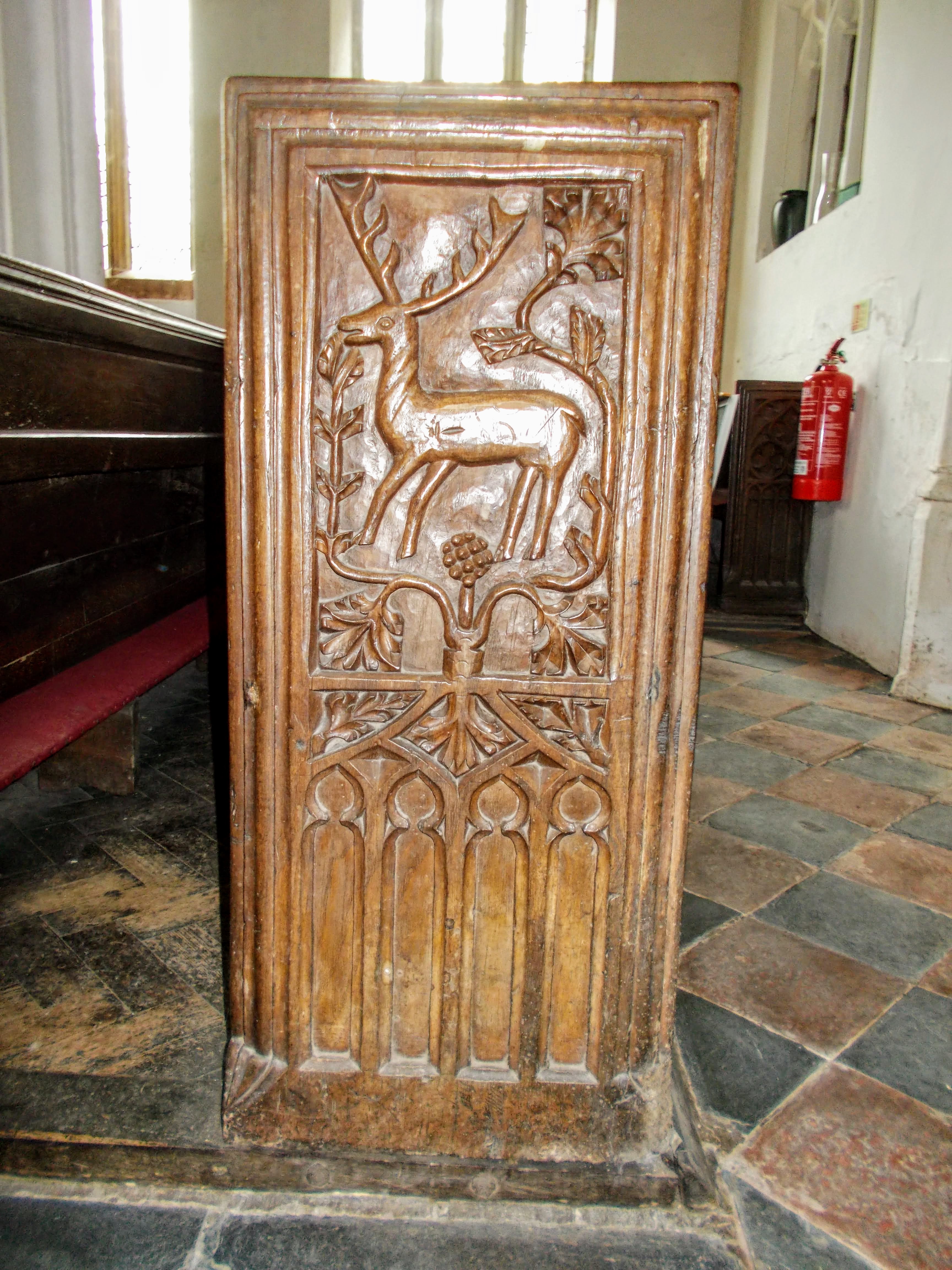
Stag, Monksilver

Stag, Bishops Lydeard

Dragon, Alford

St George slaying the dragon, Dunster

Bat, Crowcombe

Dove with an olive twig in its beak, East Quantoxhead

Spoonbill, Stogursey

Bishop's mitre and crosier, St Andrew's Church, Old Cleeve

Birds and Fruit, St Andrew's Church, Old Cleeve

Dragon, St Andrew's Church, Old Cleeve

A pair of shears and 4 teasels, Cheddon Fitzpaine

EG SG 1660, Cheddon Fitzpaine

Double-headed eagle, Cheddon Fitzpaine

Green man, Cheddon Fitzpaine

Simon Werman's name carved on a bench end in Broomfield Church

S = Simon, All Saints Church, Trull

W = Werman, All Saints Church, Trull

All Saints, Trull
Instruments of Christ's Passion: cross, ladder, pincers, hammer, lamp and the cockerel, which crowed to remind Peter that he had denied knowing Jesus three times.

Green man, All Saints, Trull

Stars of David, All Saints Church, Trull

All Saints Church, Trull
This mask like head, which faces both ways, may be Janus.  He was the Roman god after whom January is named.  He is looking back to the old year and forward to the new.

All Saints Church in Trull also has 5 bench ends, which have characters from a pre-Reformation religious procession on them: 
  • Crucifer
  • Acolyte 
  • Chorister 
  • Deacon
  • Priest
Crucifer carrying a cross

Acolyte carrying a tall candle

Chorister carrying a prayer or hymn book

Deacon carrying a casket and with a maniple over his arm

Priest dressed in alb and cope and carrying a prayer book

The carved bench ends in the south aisle of St Margaret of Antioch's Church in Spaxton were made in 1536.  Those in the nave and north aisle date from 1561.

Fuller and his tools, Spaxton, 1561
  In the upper half of the panel a length of cloth is hanging out to dry.  In the bottom half the fuller is pounding the cloth to thicken and shrink it. The tools of a fuller's trade are also shown: a comb, teasel and a pair of shears. There was a fulling mill in Spaxton in 1412.

1561, Church of St Margaret of Antioch, Spaxton

St Margaret's Church, Spaxton, 1536
IB = either John Bury, who was Rector of Spaxton 1531-1537 or John Beny, who was a carpenter working at Trull in the 1530s.

Dolphins, St Margaret's Church, Spaxton, 1536

Addorsed heads, St Margaret's Church, Spaxton, 1536

Further Reading:
Wright, Peter Poyntz: The Rural Bench Ends of Somerset: A study in medieval woodcarving. Published 1983 by Avebury Publishing Company

Friday, 15 December 2023

The Two Moors Way

The Two Moors Way, a long distance path which links Exmoor and Dartmoor, was officially opened on 29th May 1976.  It was created and developed by Joe Turner.  The original Two Moors Way ran for 102 miles from Lynmouth to Ivybridge.  The 15 mile Erme-Plym Trail from Ivybridge to Wembury was added to it in 2005, to make it a coast to coast path.  The Two Moors Way is described as "Devon's Coast to Coast" but the stretch from the Hoar Oak Tree to Hawkridge is in Somerset.

After Joe Turner's death in 2004, Peter Randall-Page, a Dartmoor based sculptor, created a pair of stone memorials to him.  They are large granite boulders with lots of small round holes carved into them.  One is located at the southern boundary of Exmoor National Park at Badlake Moor Cross near West Anstey.  The other is located on the northern boundary of Dartmoor at Drewsteignton.

Two Moors Way Signpost at Badlake Moor Cross
Lynmouth 24 miles, Ivybridge 78 miles

Memorial to Joe Turner at Badlake Moor Cross

Memorial to Joe Turner at Badlake Moor Cross

"The Walker" statue on Lynmouth seafront 
This statue marks the beginning (or end) of the Two Moors Way (& the point where it meets the Coleridge Way, the South West Coast Path and the Tarka Trail).  It was created by Richard Graham and unveiled by John Craven on 8th May 2017

Friday, 1 December 2023

Sir John William Fortescue, British Army Historian

John William Fortescue was born in Madeira on 28th December 1859.  He was the 5th son of Hugh Fortescue, the 3rd Earl Fortescue, and his wife Georgiana.  He spent his childhood at Castle Hill near Filleigh in Devon.  His family owned large areas of Exmoor.  He attended Harrow School 1873-1878 and then went on to study law at Cambridge University in 1878.  In 1880 he was appointed as private secretary to Sir William Robinson, who was Governor of the Windward Islands.  John Fortescue spent 2 years in the Caribbean and then returned to Cambridge to complete his degree and graduated in 1884.  

From 1886-1890 he lived in New Zealand, working as private secretary to Sir William Jervois, who was the Governor of New Zealand.  During this time John Fortescue wrote several articles for Macmillan's Magazine, many of which were on the subject of military history, a subject which greatly interested him.  He was then commissioned by Macmillan to write a comprehensive history of the British army.  This was published in 13 volumes between 1899 and 1930.  He also wrote several other books, including The Story of a Red Deer (a children's book published in 1897), My Native Devon (published 1924) and a biography of the Duke of Wellington (published in 1925).

In 1905 he was appointed as librarian at Windsor Castle by King Edward VII.  He remained in this job until 1926.  He accompanied King George V and Queen Mary on their 1911 visit to India and he wrote the official account of their visit.  

In 1914 John Fortescue married Winifred Beech but they had no children.  He often stayed at Simonsbath Lodge (this is now the Simonsbath House Hotel). He was knighted in 1926. He died in Cannes on 22nd October 1933 and his ashes were scattered at Five Barrows above Simonsbath.  His widow suggested that his family should pay for a memorial cairn.  This was built at the side of the Simonsbath to South Molton road above Drybridge Combe.  The cairn and the land around it now belong to Exmoor National Park and they restored the cairn in 2001.

Sir John William Fortescue's Memorial Cairn

Wednesday, 15 November 2023

Cholera Outbreak in Bridgwater in 1849

Cholera is an acute diarrhoeal infection caused by eating food or drinking water contaminated with the bacterium Vibrio cholerae.  It affects both adults and children. Most people infected with the bacterium do not have any symptoms but the bacteria are present in their faeces for up to 10 days after infection, potentially infecting other people.  A minority of people who are infected develop acute watery diarrhoea with severe dehydration. This can lead to death if left untreated.  

Cholera was common in Asia and reached Europe in 1829. The first death from cholera in England was in Sunderland in October 1831.  There were outbreaks in many other towns and cities in Scotland and England in the following months until the end of 1832. 

There was a second epidemic of cholera in Britain, which started in Edinburgh in 1848 and lasted until the end of 1849, by which time it had killed more than 53,000 people in England and Wales. There was third epidemic of cholera in Britain 1853-54 and smaller outbreaks in 1865 and 1893.

In 1849 a cholera outbreak in Bridgwater killed more than 200 people. 88 of the dead lived in the Eastover area of the town and they were buried in a mass grave in the graveyard of the church of St John the Baptist. The site of the grave is marked by an original (now broken and almost illegible) headstone and a modern replacement.  The wording is as follows:

In Memory of the decease of 88 persons from cholera, 1849.                                                    From plague, pestilence and sudden death, Good Lord deliver us.

Original headstone

Replacement headstone

Wednesday, 1 November 2023

Combwich and Bridgwater Buoys

A pair of restored 19th century buoys are on display at Combwich Wharf and Bridgwater Docks. 

The plaque on the buoy at Combwich Wharf says this:

"This buoy, one of only a few remaining examples, was constructed in Carvers Boatyard, Bridgwater in about 1860 for use in the Bristol Channel.  The original oak timbers were nearly 4 inches thick and some of these are still intact in this buoy.  

When in use the buoy would have been the other way up and anchored to the sea bed with a light and bell attached to the flat topside.

This buoy was previously sited at Harbour Garage with its pair, now at Bridgwater Docks and was given to the village by Mr Colin Wilkins, who bought the site.

This restoration and resiting was carried out with the help of Nuclear Electric PLC at Hinkley Point and the base was provided by Combwich Cruising Club.

This project was organised by Otterhampton Parish Council August 1991.                      

Further refurbishment sponsored by Otterhampton Parish Council completed in 2016 by Burnham Marine and Combwich Motor Boat and Sailing Club."

The plaque on the Bridgwater Buoy says this:

"The Bridgwater Buoy was refurbished in 2017 with the support of local people, organisations and companies led by Patricia Robinson.  The bricks on which it sits originated from the old Workhouse."

Combwich Buoy

Plaque on Combwich Buoy

Bridgwater Buoy

Plaque on Bridgwater Buoy

Saturday, 14 October 2023

Unusual War Memorials

There is a war memorial in virtually every town and village in Somerset.  However there are a few memorials, which stand out because they are a bit different.  Here are some of them:

Burrow Mump
 
Burrow Mump
Burrow Mump is an outcrop of Mercia mudstone.  In medieval times a chapel, belonging to Athelney Abbey and dedicated to St Michael, was built on top of it.  The chapel was rebuilt several times and was still standing in the mid-17th century.  By the mid-18th century it was in ruins.  In 1793 rebuilding commenced, but the church was never completed.  The church is built of lias with Ham stone and red brick dressings.  In 1836-8 a church (also dedicated to St Michael) was built at the foot of the hill in the village of Burrowbridge instead. Burrow Mump and the unfinished church were given to the National Trust by Major Alexander Gould Barrett in 1946, as a memorial to the Somerset men and women who lost their lives during the Second World War.
 
Burrow Mump

Burrow Mump Memorial Plaque
 
Holford & Kilve's Memorial Copse
Holford and Kilve's Second World War memorial is a copse of Scots pine trees on Longstone Hill on the Quantocks.  The memorial says "These trees were planted to commemorate the men and women of Holford and Kilve who served in the war 1939-45."
 
Holford & Kilve's Memorial Copse

Holford and Kilve's Memorial Copse

Blagdon Green, Blagdon Hill
"Lest we Forget.  In Memory of the Fallen"
 
Baltonsborough
This war memorial is made from a 15" Howitzer shell case.

Dowlish Wake
This memorial is carved onto a Ham stone boulder
"Remember those who died for this country"

Thatched war memorial in Drayton

"We Will Remember Them" mural painted on a wall in Haydon Road, Taunton


Dunster
The walled garden located at the back of St George's Church in Dunster is a war memorial garden.  It is dedicated to the men of Dunster who died for their country in both world wars. It can be accessed through a gate in the wall on Priory Green just opposite the dovecote. 
Dunster's War Memorial Garden

Royal British Legion Poppy Memorial, Weston-super-Mare
This colourful war memorial was installed at the front of Somerset Legion House on Weston-super-Mare seafront, when it opened in 2007 as a hotel offering holidays for ex-servicemen and women and their families.  The hotel closed in January 2020 and the memorial has now been moved to Grove Park.

Royal British Legion Memorial Bench, Collett Park, Shepton Mallet
This was put in place for the 100th anniversary of the end of the First World War in November 2018.

Corfe's memorial to those who died in the First World War but who lie in unmarked graves or have no grave at all.

Martock
Martock has a horse water trough, which is now filled with flowers, as a memorial to the 450,000 horses that were killed in the South African War 1899-1902

Porlock's Second World War Memorial Trees & Garden

First World War memorial bench, Somerton

Second World War memorial bench, Somerton

War Memorial bench, Somerton

War Memorial clock tower, Worle
This clock tower was paid for by local subscription in 1919 and was designed by local architect T. Bradford Ball.  It was built by local builders overseen by William Huish, who had proposed the idea of a clock tower as a war memorial.  It was dedicated on 14th September 1922. The original clock mechanism was a double three-legged gravity escapement.  The clock was restored in 2010 and a new electric movement was installed by Smith of Derby.

War memorial shelter, Williton Recreation Ground
The plaque on the wall of the shelter says:
Erected by 
the Parish of Williton
 in memory of those men
 of the parish who fell
 in the Second World War 
1939-45

Stained glass window
St Laurence's Church, East Harptree
This war memorial window was designed by Karl Parsons (1884-1934) in the Arts & Crafts style in 1919.  Three saints are depicted: St George in the centre, flanked by St Laurence and St Agnes.  Below the harp and tree are a woman and a child waving goodbye and a soldier going off to war.

Woman and a child waving to a soldier marching off to war

Sunday, 1 October 2023

John Biffen, MP and Government Minister

(William) John Biffen was born in Bridgwater on 3rd November 1930.  His father Victor William Biffen was the tenant farmer at Hill Farm, Otterhampton.  He was educated first at Combwich Village School and later at Dr Morgan's Grammar School in Bridgwater, where he became the head boy. He was awarded a scholarship to Jesus College, Cambridge University, where he studied history and graduated with a first class honours degree in 1953. He worked for Tube Investments Ltd from 1953-60 and the Economist Intelligence Unit 1960-61.

John Biffen developed an interest in politics at Cambridge University and he was chairman of the university Conservative Association.  He stood unsuccessfully for the parliamentary constituency of Coventry East at the 1959 general election.  In 1961 he won the by-election for the Oswestry constituency (renamed Shropshire North in 1983) and he held the seat until 1997.  He was a Eurosceptic and in 1971 he voted against the UK joining the European Economic Community. 

He served as Chief Secretary to the Treasury (May 1979-January 1981), Secretary of State for Trade (January 1981-April 1982) and Leader of the House of Commons (April 1982-June 1987).  He made remarks that upset the Prime Minister, Margaret Thatcher and he was dropped from the Cabinet after the 1987 General Election and returned to the back benches.

John Biffen married Sarah Wood in 1979.  He was made a life peer in June 1997 and moved to the House of Lords.  His title was Baron Biffen of Tanat in the County of Shropshire. He died on 14th August 2007, aged 76.  He is commemorated in Combwich with a blue plaque on the wall of Otterhampton Village Hall.

Blue Plaque in Combwich

Thursday, 14 September 2023

Luke Jerram: Withdrawn, Leigh Woods & Gaia, Taunton

Luke Jerram (born 1974////////0 is a Bristol based artist, who creates sculptures, installations and live art projects.  In 2015 he was commissioned by the National Trust's Trust New Art programme in partnership with Forestry Commission England's Forest Art Works to create an art installation in Leigh Woods.  He gave it the title Withdrawn.  It was a flotilla of five old fishing boats in the middle of Leigh Woods and was on display from 18th April to 6th September 2015. Its purpose was to promote discussion about climate change, extreme weather, falling fish stocks and our impact on the marine environment. The boats were called Gloria Jean, Joanne Marie, Martha, Seahorse and Grey Gull.  The boats were purchased from Ebay and Gumtree.  The installation was used as a venue for a series of events during the summer of 2015. At the end of the installation the boats were given away to organisations in the Bristol area who turned them into play equipment, storytelling and performance spaces.

In April 2023 Gaia, another of Luke Jerram's art installations, was on display in Taunton Minster, as part of a worldwide tour.  Gaia is a model of planet Earth and is 7 metres in diameter.  It was created from NASA imagery of the Earth's surface.

Joanne Marie

Martha and Gloria Jean

Grey Gull

Seahorse

Grey Gull

Joanne Marie

Gaia in Taunton Minster

Gaia in Taunton Minster