Friday, 2 June 2023

Norman Font, St Augustine’s Church, Locking

The highly decorated rectangular carved stone font in St Augustine’s Church at Locking probably dates from the 12th century.  At each corner there is a human figure with both arms outstretched to meet the hands of the figures on the adjacent corners. The figures are alternately male and female.  Three of the four sides are also highly decorated with intertwined Celtic serpent designs.  The fourth side is plainer with two bands of chevrons, probably because in its original location this side faced a wall. 

The font originally stood on one central pillar.  Four corner pillars were added in the 19th century for extra support.  The head-dresses of the four figures were cut off in the 19th century when the rim of the font was reduced in height to make it level.  

St Augustine’s Church was probably founded by the monks of Woodspring Priory in the 13th century.  The oldest part of the present church is the tower, which dates from 1380, but this may have been built on the site of an earlier church. 


Font

Font

Font

St Augustine's Church

St Augustine's Church

Tuesday, 16 May 2023

The Leaning Tower of Puxton

The nave and chancel of the Church of the Holy Saviour in Puxton possibly date from the 12th century.  Since then the church has been altered and enlarged several times.  There is archaeological evidence of a late Saxon and early medieval settlement in Church Field, which is next to the churchyard.  This may explain the location of the church. 

Puxton takes its name from Robert Pukerel who held land in the area c1176.  The place name Pukereleston (Pukerel’s tun or settlement) was first recorded in 1212.  The village was probably part of the manor of Banwell or Congresbury at this time. 

A tower was built on to the church in the 15th century.  Due to the low lying soft ground on which the church is built, over the centuries it has developed a significant westward lean. The lean is clearly shown on a drawing of the church done in 1821. 

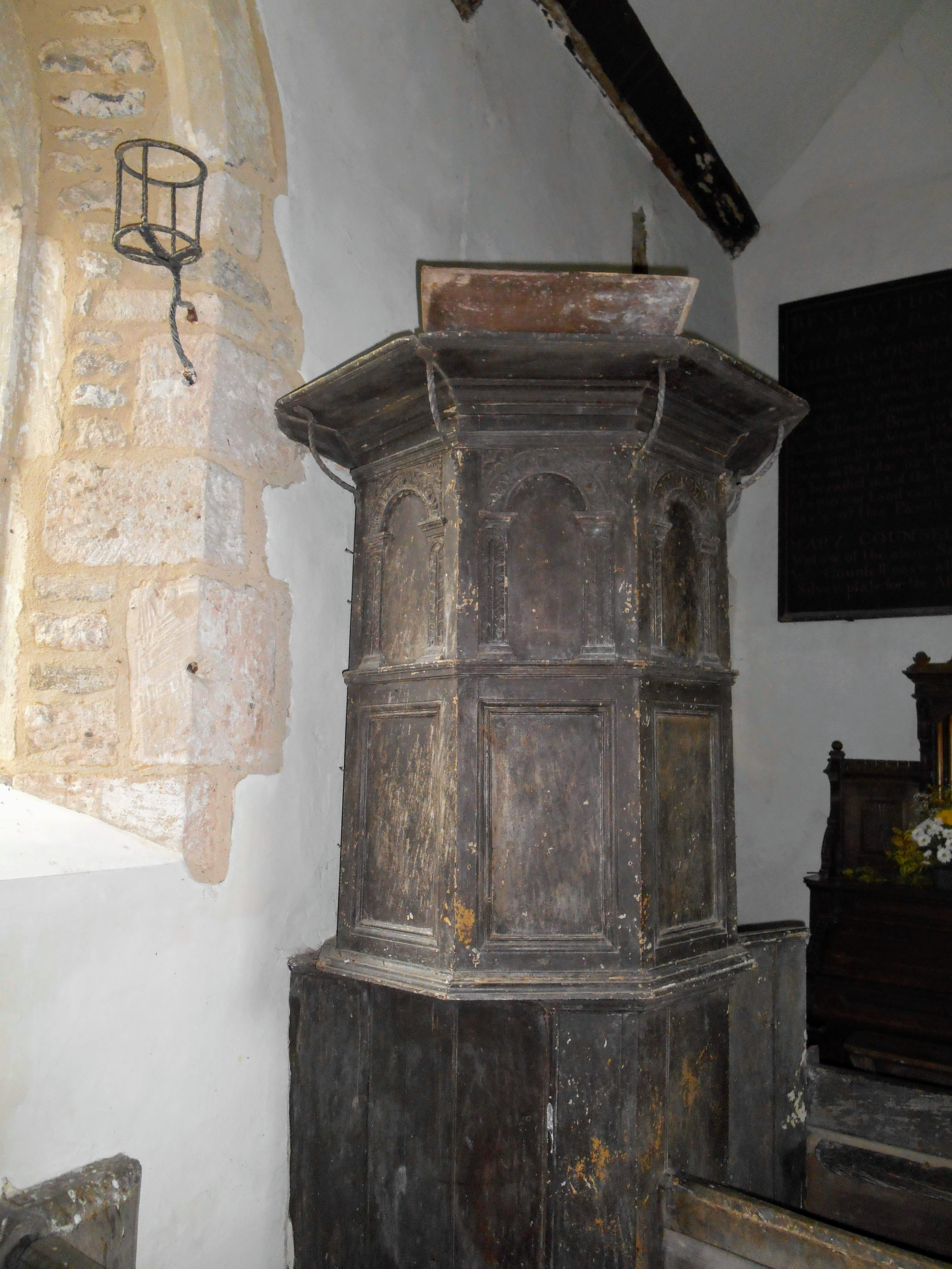
The earliest feature in the church is the circular font, which may be 12th century or slightly later.  The bench seats in the nave date from the 16th century and the box pews are Georgian.  The octagonal pulpit and reading desk are Jacobean. There is an inscribed tablet set into the base of the rood screen commemorating Mary Whippey, who died in 1666. 

Puxton Church was declared redundant in 2002 and is now cared for by the Churches Conservation Trust.  It is a grade 1 listed building. 

The leaning tower of Puxton
 

Nave of Puxton Church

Mary Whippey's Memorial Tablet


Chancel

Nave

Pulpit

Font

Porch of Puxton Church

Tuesday, 2 May 2023

St Decuman

St Decuman was born in the 7th century in Rhoscrowther in Pembrokeshire.  He felt called to evangelise the people of Somerset and arrived by boat in Watchet.  He wasn't welcomed by everyone and was beheaded.  However, undaunted he picked up his head, washed the blood from it in the waters of a well and put it back on his shoulders.  Local people built a small church to him on the spot.  Today he is commemorated in Watchet by a pebble mosaic, a holy well and a stained-glass window in the parish church, which is dedicated to him.

Stained glass window of St Decuman in his church in Watchet

Stained glass window of St Decuman in his church in Watchet

St Decuman's Church, Watchet

St Decuman's Church, Watchet

St Decuman's holy well (grid ref ST 0643 4273) is now surrounded by a tranquil and well-maintained garden.  It can be accessed by walking west down the lane on the north side of the church.  The well is on the right-hand side a 100 metres or so beyond the church.

Entrance to St Decuman's Holy Well 

St Decuman's Holy Well

Holy well

Holy well

Holy well

Inscribed stone in the holy well garden
God breathed and man became a Living Soul, Genesis Chapter 2, verse 7

St Decuman and his favourite cow on a raft on their way to Watchet
This painting is on the Watchet Harbour wall mural

St Decuman arrives in Watchet by boat from Wales accompanied by his favourite cow


St Decuman is beheaded

The sword with which St Decuman was beheaded

This pebble mosaic, which is located outside Watchet Library, commemorates the arrival of St Decuman in Watchet by boat from Wales in the late 7th century.  It was created in 1996 by Maggy Howarth of Cobblestone Designs.  

Wednesday, 19 April 2023

Stoates Mill, Watchet

Stoates Mill was built in Anchor Street in Watchet in 1832 as a replacement for Little Silver Mill, which was further upstream.  It was leased by brothers William and Thomas Stoate.  It expanded in the mid-19th century and eventually had ten pairs of water-powered grinding stones.  Grain was imported via the port of Watchet and after milling the flour and bran were exported mainly to South Wales.  

By 1877 Thomas Stoate had left the business to become a grain merchant.  William was joined in the business by his sons William, John and James.  A water turbine and steam engine were added in 1885.  In 1903 a new turbine was installed.  In 1911 a fire damaged most of the mill and the company moved their business to Temple Back Bristol.  Stoate & Sons is still in business (now at Shaftesbury 'in Dorset), with the great-great-great grandson of the first William Stoate now running the business.

In 1916 the derelict mill was acquired by the Exmoor Paper and Bag Company, who bought the paper bag plant that had been operating at the nearby Wansbrough Mill.  Water power was used at the mill until 1927 when a Gilkes Vortex turbine was installed.  This was manufactured by Gilbert Gilkes of Kendal in Cumbria.  It was rated at 45 HP and turned at 200 rpm to drive the electrical generator, which powered the works.

The Exmoor Paper and Bag Company used the mill until 1977.  The mill buildings were then used by various companies, including Watchet Products Fancy Goods Limited, which was founded in 1978. It made melamine products there but closed down in 1991.  The mill buildings were sold on a couple of times but gradually fell into a state of disrepair.  Planning permission for conversion of the mill buildings to residential use was granted in 2013 and building work began in 2016.  It was completed in 2018.

Preserved Gilkes Vortex Turbine

Stoates Mill in 2022

Stoates Mill, 2022

Stoates Mill, 2022

Sunday, 2 April 2023

Leighland Chapel

Leighland Chapel was built in 1861-2 on the site of a medieval chapel.  It was designed by C.E. Giles and is dedicated to St Giles. The medieval chapel was in existence by 1320 and in 1548 it was noted that there was a Lyland Chapel in the parish. The vicarage of Leighland Chapel was united with the rectory of Treborough in 1950 and the livings of Old Cleeve, Leighland Chapel and Treborough were merged in 1955. They are now in a benefice with St Luke's, Roadwater and St Mary's, Washford.

Leighland Chapel contains some interesting features, including a wooden bench end with a bird and acorns design carved into it, a lectern with a vine leaves and grapes carved on it and medieval tiles around the base of the font, which may have come from Cleeve Abbey. 

The reredos, capitals and pulpit were decorated with passion flowers and foliage by Rachel Reckitt (1908-1995). She also painted the portrait of St Giles and made the candelabra, which is decorated with flying geese or swans. Rachel was an artist and sculptor who lived at Golsoncott near Roadwater. She produced many works of art for several of the local churches, including Rodhuish, Old Cleeve, Carhampton and Withycombe.

There is a notice at the back of the church explaining Leighland Chapel's connection with Dom Philip Powel, who was one of the Tyburn Martyrs.  He was born in Wales in 1594, became a monk at Douai in France but returned to England in 1622 after he was ordained. He lived with the Ponytz family at Leigh Barton for 20 years. Although he was a Roman Catholic, he preached at the old chapel in Leighland, as he was a friend of the priest-in-charge there. He tried to leave England during the English Civil War but was captured, tried, found guilty of "being a monk, and staying in the country contrary to the law.  He was executed at Tyburn on 16th June 1646.

Leighland Chapel

Leighland Chapel

The nave of Leighland Chapel

Altar and reredos

Reredos

Capital decorated with flowers and foliage

Candelabra

Pulpit

Close up of the decoration on the pulpit

St Giles
His symbol is a deer

Deer and ivy

Charity board

Bird decoration on a carved bench end

Lectern decorated with carved vines
This was presented in memory of Dorothea Shaw (1895-1951), by some of her many friends.

Font surrounded by medieval tiles


Notice about Dom Philip Powel