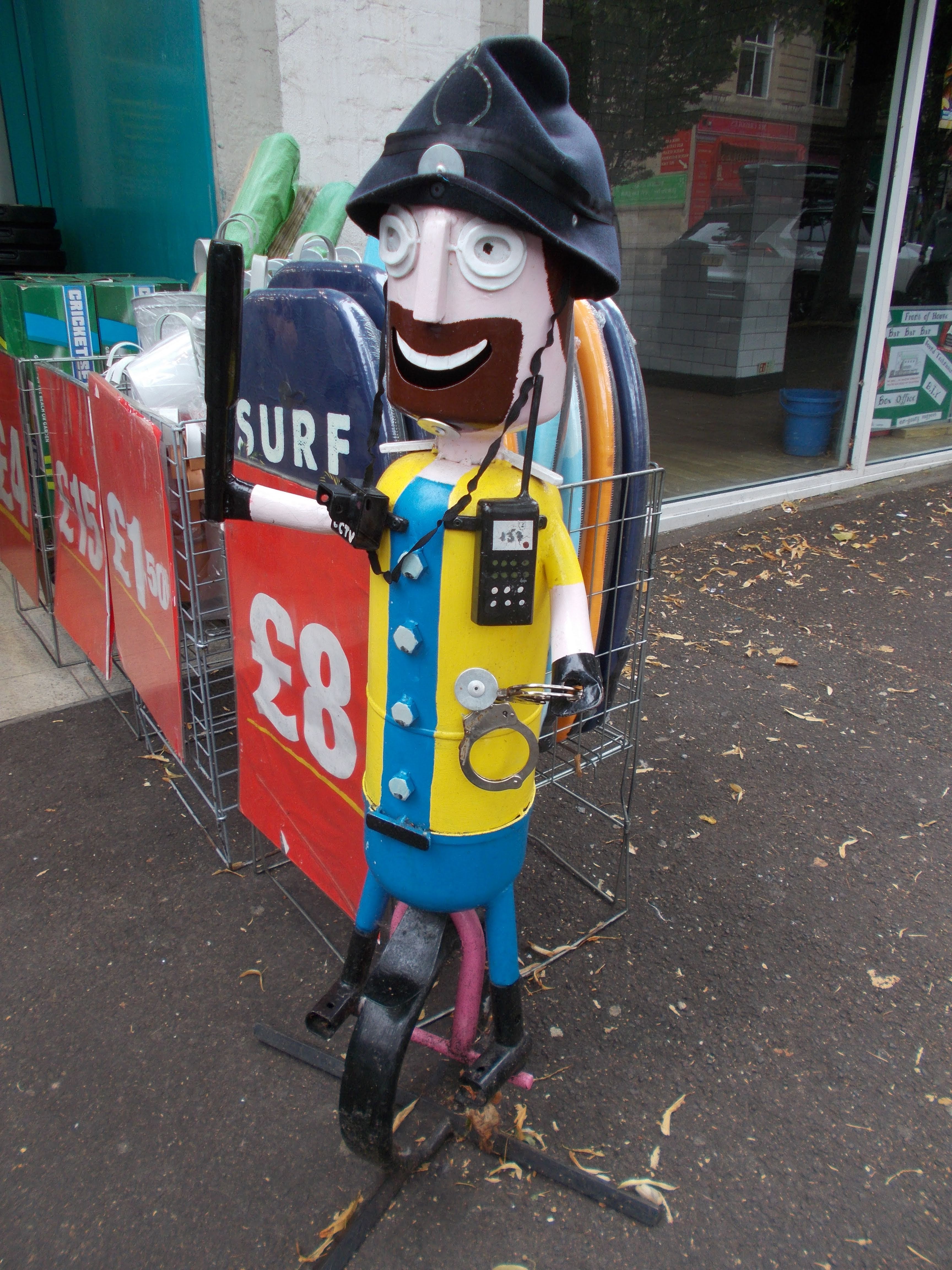
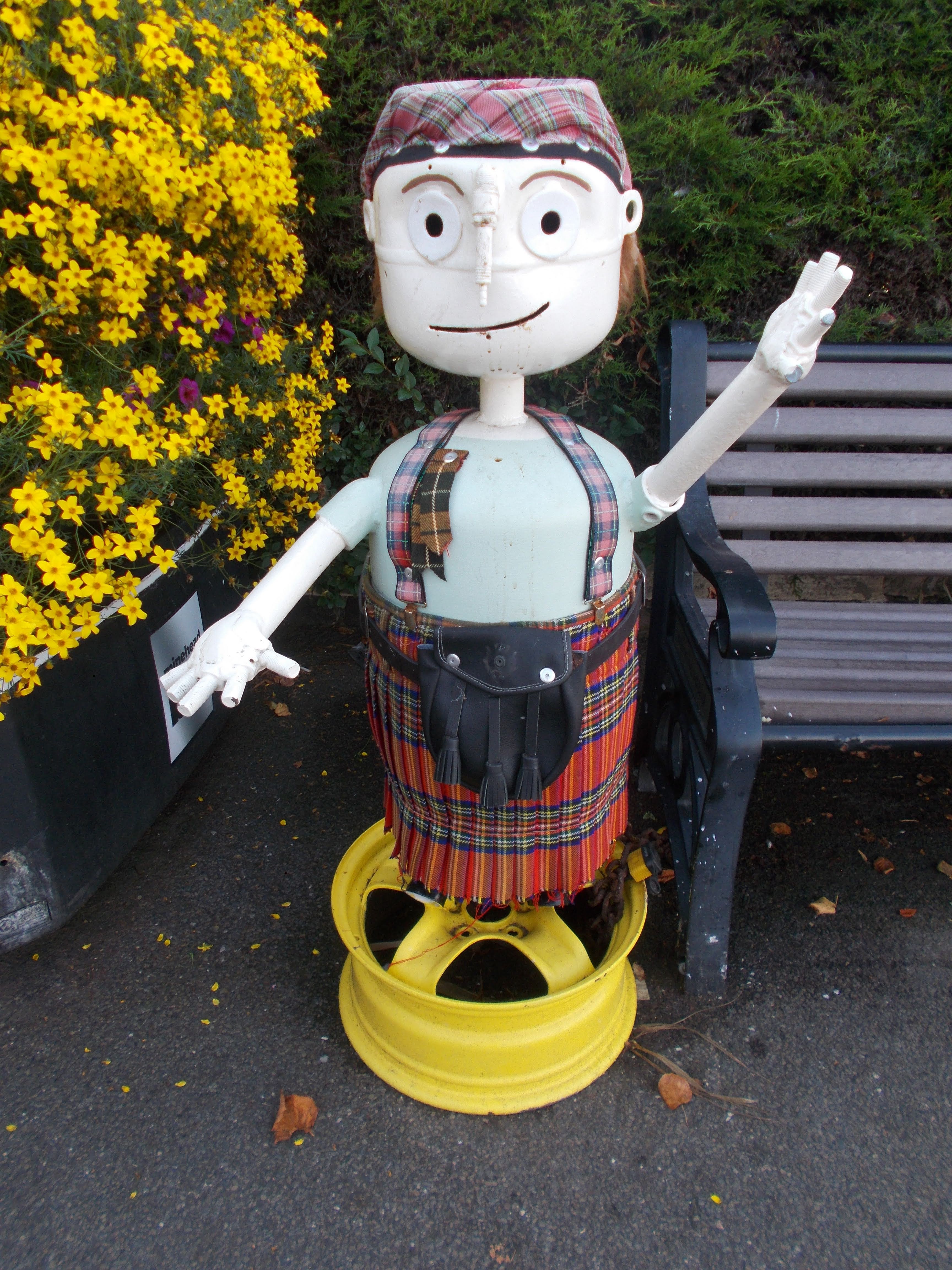
Minehead is currently home to over 150 Metal Heads and there are a few elsewhere in West Somerset e.g. Blue Anchor, Watchet and Carhampton. Local man Steven Heard, who is a former carpenter, began to produce them during the first lockdown. They are all made from scrap metal and other materials and are appropriately dressed and decorated for their locations. There is now a Metal Heads Trail Map: copies can be picked up from the Tourist Information Centre in the Beach Hotel. Here are a few I have found so far:
Thursday, 30 June 2022
Minehead's Metal Heads
Friday, 8 April 2022
Frederic Weatherley - Songwriter
Frederick Edward Weatherly, songwriter and barrister, was born at 7 Wood Hill (now 63 Woodhill Road) in Portishead on 4th October 1848. He was educated at Hereford Cathedral School and Oxford University. After graduating he remained at Oxford and worked as a teacher. In December 1872 he married Anna Maria Hardwick in Worle and they had a son and two daughters. They later separated and he lived with Maude Francfort for many years.
At some point in his adult life Frederick dropped the k from the end of his name and became Frederic. In 1887 he left teaching to qualify as a barrister in London. In 1893 he joined the western circuit and moved to Clifton, Bristol. In 1900 he moved to Bath where he continued to work as a barrister. Frederic’s wife Anna died in 1920. Maude Francfort died in 1923 and later the same year Frederic married a widow, Mrs Miriam Bryan. He died in Bathwick on 7th September 1929 after a short illness and was buried at Bathwick Cemetery.
Frederic Weatherly published his first song lyrics, poems, two novels, many children's books, and librettos for cantatas and oratorios while he was living in Oxford. He went on to write the words to many of the most popular songs in the English-speaking world in the late 19th and early 20th centuries. His songs were performed by the leading singers of the time. He also translated several Italian and French operas into English.
Frederic Weatherly claimed to have published more than 1,500 songs in total. Dozens of them were extremely popular in his lifetime, and several of them, including Nancy Lee (1876), The Holy City (1892), Danny Boy (1912) set to the tune of 'Londonderry Air', and Roses of Picardy (1916) remained popular after his death.
Thursday, 31 March 2022
Banwell's Old Fire Station
In East Street, Banwell there is a building which housed the town’s fire engine from the late 19th century until the 1980s. The inscription over the main door reads as follows:
“This building is presented by Miss Fazakerley of Banwell Abbey and Fazakerley House, Lancashire, being the property of Banwell for ever to be used for the housing of the fire-engine belonging to that Parish. 19th Day of December 1887 in the year of the Jubilee of Her Most Gracious Majesty Queen Victoria.”
Miss Emily Fazakerley was a wealthy, generous and eccentric lady. She was born on Anglesey in 1840 and later lived at Denbigh Castle in North Wales. She moved to Banwell for health reasons in 1883 but died in 1888 at the age of 48. She was buried in London.
Miss Fazakerley paid for a new horse drawn fire engine and for uniforms for the crew. She also provided instruments and uniforms for a village brass band. The new fire engine replaced the wooden-wheeled hand-drawn machine, which was made by James Manley of Redcliffe, Bristol in 1810 and stored in the nearby church. The 1810 fire engine had two reciprocating 4 inch bore and 8 inch stroke pumps. It could deliver 44 gallons of water per minute to a height of 80 feet. Four men were needed to man it and many volunteers forming a bucket chain were required to refill the engine’s reservoirs with water.
The fire engine house also had a rest room and the fire bell, which was used to summon the firemen from their homes and workplaces, is still hanging on the roof.
The building is still used by the Banwell and District Volunteer Fire Unit.
Thursday, 17 March 2022
Black Nore Lighthouse
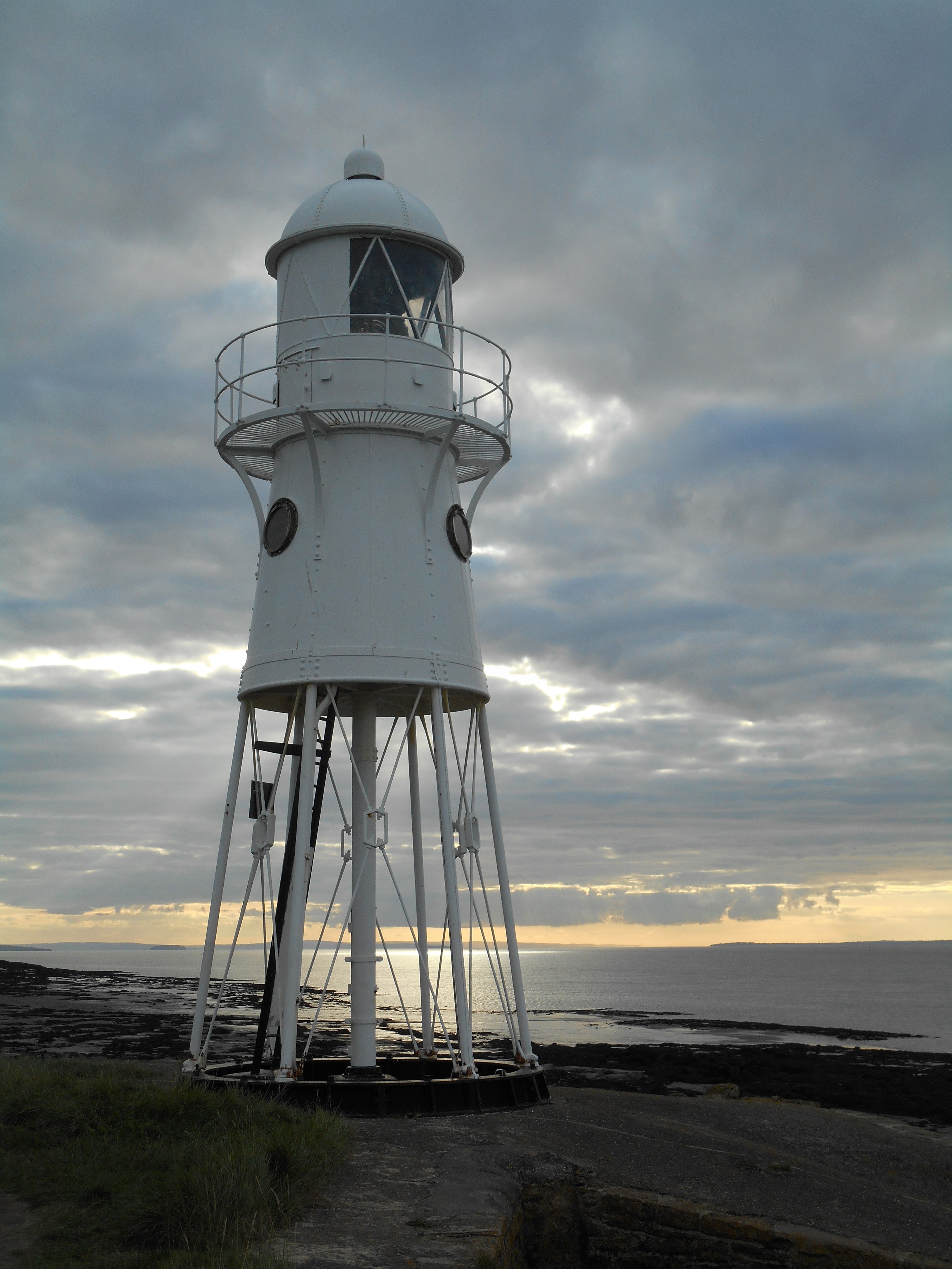
Black Nore Lighthouse was built on a coastal outcrop at Portishead by Trinity House in 1894. Its purpose was to be a navigation aid for shipping heading for the port of Avonmouth or the River Avon. There is no vehicular access to it – the lighthouse can only be accessed via the coastal footpath. Links to the coastal footpath at Black Nore are available at the junction of Glenwood Rise & Nore Road and at the northern end of the cul-de-sac called Pinecroft.
Despite its name, the lighthouse is painted white. It is made of riveted cast iron, has six legs and is 11 metres high. The outcrop on which it was constructed, was built up with masonry to form a platform. There is a ladder underneath it, which leads up to an entrance hatch. Its lamp was originally powered by gas. The mechanism had to be wound every day and this task was undertaken by members of the Ashford family, who lived nearby at Black Nore Farm. The light was converted to electricity and automated in 1941, so that it could be switched off during air raids. The winding and drive mechanisms were replaced by an electric motor in 2000.
The lighthouse was decommissioned by Trinity House on 27th September 2010 and the internal mechanism was removed. It was sold to a community interest company in October 2011 for £1. They have pledged to keep it as a monument on the coast for everyone to enjoy. It has been a grade II listed building since June 2011.
Monday, 28 February 2022
Ralegh's Cross
Ralegh's Cross was erected at a crossroads c1425/6 probably to mark the boundary of the Raleigh family's Nettlecombe estate and possibly also to mark the location of a dangerous bog. According to Raleigh family tradition, the cross was erected by Simon Raleigh, who had fought at the battle of Agincourt in 1415, as a memorial to his wife Joan, who died in Devon but was buried at Nettlecombe.
The cross is currently located in the grounds of the Ralegh's Cross Inn. However it was originally located a couple of hundred metres to the west in a field on the north side of the B3190 (grid reference ST037 344). The road junction moved when the land was enclosed. The remains of the cross were moved to its current location (grid reference ST 038 344 ) in the late 18th or early 19th century.
All that remains today is a 70cm high weathered red sandstone shaft set in an octagonal socket and a single step.
Monday, 31 January 2022
John Locke
John Locke is regarded as possibly the most influential English language philosopher and political theorist. His works lie at the foundation of modern philosophical empiricism and political liberalism. His ideas had an influence on the development of many important psychological concepts and provided inspiration for the European Age of Enlightenment and the Constitution of the United States.
John Locke was born in the village of Wrington on 29th August 1632 and baptised the same day in All Saints Church. He probably spent his childhood in the hamlet of Belluton near Pensford. Locke attended Westminster School and Christ Church College, Oxford where he studied, among other things, medicine and later became a tutor at the University. In 1666 he met Anthony Ashley-Cooper, later the 1st Earl of Shaftesbury, who became his friend and patron. Locke became Shaftesbury’s aide and personal physician. In 1675 Locke travelled to France for health reasons and because his personal safety was threatened, as Shaftesbury had lost favour with King Charles II. He lived in France until 1679. While he was there he studied the work of various French philosophers.
After trying unsuccessfully to exclude the Catholic James II from becoming king after Charles II, Shaftesbury fled to exile in the Netherlands in 1682 where he died the following year. Locke travelled to the Netherlands in 1683 and stayed there until after the Glorious Revolution of 1688, when King James II was overthrown in favour of the Protestant William of Orange and his wife Mary.
When Locke returned to England in 1689 he made his home with the family of his close friend Damaris Masham at High Laver in Essex and lived there until his death on 28th October 1704. He is buried in the churchyard of All Saints Church, High Laver.
John Locke’s major works were Letters concerning Toleration (1689, 1690 and 1692), Two Treatises of Government (1689), An Essay concerning Human Understanding (1690); Some Thoughts concerning Education (1693) and The Reasonableness of Christianity (1695).
Saturday, 1 January 2022
Monk's Steps, Kewstoke
Monk’s Steps or St Kew’s Steps, as they are also known, run from Woodspring Avenue near the top of the northern slope of Worlebury Hill in a north westerly direction for about 150 metres down a natural gully to join the bottom end of Monks Hill in Kewstoke.
The origin and original purpose of the steps, which are made of roughly worked stone, is uncertain but they may date back to the early medieval period. At this time there was an Augustinian Priory called Woodspring a mile and a half north at Middle Hope. St Paul’s Church at Kewstoke, which is located at the bottom of Monk’s Steps, was linked to Woodspring Priory for a while during the medieval period, so that may be how they acquired the name.
The freehold of Monk’s Steps was acquired by the National Trust from R.H.C. Butt on 7th July 1936. The grid reference for the top of the steps is ST 337 632 and for the bottom it is ST 336 633.
Wednesday, 15 December 2021
Second World War Bomber Crash Memorial in Bridgetown Wood
A memorial stone has recently been placed in Bridgetown Wood, by the side of the bridlepath, which runs between Bridgetown and Howetown Farm. It commemorates the Stirling bomber, which crashed nearby, just after midnight on 27th January 1944. All 8 men onboard the plane were killed and the wreckage was scattered for up to 3.5 miles in an easterly direction.
The Stirling bomber (serial number EH933) was part of 1660 Heavy Conversion Unit. It was on a training exercise and had flown from RAF Swinderby in Lincolnshire. Seven of the men were members of the RAF Volunteer Reserve and the navigator was a member of the Auxiliary Air Force. The plane was undertaking a cross-country navigation exercise and was on the fourth part of its journey, which involved flying from Sidmouth to Ilfracombe. However it flew off course and then dived steeply and broke up in the air. The main part of the aircraft crashed at Bridgetown. The names of the men who died are recorded on the memorial:
- Sgt Ronald A Partridge
- Sgt Claude V Tomkinson
- Sgt Thomas H Jones
- Sgt Ben Ackroyd
- Sgt Alfred Thursby
- Sgt Herbert Hewitt
- Sgt John Kerry
- Sgt Richard Street
Thursday, 2 December 2021
Guglielmo Marconi
Guglielmo Marconi was born in Bologna, Italy. His father Giuseppe Marconi was Italian but his mother Annie Jameson came from County Wexford in Ireland. As a boy he was very interested in physical and electrical science and in 1895 he succeeded in sending wireless signals over a distance of 1.5 miles on his father’s estate at Pontecchio near Bologna.
In 1896 Marconi brought his equipment to England because the
Italian government was not interested in his work. He was introduced to Sir William Preece, who
was Chief Engineer at the Post Office.
In the same year he was granted the world’s first patent for a system of
wireless telegraphy. He demonstrated his
system successfully in London and on Salisbury Plain.
On 13th May 1897 Marconi and his assistant George
Kemp successfully transmitted long wave wireless messages between Lavernock Point on the coast of South
East Wales and Flat Holm Island in
the Bristol Channel, a distance of 3 miles. These were the first ever wireless
messages to travel over open water. On
18th May 1897 they succeeded in transmitting wireless messages from
Lavernock Point across the Bristol Channel to Brean Down, a distance of nearly 9 miles.
In July 1897 Marconi formed the Wireless Telegraph and Signal Company Limited This was re-named Marconi's Wireless Telegraph Company Limited in 1900.
In 1899 Marconi established wireless communication between France and England across the English Channel. In December 1901, in order to prove that wireless waves are not affected by the curvature of the Earth, Marconi transmitted the first wireless signals across the Atlantic between Poldhu in Cornwall and St. John's in Newfoundland, Canada - a distance of 2100 miles. In 1907 he opened the world’s first commercial transatlantic wireless telegraph service between Glace Bay in Nova Scotia and Clifden in County Galway, Ireland.
In 1909 Marconi was awarded the Nobel Prize in Physics jointly with German physicist Ferdinand Braun, "in recognition of their contributions to the development of wireless telegraphy". He served in the Italian Army during the First World War and during this time and afterwards he continued his experiments into short wave wireless communication. In 1923 he successfully conducted trials between Poldu in Cornwall and his yacht Elettra, which was cruising in the Atlantic Ocean and Mediterranean Sea over 1,400 miles away. This began the development of shortwave wireless communication, which is the basis of most modern long-distance radio communication. In 1924 Marconi’s company obtained a contract from the Post Office to establish shortwave communication between England and the countries of the British Empire.
In the 1930s Marconi conducted experiments in Italy using microwaves and in 1935 he gave a practical demonstration in Italy of the principles of radar. He died at his home in Rome on 20th July 1937 following a series of heart attacks.
Guglielmo Marconi’s achievements are commemorated by numerous monuments and plaques in various locations around the UK where he lived, worked and conducted experiments. He has at least 26 roads named after him in Great Britain, including ones in Weston-super-Mare, Portishead, Highbridge and Penarth.
Thursday, 25 November 2021
Edith Cavell
Edith Louisa Cavell was born on December 4th 1865 in the village of Swardeston in Norfolk, where her father Frederick was the vicar for 45 years. After being educated at home for several years, Edith boarded at Belgrave House School in Elton Road, Clevedon from 1883-84. She then attended schools in London and Peterborough. In 1889 she became governess to a family in Brussels and she remained in this post for six years. She returned to England in 1895 to nurse her seriously ill father and she then decided to train as a nurse. She trained at the Royal London Hospital and then worked at various hospitals in London and Manchester.
In 1907 Edith was appointed as director of a new nurses’ training school in Brussels, which had just been set up by Dr Antoine De Page. She successfully persuaded potential recruits and members of her committee that nursing was a respectable profession and one which required professional training.
After the German occupation of Belgium in late 1914, Edith became involved in an underground group formed to help British, French, and Belgian soldiers reach the Netherlands, which was a neutral country. The soldiers were sheltered at the Berkendael Institute, which had become a Red Cross hospital. They were provided with money and guides by a Belgian called Philippe Baucq. About 200 men had been helped before Edith and several others were arrested by the Germans on 5th August 1915.
The group of nine people was brought before a court martial on October 7th, 1915, accused of assisting the enemy and of trying to damage the German war effort. Edith Cavell made a full confession and was sentenced to death on October 9th, along with four others. The remaining four were sentenced to hard labour. Edith Cavell and Philippe Baucq were executed by a firing squad on October 12th 1915 in Brussels, despite the efforts of the American and Spanish ministers to secure a reprieve. Edith’s execution on a charge, which did not include espionage, was considered outrageous and was widely publicised by the Allies.
After the war there was a funeral service for Edith Cavell at Westminster Abbey and on 15th May 1919 her body was reburied on the outside of the south east corner of Norwich Cathedral. She is commemorated on the Swardeston village sign and by a statue in St Martin’s Place in London. There are busts of her at the London Hospital Museum; in Brussels; Melbourne in Australia and Norwich. She also has many streets in the UK and across the world named after her and a bar in Tombland, Norwich There is a blue plaque on 1 Elton Road, Clevedon, commemorating the time she spent at school in Clevedon.
There is another Somerset connection to Edith Cavell - Sister Elizabeth Bastable Wilkins worked with her at the Red Cross Hospital in Brussels. On one occasion the Germans raided the hospital looking for British soldiers. Sister Wilkins warned the ward nurse and 4 British soldiers were hidden away, while Sister Wilkins hid their documents. She was arrested, but released after 3 hours. On 5th August 1915 she was arrested again, at the same time as Edith Cavell. However, she was released. She visited Edith Cavell while she was in prison and looked after her dog. Elizabeth Wilkins later became Matron of Chard Hospital, a position she held for over 30 years.
Further Reading:
Edith Cavell: Faith before the Firing Squad: Catherine Butcher. Monarch Books, 2015
Edith Cavell: Nurse, Martyr, Heroine: Diana Souhami. Quercus Publishing, 2015