Thursday, 14 March 2019

A Panoply of People

This blog post brings together a plethora of sculptures of people from around Somerset.


Manor Farm, Lower Street, Merriott


Jack and Jill gates at Kilmersdon School
Jack and Jill Hill in Kilmersdon is supposed to have been the inspiration for the nursery rhyme of the same name.  It links Ames Lane to School Lane. 

The Belfry, Priddy
Bristol Exploration Club, which is one of the UK's major caving clubs, has its headquarters at a hut called The Belfry in Priddy.  There is a large bat over the entrance and a large skeleton on the side wall.

Sainsbury's, Hankridge Farm
This large relief sculpture is by local artist Christopher Dean. It was commissioned by Sainsbury's in 1992, which is presumably when the Hankridge Farm store opened.  According to the plaque beside it, "it depicts the elements of life, water, earth, air and fire, together with the activities associated with a supermarket."  It is located to the side of one set of entrance doors but I must have walked by it dozens of times before I noticed it.

Yankee Jack, Watchet Harbour
John Short (1839-1933) sailed the world in various sailing ships, first as an able seaman and later as bosun. In the 1860s some of the ships he was sailing in, ran the blockade in the American Civil War, For this reason he was given the nickname  “Yankee Jack” by people of Watchet.   He had a good voice and often sang sea shanties while on board ships.  He memorised many sea shanties and in the early 1900s he was visited by two collectors of sea shanties - Cecil Sharp and Sir Richard Terry - who transcribed the lyrics and tunes John had remembered.  

In March 2008 a statue of Yankee Jack, commissioned by Watchet Market House Museum Society, was unveiled at Watchet Harbour.  It was sculpted by Alan Herriot from Scotland.


The Ancient Mariner, Watchet Harbour
This statue of Samuel Taylor Coleridge's Ancient Mariner was commissioned by Watchet Market House Museum in 2002.  A competition was held to suggest designs for the statue and it was won by Scottish sculptor Alan Herriot.  It was unveiled in 2003.


Man on a Bench, Bruton
This bronze sculpture was designed by Giles Penny and installed close to the packhorse bridge in Bruton in June 2015.  Apparently it cost £22,000 and gets very hot in the summer when the sun is shining, so if you choose to sit down on it on a hot day, beware!


Old Bluecoat School and Almshouse, Frome
These two ladies are Charity Girls.  They date from around 1803 and were originally on display at Keyford Asylum, which has been demolished.

Nancy Guy and Billy Ball, Old Bluecoat School, Frome
An almshouse was founded on The Bridge in Frome in around 1465 by William Leversedge.  It was replaced by the current building in 1728, at which time a free school (called the Bluecoat School) was incorporated into it.  This survived until 1921.  The name derives from the colour of the coats worn by the pupils.  Statues of an almswoman (known locally as Nancy Guy) and a schoolboy (known locally as Billy Ball) adorn the facade.  The building still provides housing for retired people and is now called Blue House.

Doreen, Donyatt Halt 
Doreen Ash was evacuated to Donyatt in September 1939 at the age of 5.  In c2009 a bronze statue of her sitting on a suitcase was placed next to a wooden hut on the platform of Donyatt Halt.  In November 2015 the wooden hut was burnt down and Doreen's statue was badly damaged by an arson attack.  The Chard to Taunton railway line opened in 1866 but Donyatt did not get a station until 1928.  The line closed in 1962.

Doreen sometimes gets dressed up in the winter!

Frank Foley, Highbridge 
Frank Foley, who was born in Highbridge, was a British Secret Intelligence Service officer based in Berlin in the 1930s.  He issued 1,000s of visas to Jews, enabling them to leave Germany, thus saving them from the Holocaust.   In 2005 a statue of Frank Foley designed by Jonathan Sells was unveiled in Market Street, Highbridge. It was paid for by public fundraising.

Patrick, Wadeford
This statue is by the side of the road as you drive through the village of Wadeford between Chard and Combe St Nicholas.  His name is Patrick - it says so on the base - and on the lamppost it says "Good fortune to you.  Share a little of it."   Patrick belongs to Chardleigh House, which is a residential home for young people with social difficulties.  It is run by a company called 3 Dimensions Care Ltd.


Jane Seymour, Nether Stowey 
This brightly painted relief sculpture of Jane Seymour, 3rd wife of Henry VIII, can be found in the garden of a house in Castle Street, Nether Stowey.  The house is near the junction of Castle Street with Mount Road.   Jane is at a 90 degree angle to the road and can be seen most clearly from the pavement in the winter when the wisteria around her has lost its leaves.  Her black and white spotted dog stands by her side. The statue was created in 1970 by Doug Forsey, apparently to fill an empty space where a door had been blocked up. She was made from chicken wire and cement.

Jacob wrestling with the Angel, Rodhuish Church
 This aluminium and iron sculpture was made by local artist Rachel Reckitt (1908-1995).  She donated it to St Bartholomew's Church in Rodhuish.

Quarryman, Norton-sub-Hamdon
This chap is seated outside the Lord Nelson pub in Rectory Lane, Norton-sub-Hamdon.  I haven't been able to find out how long he has been there or by whom he was made but I presume he is a former quarryman.

Quarryman sculpture near Stoke-sub-Hamdon

These 2 skeletons live on a shelf outside Victoria Cottage in Aller near Langport, I'm not sure why they are there!

Handyman skeleton, Nether Stowey

Samuel Taylor Coleridge lurking in the Coleridge Way Garden in Porlock

One of 10 carved faces on the outside of St Mary's Church, Holford

Unusual piscina in St Mary's Church, Oare
It is in the shape of a man's head clasped between two hands and possibly dates back to the 15th century.

Children through the Ages by David Backhouse, John Nankivell & Claire Venables, Sainsbury's, Wessex Fields, Frome
On the right a boy walks through Selwood Forest in the 7th century.  The children to the left of him are running through the ages to the present day and are all carrying objects, which represent Frome industries.  The background shows some of the best known buildings in Frome.  It was cast by The Morris Singer Foundry in 1993

Old Father Time, Wilton Farm, Curry Rivel

Stone face, St Michael's Church, Creech St Michael

Stone face, St Michael & All Angels Church, Bawdrip

Stone face, St Michael's Church, Compton Martin

140 Smiles, High Street, Street
A Millennium work of art by Brookside School in Street.  It is comprised of self-portraits in pottery made by the children in years 3 &4 in January 2000, with the help of the ceramic artist Julia Gatrill.

Friday, 1 March 2019

Whit Stones, Porlock Hill

The Whit Stones are two large sandstone slabs located at the top of Porlock Hill and about 50 metres to the south of the A39.  They are currently slanting eastwards but would originally have been over 1.5 metres high when they were upright.  They are both over a foot thick.  They are located at grid reference SS 853 462.

According to legend, the Whit Stones were thrown to their present location by the Devil (with or without help from an unnamed giant) from Hurlstone Point (hence its name).  It is more likely that they were in fact either boundary markers of part of a prehistoric burial chamber, stone row or stone circle.  They were sometimes referred to in the past as White Stones.  They may date from any time between the Neolithic period and late Bronze Age (2350 BC to 701 BC).

The Whit Stones

Whit Stones

Whit Stone - looking east down Porlock Hill

Thursday, 14 February 2019

Zulu the Donkey, Stoke Pero Church

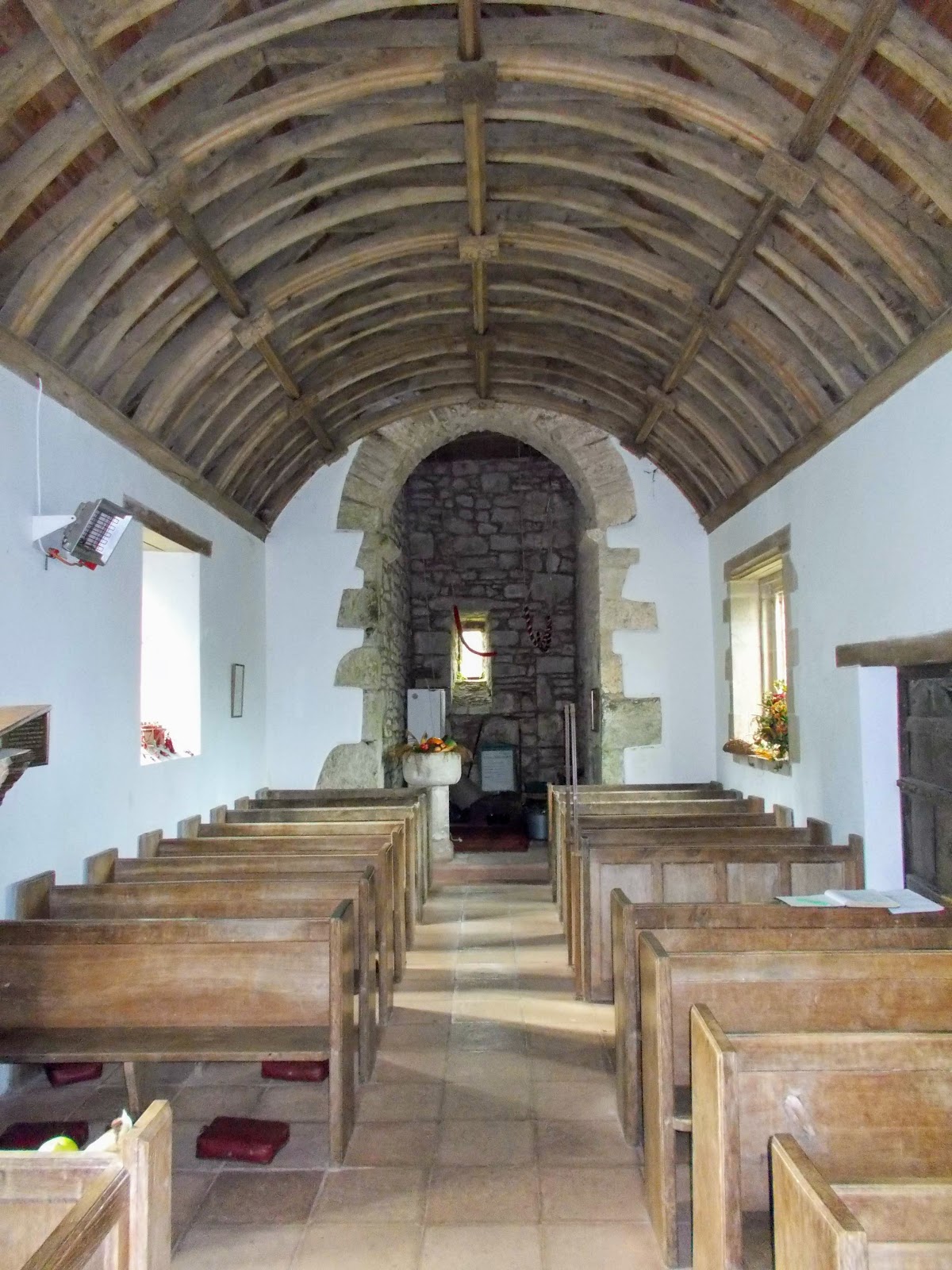
Stoke Pero Church stands at an altitude of 310 metres above sea level and is the highest church on Exmoor.  The church was built in the 13th century on the site of an older church, but it was extensively rebuilt and restored 1897-98.  The only original features are the tower and the porch.  Unusually the church is not dedicated to a particular saint.

The restoration was paid for by Sir Thomas Acland (12th Baronet), the owner of the nearby Holnicote Estate.  Zulu the Donkey carried all the timber used to rebuild the roof up from Porlock twice a day.  His efforts are commemorated by a portrait drawn by Hope Bourne, which hangs on the wall in the church.  Hope Bourne was a writer and painter who lived a simple and mainly self-sufficient life at various locations on Exmoor.  She died in 2010 aged 91.

Stoke Pero church was restored again in 1955.

Hope Bourne's portrait of Zulu the donkey

Zulu the donkey
 
Stoke Pero Church

Nave and chancel of Stoke Pero Church
 
The Nave of Stoke Pero Church
 
Font decorated for harvest festival

Friday, 1 February 2019

Wibbly-wobbly Hedges, Montacute House

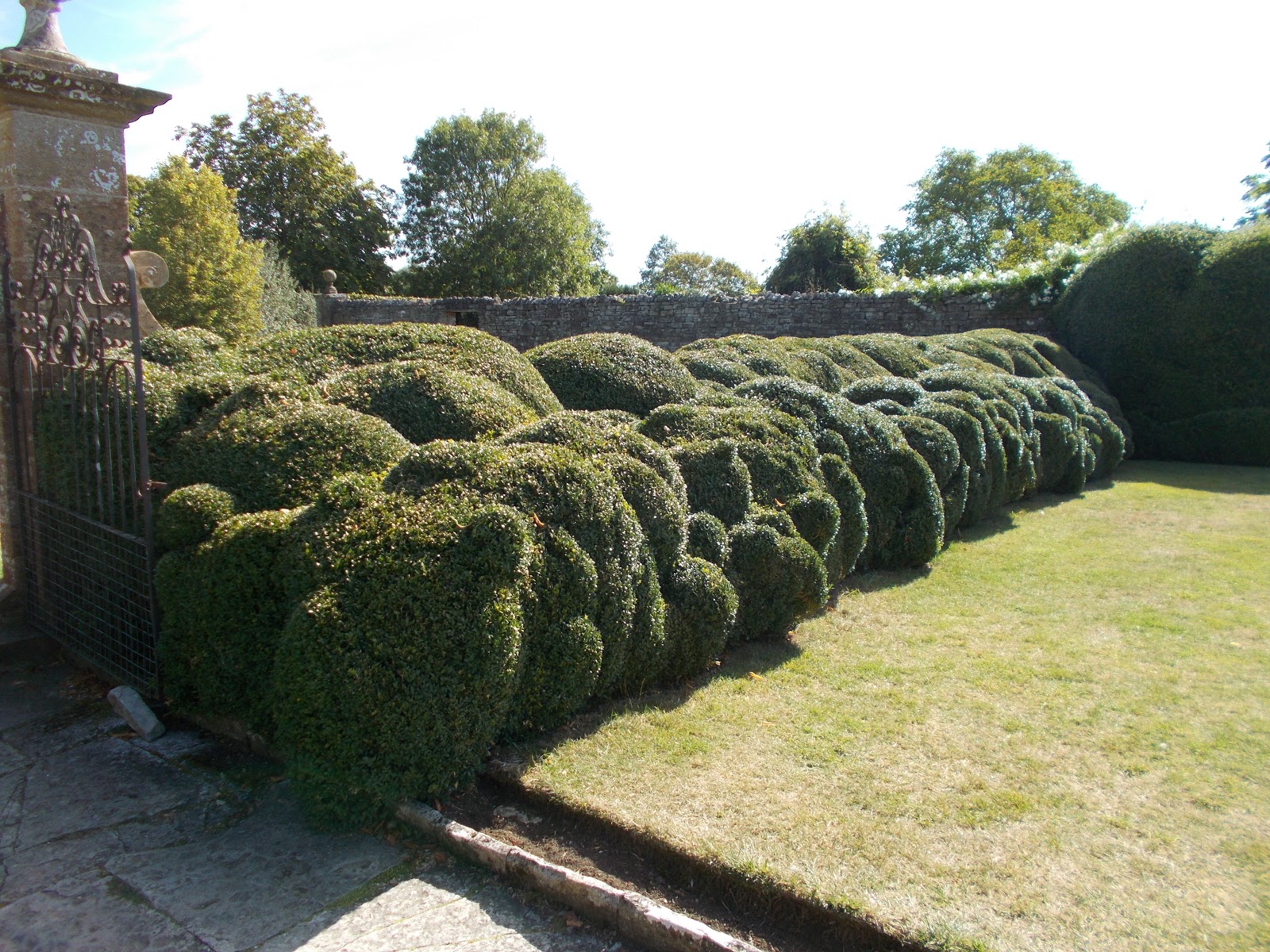
Montacute House (owned by the National Trust) has some particularly fine examples of wibbly-wobbly or "cloud" hedges.  The ones at Montacute are yew trees.  They were not originally designed to be shaped like this, but the hedges buckled under the weight of heavy snowfall in January 1947, which lasted until March.  Due to a postwar labour shortage, they weren't cut until June 1947, by which time they had become permanently misshapen.  They are now clipped to maintain the "cloud" appearance.

The National Trust's garden at Lytes Cary near Kingsdon has some smaller scale but beautifully clipped box cloud hedges.

A house facing the pebble beach at Porlock Weir has a short section of cloud hedge, although whether it is clipped this way deliberately I don't know.

Wibbly-wobbly hedge close up in the Cedar Lawn Garden

North Garden

North Garden

Wibbly-wobbly hedge undergowing repair, August 2018

Wibbly-wobbly hedge and Orangery in the North Garden

Wibbly-wobbly hedge in the Cedar Lawn Garden

Wibbly-wobbly hedge and Lord Curzon's Pavilion, Cedar Lawn Garden

Wibbly-wobbly hedge and Montacute House from the Cedar Lawn

Montacute House and wibbly-wobbly hedge from a very parched Cedar Lawn, August 2018

Cloud hedge at Porlock Weir

Cloud hedge at Lytes Cary

Cloud hedge at Lytes Cary

Monday, 14 January 2019

Smitham Chimney, East Harptree Woods

Smitham Chimney and the pond next to it are the only visible remains of a lead smelting plant.  The stone and brick chimney is located on Smitham Hill in the middle of East Harptree Woods.  A public footpath runs through the site.  The grid reference for the site is ST 554 546.

Lead mining in the Mendips dates back to at least the Iron Age and it continued in the Roman period and on into medieval times.  It reached its peak in the late 16th/early 17th centuries but by the 18th century most of the easily available lead had been mined and flooding in the shafts became an issue.  Silver, zinc, iron, ochre, manganese and calamine were also mined at various locations on the Mendip Hills. At various periods lead was mined at East Harptree; Velvet Bottom at Charterhouse; Priddy; Stockhill and Chewton Mendip.  At East Harptree lead was mined from veins in the Carboniferous Limestone and zinc and manganese were mined from veins in the Dolomitic Conglomerate.

In 1867 a group of Cornish miners formed the East Harptree Lead Works Company, in order to re-smelt the heaps of slag and slimes left by previous mining ventures.  New techniques developed in Cornwall meant that they could now release lead that earlier miners had not been able to remove from the ore. The lead produced was used for the shot in guns.  The chimney vented the smoke produced by five lead condenser flues.  These are clearly shown on an Ordnance Survey map of 1883 stretching out in a north easterly direction from the chimney.  They have subsequently been planted over with conifers and are now barely visible.  Areas of what is known in the Mendips as "gruffy ground" (uneven pockmarked mined ground) can apparently be seen in the woods.  The pond was originally a reservoir for the lead smelting works.

The site at East Harptree closed in 1875 and all the buildings except the 70 feet high chimney were later demolished.  The chimney was renovated in 1914 and again in the 1973 by the Mendip Society and Somerset County Council. 

A brickworks is shown on the 25" Ordnance Survey map of 1883 on the eastern side of the lead works.  However it was already disused by this time.

Maybe it is an optical illusion but the top of the chimney looks like it is leaning to the left?

Doorway at the bottom of the chimney:
it looks like lots of birds nest inside, judging by the huge pile of sticks behind the grill!

Smitham Chimney

Smitham Chimney and pond

Reflection of Smitham Chimney in the pond

Smitham Chimney and Pond

Pond

Tuesday, 1 January 2019

Thomas Coryate's Shoes, Odcombe Church

Thomas Coryat(e) was born in the village of Odcombe in around 1577.  His father George was the rector of Odcombe.  Thomas went to school in Winchester.  He then went to Oxford University for three years, where he studied Greek and Latin, but he left without a degree.  He wanted to see the world and become famous.  He joined the household of Henry, Prince of Wales, thanks to his acquaintance with the Phelips family of Montacute.  He was the unofficial court jester.

In May 1608 Thomas sailed from Dover to Calais and travelled on to Paris.  He was befriended by members of King Henri IV's household.  He then travelled on to Lyon, Savoy, Turin, Milan, Mantua, Padua and Venice.  He walked some of the way, carrying only a staff and a knife for protection, but he also travelled by boat, horseback, coach and cart.  He arrived in Venice on 24th June 1608 and stayed in the city for 6 weeks.  He then returned to England via Padua, Vincenza, Verona, Bergamo, Zurich, Basel, Strasbourg, Heidelberg, Mainz, Cologne, Middelburg and Flushing.  He was threatened with violence by a German peasant in the Black Forest when he was caught picking grapes in a vineyard.   He sailed from Flushing (Vlissingen) in the Netherlands to London and arrived there on 3rd October 1608, having travelled approximately 1,975 miles. 

On his return to Odcombe Thomas Coryat hung his shoes up in the parish church.  They remained there until the early 18th century.  They were lost at some point after this and today there is a stone replica of the shoes hanging on the wall in the church of St Peter and St Paul.

Table forks were widely used in Italy at this time, but not in England.  Thomas acquired one, which he brought back to England and he is credited with introducing forks to this country. 

Thomas Coryate wrote a book about his experiences called Coryats Crudities.  Thomas asked well known people to write commendatory or panegyric verses to preface his book.  About 60 people supplied contributions, some of which mocked or insulted Thomas.  The book was published in 1611.  It was possibly the first ever guidebook for travellers to Europe.  The book contained illustrations; statistics; architectural descriptions; information about local customs, prices, exchange rates, food and drink.  In the book he described how the Italians shielded themselves from the sun and he was the first person to use the word "umbrella" in English literature.

On 20th October 1612 Thomas set off again on his travels. He sailed to Constantinople (now Istanbul), in Turkey where he stayed for 10 months and learnt Turkish and Italian.  In January 1614 he sailed to Iskenderun in Turkey and then travelled on to Aleppo (Syria).  In March 1614 he walked with a caravan of Christian pilgrims to Jerusalem via Damascus.  He then visited Nazareth, Bethlehem, Jericho and the River Jordan before walking back to Aleppo.  He stayed there for 4 months writing up his notes, which he sent back to England.  These were eventually published in 1625 by Thomas Purchas in his Purchas his Pilgrimes.

Thomas Coryate, who was known as the Odcombian Legstretcher, then decided to walk to India, to prove he was the greatest walker in the world.  He joined a caravan of people and walked to Isfahan (Iran) via Diyarbakir (Turkey), Tabriz (Iran) and Qazvin (Iran).  After 2 months in Isfahan he joined another caravan and walked to Ajmer in India via Kandahar (Afghanistan), Multan (Pakistan), Lahore (Pakistan), Delhi and Agra. He arrived in Ajmer in July 1615, having walked a total of about 3,300 miles from Aleppo to Ajmer.  He stayed in Ajmer for 14 months where he learnt Persian and Hindustani and continued to study Turkish and Arabic.  In September 1616 Thomas left Ajmer and visited Kangra and Hardwar before returning to Agra in July 1617.  He then travelled 400 miles to visit the ruined city of Mandu. 

In November 1617 Thomas set off for Surat.  He died of dysentery at Surat in Gujarat in December 1617.

Thomas Coryate said Odcombe, was famous for five things:

 "its wholesome and pleasant air; its wool; its Church 'being erected upon so loftie a place that it overprieth and overtoppeth the whole countrie round about', its sweet springs of water, and finally and most important, the love and unity of its inhabitants, 'for we all from the verie highest to the lowest are most firmly knit together in an indissoluble knot of friendship."

Replica of Thomas Coryate's shoes in Odcombe Church

Am I the only one who thinks the shoes look like flatbreads decorated with cheese and tomatoes?

Thomas Coryate's thoughts about Odcombe

Piece of brick from Thomas Coryate's grave in Surat, India

Dom Moraes' memorial in Odcombe Churchyard

Dom Moraes (19th July 1938 – 2nd June 2004) was an Indian writer and poet.  He wrote in English and published a number of books.  He was fascinated by Thomas Coryate's life and visited Odcombe on several occasions.  In 2003 he and his partner Sarayu Srivatsa visited Odcombe to promote their book about Thomas Coryate - The Long Strider: How Thomas Coryate Walked from England to India in the Year 1613.  He brought with him a piece of brick from Thomas Coryate's grave and this is now mounted on a shelf in Odcombe Church, next to the replica shoes.

After Dom's death in 2004, Sarayu brought some earth from his grave in India and scattered it in Odcombe Churchyard.  He also installed a memorial stone to Dom in the churchyard close to the main entrance to the church.

St Peter and St Paul's Church, Odcombe

St Peter and St Paul's Church, Odcombe