Monday, 12 March 2018

Old Macdonald had a Farm

Old Macdonald had a farm in Somerset: and on that farm he had lots of sheep, numerous cows, a few pigs, a couple of alpacas, a duck, a cockerel and a couple of geese:

Black Lamb and his friends, Shepton Mallet Roundabout

The rest of the flock, Shepton Mallet Roundabout

Lamb on an elaborately carved wooden bench, Butleigh Churchyard

Willow flock of sheep near Wellington

Willow flock of sheep in Cheddar

Mosaic sheep on the outside wall of the public toilets in Wheddon Cross

Lamb, Millennium Window, St Mary's Church, Luxborough

Wooden Cows, Chard

Half a cow!  Farrington Gurney Farm Shop

Bull at the Sedgemoor Livestock Market

Highland Cow at Sanders Garden Centre, Brent Knoll

Willow longhorns at Steart Marshes

Colourful cow in Great Elm

The winged bull of St Luke and a packhorse
St Michael's Church, Brent Knoll

A rather scary looking bull on the outside of the public toilet wall at Wheddon Cross

Cow bench, Somerset Rural Life Museum, Glastonbury

Two cows, a sheep, a cockerel and a chicken on a mural just off the Esplanade, Watchet

Pig weathervane at Grabhams Farm near Wembdon

Wire pig sculpture in the garden of Coleridge Cottage. Nether Stowey

Gloucester Old Spot pig in the garden of Coleridge Cottage, Nether Stowey

Sow and five piglets on a roof boss, South Porch, St Cuthbert's Church, Wells

Ducks Puddle, East Quantoxhead

Ducks Puddle, East Quantoxhead

Thatched ducks on Mallard Cottage, Porlock

Lamb on the reredos of St Peter and St Paul's Church, Odcombe

Herd of cows, Main Road, Middlezoy
Sadly someone had parked their car in front of the mural, so I couldn't take a photo of the whole herd at once.  I think this mural was painted by Simon Watson in 2013.
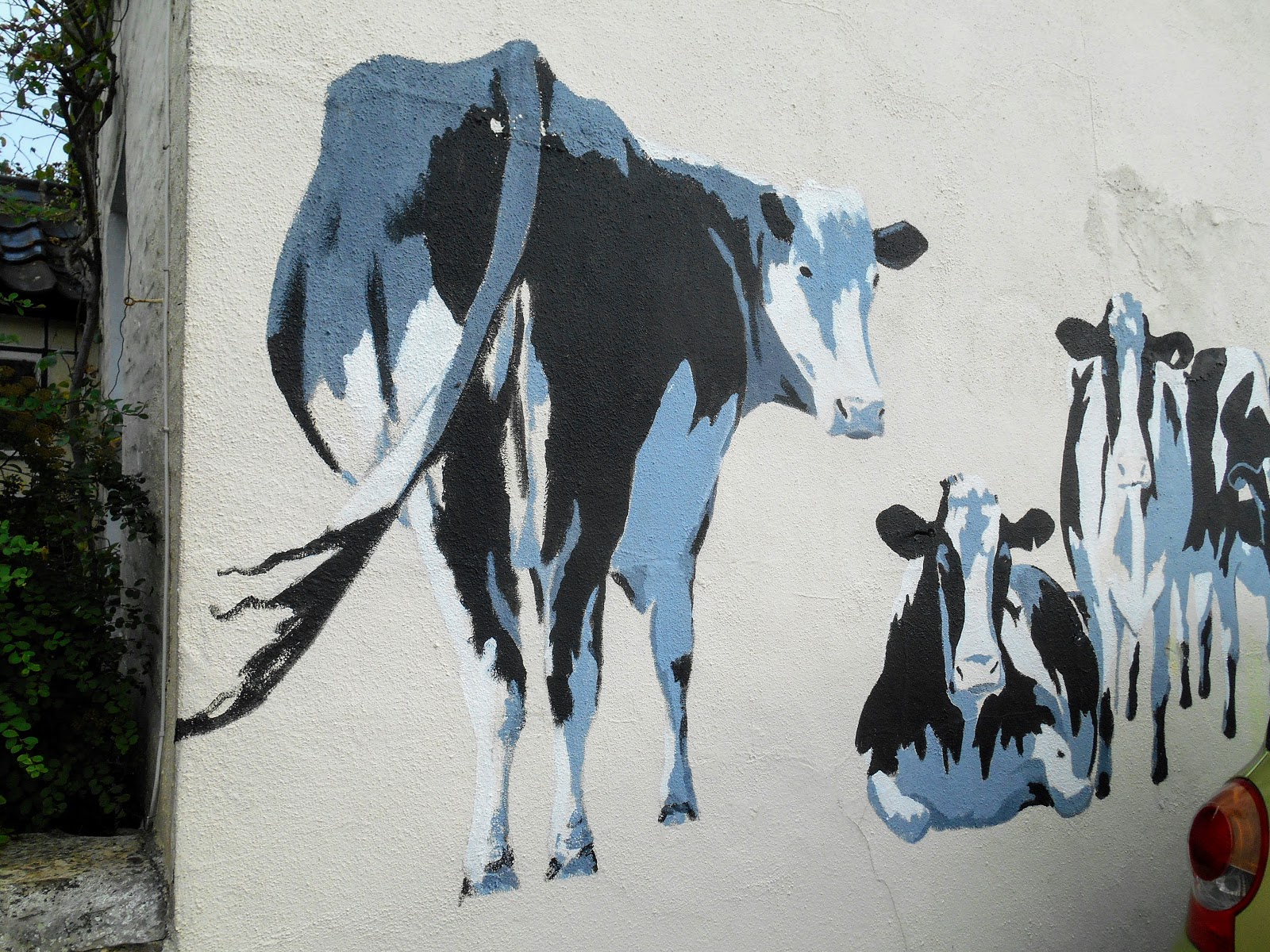
Rear end of a cow, Main Road, Middlezoy

Two more cows in Middlezoy
These 2 are located on the side of a house beside the track up to the church in Middlezoy

Cockerel on the East Coker village sign

Cockerel on the top of a signpost in East Coker

Cows on display outside Thorne's Butchers in West Street, Wiveliscombe

Wire sculpture of a goose in the garden of Coleridge Cottage, Nether Stowey

Goose in the garden of Coleridge Cottage, Nether Stowey

Colourful cows at Watchet Harbour

Colourful cows at Watchet Harbour

Memorial to Derek the goose at Splash Point, Watchet
She arrived in Watchet Harbour during a storm in 2010 and liked it so much that she stayed until her death in October 2021

A more permanent memorial to Derek the Goose at Watchet Harbour

Cow and sheep with tractor, adjacent to the 'Welcome to Wiveliscombe' sign

Cows and sheep on a kneeler in St Mary Magdalene's Church, Exford

Wilbur the Pig, Orchard Shopping Centre, Taunton
He was one of the exhibits in the 2023 Somerset Trash Trail

Four sheep (along with deer, badgers, a heron & a bird of prey) are depicted on this Platinum Jubilee seat in Somerton.

Cockerel mural by Irony on Sultan's Kebab House, Weston-super-Mare

Pickney Farm Alpacas

Pickney Farm Alpacas

Sheep kneeler, Church of St Peter & All Hallows, West Huntspill

Cows and chickens in the bus stop on the A39 at Polsham

Cows on a house at Stileway near Meare

Milking times, Stileway

Geese and chickens, Stileway

Thursday, 1 March 2018

Murder at Road Hill House, Rode

Road Hill House in the village of Rode was the scene of a murder on the night of 29th/30th June 1860. Three year old Francis Saville Kent was taken from his bed, stabbed and had his throat cut.  His body was thrown down a disused privy in an outbuilding near the house. 

Detective Inspector Jonathan (Jack) Whicher of Scotland Yard was brought in to investigate the murder.  He suspected that Constance Emilie Kent, Francis Kent's 16 year old half-sister, was probably the killer and had her arrested.  However the case was not brought to trial.

Contance Kent was born in Sidmouth, Devon in 1844.  Her parents were Samuel Saville Kent and his first wife Mary Ann. She was one of their four surviving children (6 had died in infancy).  Samuel was a factory inspector and the family lived in a number of places around southern England.  

After Mary Ann's death in 1852 Samuel married Mary Drewe Pratt, who had been his children's governess since 1843. They had four children together, including Francis Saville, who was born in 1856.  In 1855 the family had moved to Road Hill House.  Constance did not get on with her stepmother but she was close to her younger brother William.  William was suspected by some people of having been Constance's accomplice in the murder, although she always denied this.

Constance made a confession to a priest in 1865 and then confessed to the police.  However there were several anomalies in her written statement, so it is possible that she was not the murderer.  The other possibility is that the culprits were either her brother William or her father Samuel and the younger children's nursemaid Elizabeth Gough, who it was suspected were having an affair.    

Constance was found guilty of the murder and was initially sentenced to death.  Her sentence was later commuted to life imprisonment and she served 20 years in Millbank, Parkhurst, Woking and Fulham Prisons. 

Constance was released in 1885 at the age of 41.  She emigrated to Australia in 1886 to join her brother William in Tasmania, where he was working as a marine biologist.  She changed her name to Ruth Emilie Kaye and trained and worked as a nurse in Victoria and New South Wales until her retirement in 1932.  She died in Australia in 1944 aged 100.

Kate Summerscale has written a book about the case, which is titled The Suspicions of Mr Whicher.  This was also the title of a series of BBC films about the career of Jack Whicher (played by Paddy Considine), the first of which was about the murder at Road Hill House. 

Road was a village in Wiltshire at the time of the murder.  It has subsequently changed its name to Rode and in 1937 it was moved into Somerset.  Road Hill House is now called Langham House.  The current owners obviously value their privacy, as it is shielded from view at the front by a very tall dense hedge.  It is possible to see the side and back from a public footpath.

Side view of Road Hill/Langham House
 
Outbuildings at the side of Road Hill House
 
Rear View of Road Hill House
 
Front gates of Road Hill/Langham House

Thursday, 15 February 2018

David's Beacon, Thorn Hill, Thornfalcon

David Small was a local farmer who lived in Thornfalcon all his life.  He served as a parish councillor on Ruishton and Thornfalcon Parish Council for many years and was chairman of the parish council for a while.   Very sadly he died aged 60 in November 2002 as a result of an accident on his farm.

Earlier in 2002 Mr Small and the parishioners of Thornfalcon had erected a beacon on the top of Thorn Hill, Thornfalcon to commemorate the Queen's Golden Jubilee in May 2002.  The beacon is still in place, although it currently rather rusty and has several holes in the bottom of it and so it wouldn't contain a fire very well at the moment.  There is a plaque on the beacon, naming it as David's Beacon.

Although not very high (77 metres), Thorn Hill is visible for miles around, as the land to the north is generally flat and low lying and the hill is topped with a distinctive plantation of trees.

David's Beacon looking north towards Creech St Michael
 
David's Beacon
 
Looking north from the top of Thorn Hill
 
Plaque on David's Beacon
 
Memorial Bench
Looking north east from the top of Thorn Hill
The bench is in memory of Andrew Boyes of Creech St Michael, who died in 2000 aged 25
 
Plantation on the top of Thorn Hill

Thursday, 1 February 2018

Willett Tower, Elworthy, Brendon Hills

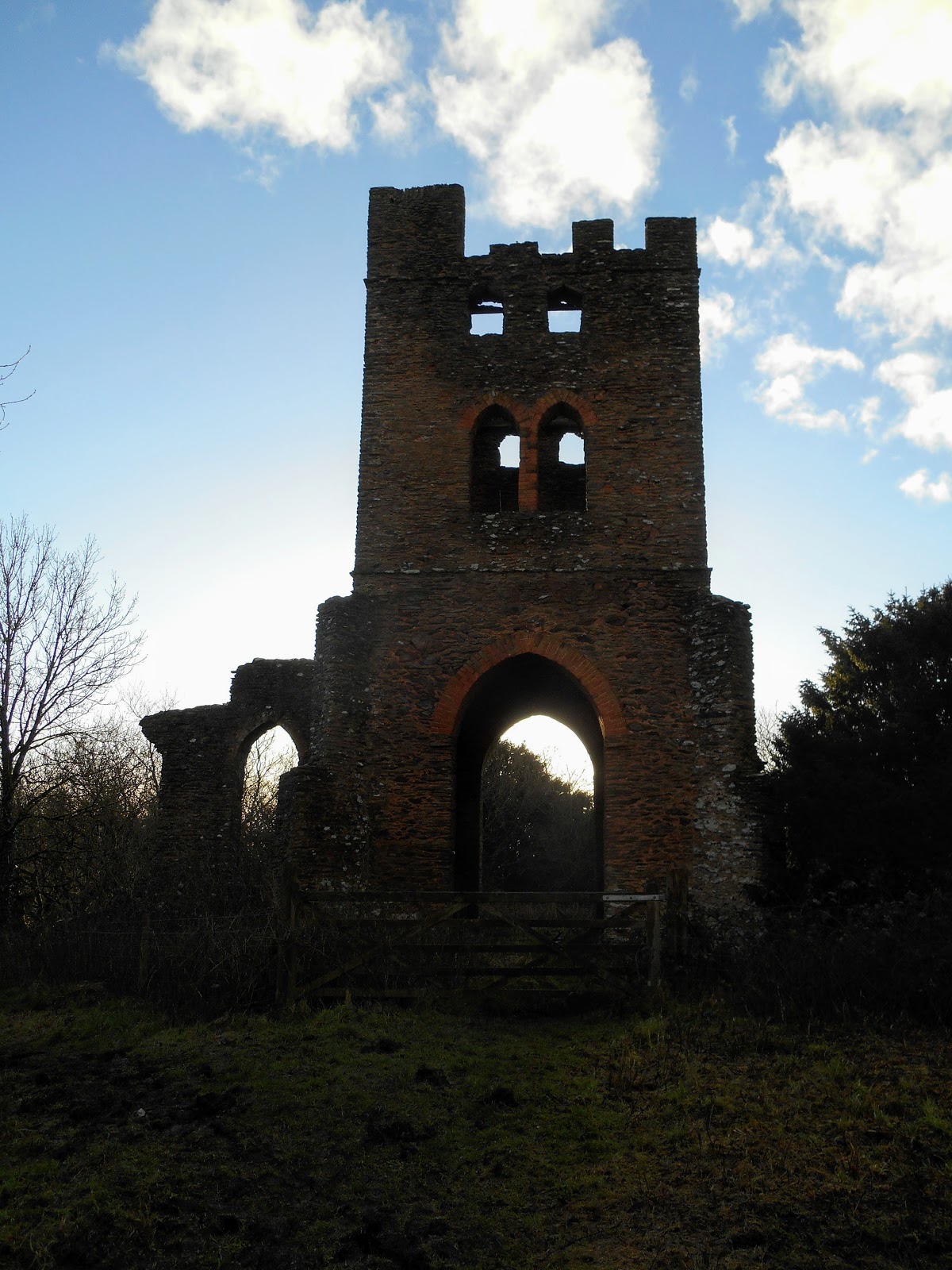
Willett Tower is a 15 metre high roofless folly located in the parish of Elworthy in the Brendon Hills.  It stands on the top of Willett Hill at a height of 280 metres above sea level.  Today it is surrounded by a Forestry Commission plantation but this would not have been there when it was first built.  The tower can be seen from a number of places on the south west facing ridge of the Quantock Hills to the north east.  However it isn't so easily seen from elsewhere on the Brendon Hills, as most of the land to the west is much higher than Willett Hill.

It is not known for certain when Willett Tower was constructed or for whom.  It was probably built c1774 at a cost of £130.  James Bernard, Lord of Crowcombe Manor contributed £80 of this and the rest was raised by a public subscription.  James Bernard had a number of follies built in the grounds of Crowcombe Manor. 

Some sources say that Willett Tower was built c1820 for Daniel Blommert of nearby Willett House, possibly by the architect Richard Carver.  However in his book History and Antiquities of the County of Somerset, which was published in 1791, Collinson said that the tower had been erected a few years earlier, which fits with the 1774 date or with 1782, which is the date suggested in the Victoria County History of Somerset.

There are signs inside the tower that it once had an internal wooden staircase, which would have enabled it to be used as a prospect tower but this has long since disappeared.  There is a wing jutting out on the south side of the tower with a window.  It is not known if this wing once extended further to form a nave or if it was a purely decorative feature.  There may once also have been a wing on the north side but this is no longer standing.

There is a small parking area at the western side of the B3224 and at the northern tip of the Willett Hill Plantation.  There are no public footpaths or bridleways through or around the plantation but neither are there any "keep out" notices, so I presume the access is permissive.  The Forestry Commission notice at the parking area just says "Shooting let.  Please keep dogs on leads". From the parking area it is possible to follow any of a number of tracks and paths, which wind their way up and around the hill.  However there are no signposts to the tower and we must have missed a turn off the main track, as we ended up walking round to the south west side of the hill before we eventually found a track leading to the tower.  There is usually at least one car in the parking area whenever I drive by it and I suspect that most of the visitors are local dog walkers.  The tower itself is fenced off but you can get to within about 10 metres of it.

Grid reference: ST 095 335

Willett Tower in the winter sunshine
 
Willett Tower
 
South side of Willett Tower and adjoining wing with window
 
Willett Tower looking west
 
Willett Tower in silhouette
 
Willett Tower through the trees

Thursday, 11 January 2018

St Dunstan

Dunstan was born in Baltonsborough c909 AD.  His parents were Heorstan and Cynethryth. He was educated at Glastonbury Abbey and then joined the household of his uncle Athelm, who was Archbishop of Canterbury from 923 or 925 to January 926.  Dunstan later joined the court of King Athelstan but was expelled from it in 935 after being accused of practising black magic.

Dunstan took monastic vows, was ordained as a priest by Elphege the Bishop of Winchester and then returned to Glastonbury where he lived as a hermit where he painted,  embroidered and made things out of metal.  In 939 Edmund I became King of Wessex and Dunstan was recalled to court.  Edmund made him Abbot of Glastonbury in c943.  Dunstan encouraged the restoration and increase of Benedictine monasticism in England. 

King Edmund was killed in a fight at Pucklechurch near Bristol in May 946 and was succeeded by his younger brother Eadred.  Dunstan had a privileged place in the royal court as one of the king's advisors.

When Eadred died at Frome in November 955, Eadwig, eldest son of Edmund I, became king. Dunstan clashed with Eadwig, who forced him into exile at Ghent in modern day Belgium.  While he was there he studied continental monasticism. 

Dunstan returned to England in 957 when England was divided up between Eadwig and his younger brother Edgar. Eadwig ruled the area to the south of the River Thames and Edgar ruled the area to the north.  Dunstan was made Bishop of Worcester in 957. Eadwig died in October 959 and Edgar ruled over the whole of England from then onwards.  

Dunstan was made Bishop of London in 959 and Archbishop of Canterbury in 960.  He restructured and reformed many abbeys and the Church in England.  Edgar died in 975 and was succeeded by his eldest son Edward but he was assassinated at Corfe Castle in March 978.  Edward's brother Æthelred became king but by this time Dunstan was getting old and he retired to Canterbury where he continued to preach and teach up until his death.

Dunstan died on 19th May 988 and his feast day is 19th May for this reason.  He was buried in Canterbury.  He was made a saint soon after his death and was greatly venerated.

Stone marking the place where Dunstan was born in Ham Street, Baltonsborough
 
"Here stood the beehive or cob cottage, the traditional birthplace of St Dunstan 909-988
This stone was carved by Jenny Cox on a medieval roof boss from Glastonbury Abbey and placed here in 1988"

Stained glass of St Dunstan in All Saints Church, Selworthy
 
St Anne, St Barnabas and St Dunstan Window, All Saints Church, Selworthy

St Aldhelm, King Alfred and St Dunstan window
St Peter & St Paul's Church, South Petherton
This window was given in memory of Hugh Ruscombe Poole (1848-1918) and Mary Eveline Poole (1857-1916) by their children in 1925. Below the figures Sherborne Abbey (St Aldhelm was Bishop of Sherborne), Burrow Mump (associated with King Alfred) and Glastonbury Abbey (St Dunstan was Abbot of Glastonbury).

Edgar Window, Bath Abbey
This stained glass window shows Dunstan, as Archbishop of Canterbury, crowning Edgar as the first King of All England in the Anglo-Saxon Abbey in Bath on 11th May 973.  The words that Dunstan wrote for Edgar's coronation service remain the basis of coronations today.

Banner in St Dunstan's Church, Baltonsborough

Monday, 1 January 2018

The Lost Village of Clicket

The Lost Village of Clicket is located on a public footpath, which runs along a damp and dark valley bottom parallel to an unnamed stream between Luxborough Churchtown and Timberscombe.  It is very easy to miss, as there are no information boards and the various ruins of houses, a farm, a mill, quarries and limekilns are very overgrown, particularly in the summer months. 

Clicket was never a large settlement and the various buildings which made up the "village" were scattered along the valley bottom.  Bickham's Mill (also called Beckham Mill) was located to the north east of Clicket on the east side of the valley.  Thorn Farm, which is now ruined, was further up the eastern side of the valley to the east of Bickham's Mill.  Thorn Farm and Bickham's Mill may date from the medieval period.  The village of Clicket may have existed as early as the 14th century but it doesn't definitely appear in records until 1809.

In the 1851 Census there were 14 people living in Clicket in four families called Cole, Tarr and Williams (2 families). In 1861 the population of Clicket was 15: there were four families - Williams, Tarr and Webber (x2).  Clicket was not listed separately in 1871 but in 1881 there were 20 people listed as living there in three families - Webber (x2) and Hole.

The last baby to be born at Clicket was Lily Burge (later Bryant), who was born in 1889 (she died in 1977 in Bristol).  In 1890 Clicket was abandoned because there was no employment left (the quarry and mill had closed), farming was in a depression and with no road access the village was too inaccessible.

Ruined house at Clicket in December 2017
 
Ruined house in Summer 2015

Ruined house in December 2017

Miscellaneous ruins

More ruins

I think this is the remains of a lime kiln close to the disused Nurcott Quarries to the south of Clicket

Wall - not sure to what it once belonged

Packhorse Bridge in December 2017
 
The same bridge in Summer 2015

Ruins of Bickham's/Beckham Mill

Bickham's Mill, December 2017

Snowdrops at Bickham's Mill, February 2022

Not so lost after all!

Sunday, 31 December 2017

Funny Gate, Stowborrow Hill, Quantock Hills

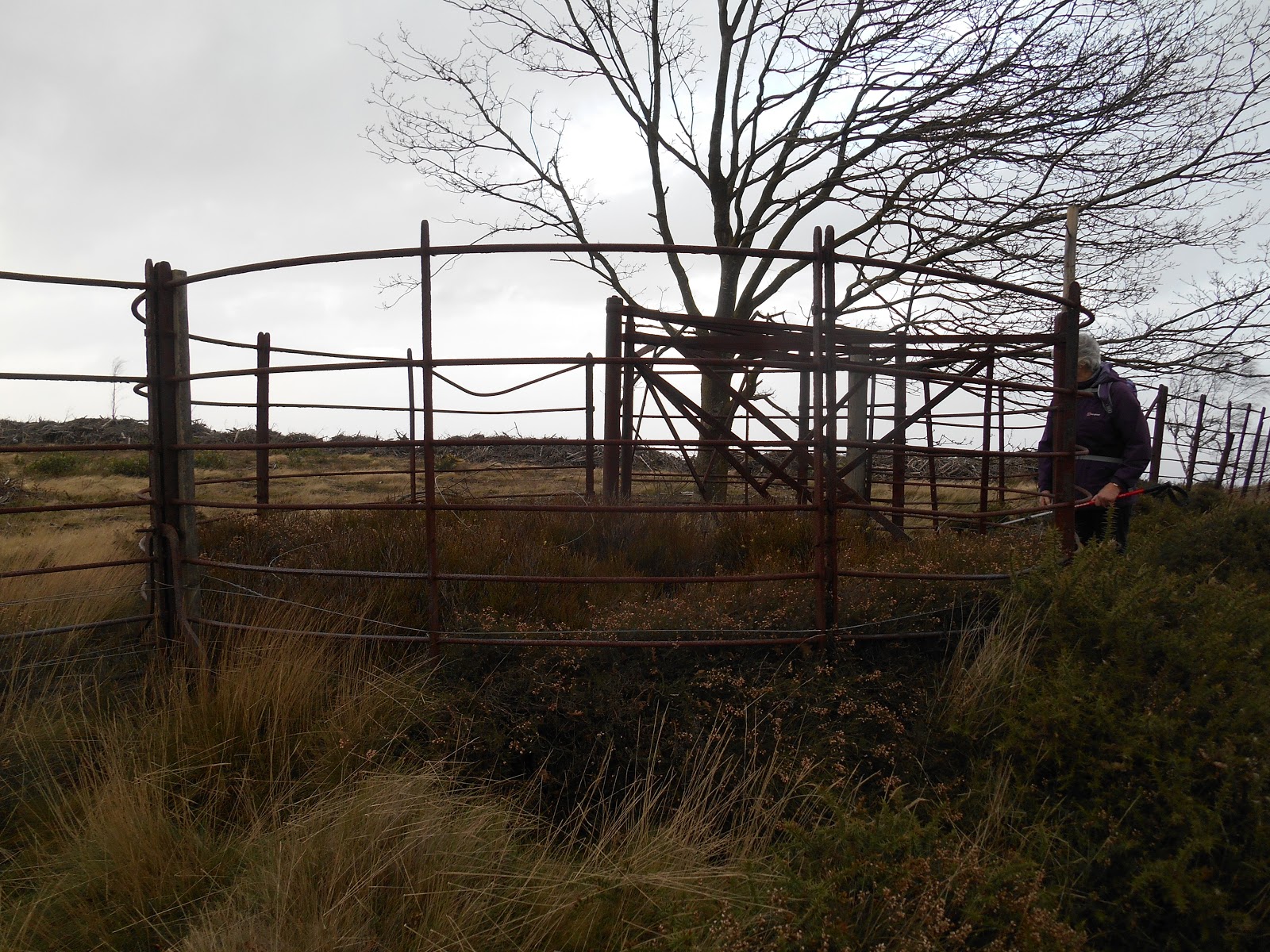
On top of Stowborrow Hill at the northern end of the Quantock Hills there is a tall old disused circular rusty wrought iron gate.  It is not marked on any modern map that I have found but is apparently known locally as "Funny Gate".  I am reliably informed that it has been in a dilapidated state for at least 50 years.  According to the Somerset Historic Environment Record it was probably erected in about 1850 when the adjacent deer park was enlarged.  Whoever wrote the entry in the Somerset HER didn't entirely understand how it worked but it seems to have had a revolving quadrant with various different modes for allowing animals through or retaining them within the enclosed area in the middle or preventing them from entering or leaving the deer park at all.  Presumably it was used when animals needed to be sorted out for any reason?   The diameter of the circular section is 3.5 metres and it is 1.8 metres high.   Grid reference ST 120 416

I am also informed that there is a working example on the Chatsworth Estate in Derbyshire.  However I have not been able to find anything online about this gate.

Funny Gate
 
Funny Gate
 
Funny Gate