Friday, 7 August 2015

Windmills

At the time of the Domesday Book there were about 370 mills in Somerset but these were all driven by animals or were water powered.  Only Norfolk and Lincolnshire had more mills at this time.  The earliest reference to a windmill in Somerset was at Seavington near Ilminster in around 1212.  References to windmills became more common from the 13th century onwards.  Many of the early windmills were erected on land which belonged to Glastonbury Abbey e.g. the Polden Hills, which had good soil for growing corn.  

The earliest windmills were post mills.  These continued to be used until the 19th century.  Bishops Lydeard church has a 15th century carving of a post mill on a wooden bench end.
Post mills consist of a timber body containing the machinery and carrying the sails, which pivots around a single massive vertical timber post, so that the sails can be turned to face the wind. The post is held in position by 4 diagonal quarter bars, which are in turn fixed to 2 timbers known as cross trees at ground level.   Post mills were often set upon specially constructed artificial mounds or sometimes made use of existing round barrows (ancient burial mounds).
In the 16th century the power of the abbeys and manors began to decline and many windmills were abandoned.  By the early 18th century tower mills were replacing post mills in Somerset.  They were more stable than post mills and also had more storage and working space in them. In a tower mill only the cap and sails had to be turned to face the wind.  In many cases the tower mills were built on sites that had previously been occupied by post mills. 
Many of Somerset's windmills ceased to be used by the mid-19th century. After the repeal of the Corn Laws in 1846, cheap grain imports from the Americas flooded the market and prices dropped.  Imported grain was milled close to the ports where it arrived in the country. The decline in Somerset’s windmills was accelerated by a move away from arable to pasture and a series of bad harvests in the 1870s. 
No post mills have survived in Somerset to the present day. Only 2 windmills in Somerset today are in working order - Stembridge Mill at High Ham, which is owned by the National Trust and Ashton Windmill at Stone Allerton, which is owned by Somerset Council.  Both are open to the public on certain days.   The truncated remains of tower windmills can be seen at Walton, Watchfield, Uphill, Worlebury, Portishead, Felton, Locking, Brockley Wood, Hutton, West Monkton and Weare.  Replica windmills have been constructed at Kenn and Windmill Hill near Ashill.
Ashton Windmill, Stone Allerton

Ashton Windmill, Stone Allerton
The earliest reference to a windmill on this site on relatively high ground near Wedmore was in 1317.  The mill was rebuilt in 1549.  The current tower mill was built between 1760 and 1774.  The cap was originally thatched.  The last miller was John Stevens, who bought the mill in 1887 and owned it until his death in 1938.  Auxiliary power was added by a steam engine in 1894.  In 1900 Ashton Mill was refitted with gear taken from the tower mill at Moorlinch, which was being demolished.  At the same time 3 iron hoops were put round the tower to strengthen it.  Parallel sided towers are weaker than those with tapered walls. In its later years the mill was used only to grind animal feed and it stopped working altogether in 1927.  It was used as a Home Guard post during the Second World War.  It fell into disrepair but was restored in the 1958.  It was cared for by Bristol Museum from 1966 but needed to be restored again in the 1970s.  It is now owned by Somerset Council.  More information about it can be found here: 

 Stembridge Mill, High Ham

Stembridge Mill, High Ham
The current tower mill was built in 1822 but replaced an earlier mill, which stood nearby.  The tower is built of blue lias stone and it is the last windmill in England to have a thatched cap, a feature which used to be common in Somerset.  The mill worked until c1897-8 when the cap jammed.  After this time it was powered by a steam engine but the mill ceased working commercially in 1908.  The windmill was acquired by the National Trust in 1969.  It was restored most recently in 2009.

Walton Windmill
There was a post mill at Walton in around 1342.  A tower mill was built, possibly on the same site c1741.  This mill was rebuilt c1797.  It had 4 sails.  The last miller was Charles Phillips, who ran a bakery and grocery business from the mill until c1906.  In 1926 it was converted into a house by Rev G.M. Evans of Westonzoyland.  The tower was heightened to form a parapet and look out platform.

Weare

Weare tower mill was probably built around 1760.  It stopped working in around 1880 and in 1910 the mill and miller's cottage were incorporated into a new house.

Replica windmill at Windmill Hill, Ashill
There was probably originally a real windmill on this site but this isn't it!

Watchfield Windmill
Watchfield tower mill was built of lias blocks in around 1817 and worked for almost 100 years until c1914.  It had a thatched cap and or much of its working life it was worked by 3 generations of the Spearing family.  In the 1890s a steam engine was brought in.   It was converted into a house.  When I visited in August 2015 it was very difficult to see the mill from the public road.

Burlinch Mill, West Monkton

Burlinch Mill in West Monkton parish was marked on the 1st edition Ordnance Survey map in 1817.  It was probably in use until around 1880.  It is located in the middle of a plantation of trees but the trees were not planted until c1840.  The ruins of the vertical sided tower can be seen from the public footpath that runs WSW from Coombe Bottom to Burlinch Plantation. Grid reference: ST 265 294. 

Burlinch Mill, West Monkton

Woodball Cottage Windmill, West Monkton
The tower of this former windmill has been incorporated into the house.  You can just about make it out on the left hand side of the photo.

Bench end in Bishops Lydeard Church depicting a post mill

Bench end in North Cadbury Church depicting a post mill

St George's Church, Bicknoller
This window, which features a post mill, was given in memory of Violet Lena Vernon (1872-1935) by her husband and sons in 1936.

Windmill Hamlet, Stoke St Gregory
There is a road/hamlet at the south east end of Stoke St Gregory called Windmill.  Presumably there was once a real windmill there but no longer.  The hamlet of Windmill is, as you can see, twinned with Utopia!

The Observatory, Worlebury Hill

A windmill was first recorded at the east end of Worlebury Hill in 1760.  In 1870 an advertisement was placed for the sale or rent of the windmill and its associated bakery business.  However it was converted into an observatory not long after and a parapet was added.

Replica Windmill, Kenn

A three storey windmill with a thatched cap was built at Kenn in 1821.  By around 1883 wind power was being supplemented by a steam engine.  The windmill had stopped working by 1900.  It was used as a Home Guard lookout during the Second World War.  The ruined tower survived until 2003 when it was demolished during the building of Kenn Business Park.  A replica mill tower was built on Windmill Road.


Uphill Windmill

The windmill on Uphill Hill was probably built in the 1780s.  It was derelict by 1829.  The tower was rebuilt with a castellated top and internal spiral staircase in 1934 so it could be used as an observation tower.  It is still in use for this purpose

Portishead Windmill

Portishead Windmill was built by John Nesbitt in 1832.  However it had stopped working by 1846 because it was unable to compete with a steam driven mill in the town.  Around 1848 the machinery was removed and the mill tower was converted into additional living accommodation for the tenants of Mill Cottage.  When a golf course was laid out around it in 1908 the tower was incorporated into the clubhouse.  It is currently an integral part of the Windmill Inn public house.

Broadfield Mill, Felton Common

Broadfield Mill on Felton Common was located on the top of a hill, 190 metres above sea level.  It is not known when it was built but it ceased to work late in the 1880s and was converted into a house soon afterwards.


Vale Mill, Locking

Vale Mill on Moor Lane at Locking was built in around 1813. The windmill stopped working between 1906 and 1910.  It stood empty but intact until it was gutted by fire in 1962.  It remained derelict until the late 1960s when it was incorporated into a new house.

It is not known when Brockley Wood Windmill was built but it was in ruins by 1829.  Part of the tower is still standing deep in the heart of Brockley Woods.

Hutton Windmill was probably built in the early 19th century.  It had stopped working by 1864 and was derelict by the 1920s.  It was rebuilt and used a Royal Observer Corps Post during the Second World War.  It is now located in the garden of a private house on Windmill Hill.

Further Reading:

Windmills of Somerset and the Men who Worked Them: Alfred J. Coulthard and Martin Watts, published by The Research Publishing Co. in 1978.

Somerset Windmills: Martin Watts, published by Agraphicus in 1975

Monday, 3 August 2015

Village Stocks

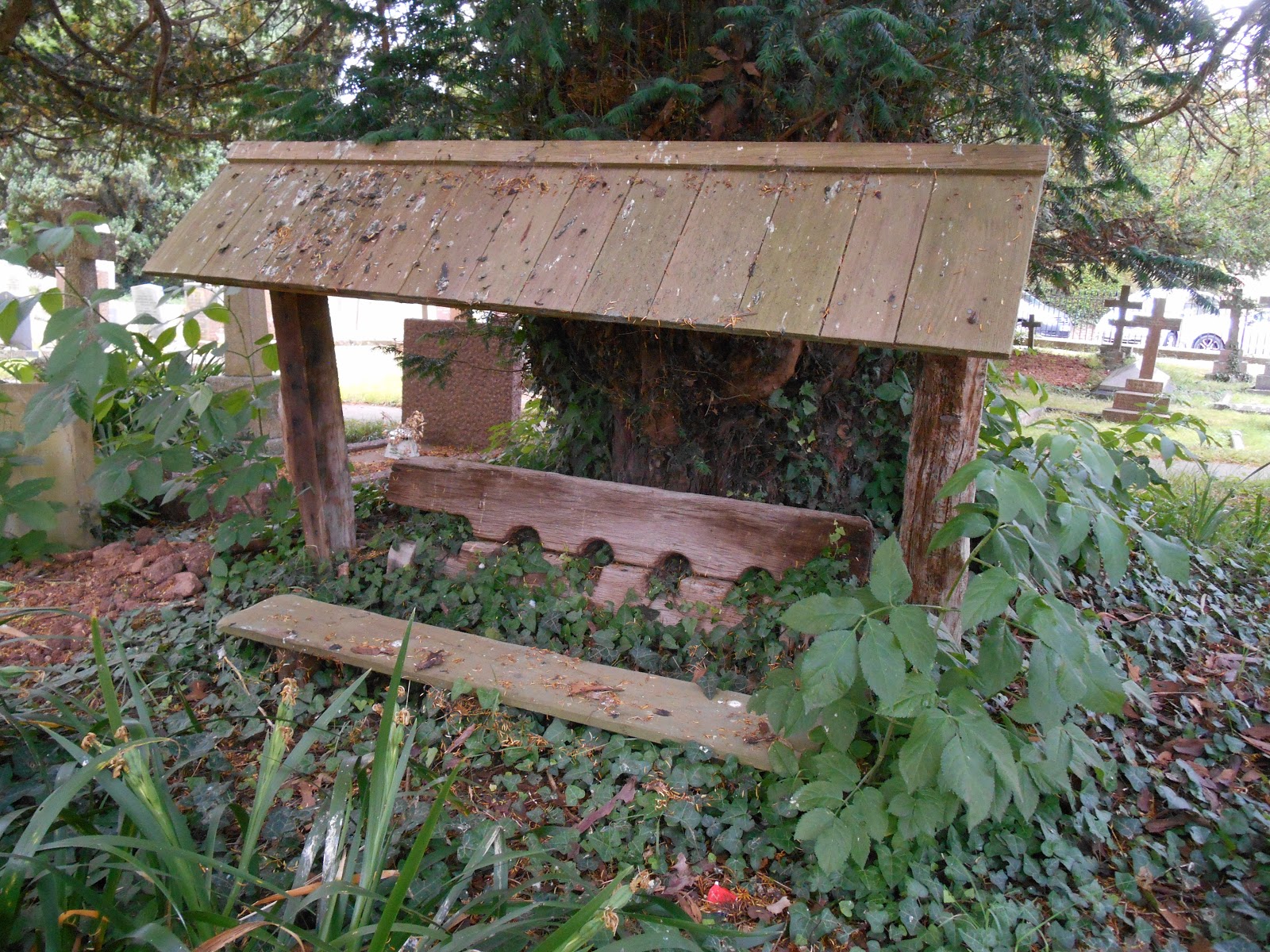
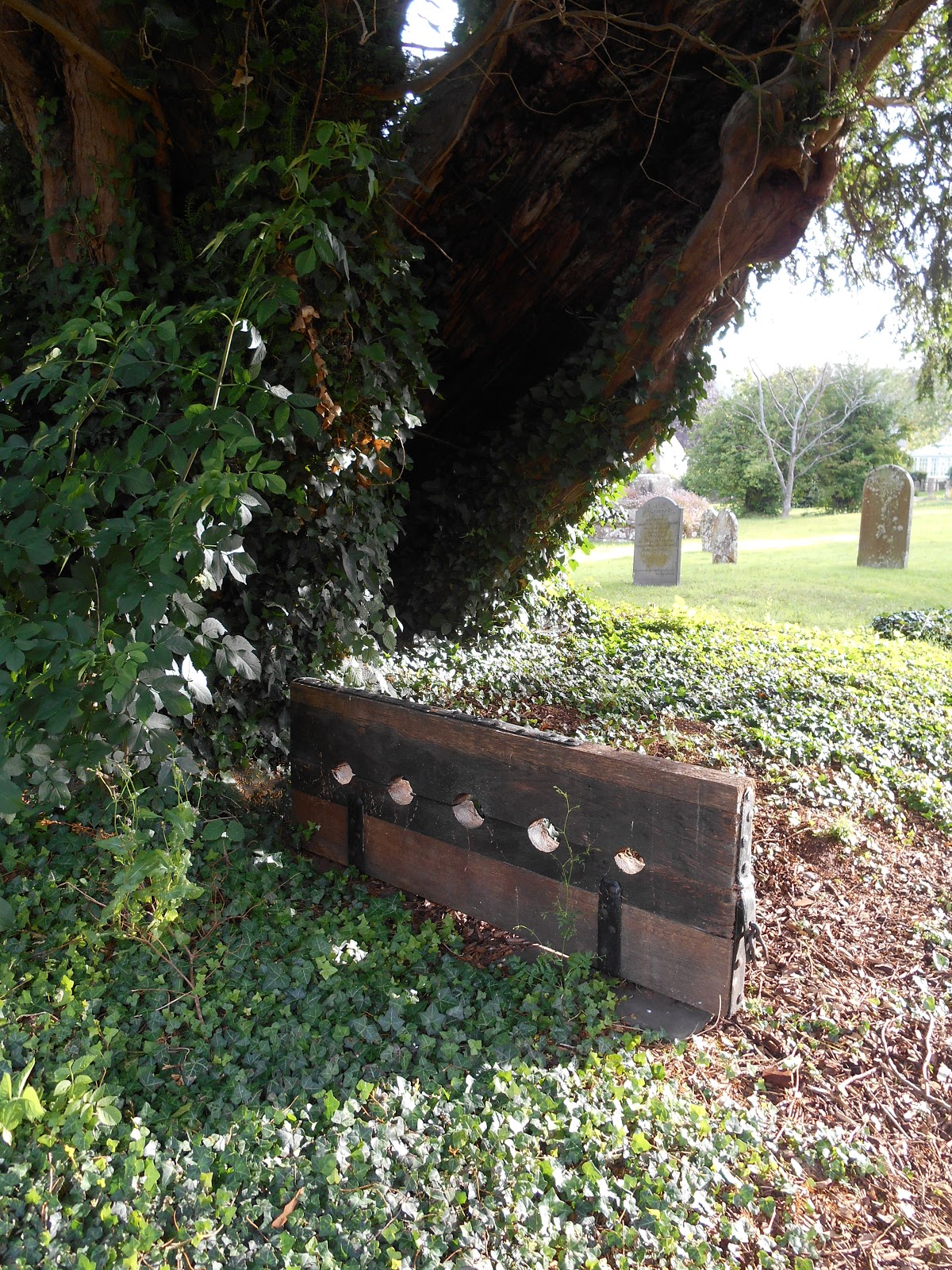
Stocks were a form of punishment by public humiliation.  They were used to punish petty offenders.  The culprit's ankles and sometimes wrists were locked into the wooden stocks and they were left there for passers-by to ridicule them.  In England they were probably first used in Anglo Saxon times but became widespread after a statute was passed in 1351, which made it compulsory for every village to provide and maintain a set. The stocks survived as a form of punishment until the mid 19th century.  Some sets of stocks originally also had whipping posts next to them.  These were vertical posts with iron clamps to hold an offender's wrists while he or she was whipped.

Only a few sets of stocks have survived into the present day in Somerset and most of these are to be found in churchyards, with the rest located mainly on village greens.  Most of the surviving stocks in Somerset are also to be found in the Taunton area.  Why this should be I don't know - were the people in the Taunton area less law abiding than elsewhere?


 Trull Churchyard, Taunton

 Stoke St Gregory Churchyard
 West Monkton Churchyard, Taunton

 Thurloxton Churchyard - half a set of stocks

Creech St Michael Churchyard, Taunton - under a yew tree

 Brushford's stocks are high up on the wall in the church porch


Bicknoller Churchyard at the foot of the Quantock Hills

St Giles Church, Bradford on Tone

The stocks at Faulkland are flanked by 2 enormous standing stones

North Cheriton - outside the entrance to St John the Baptist Church

Martock's stocks are kept behind bars!
 
Catcott's stocks are mounted on the wall in the church porch
 
 Under a yew tree in St George's Churchyard, Wembdon

Skilgate's stocks are mounted on the wall in the church porch

Tintinhull village green

One set of a stocks does look much like another!  

Other sets of stocks can be seen at Wambrook and Templecombe.

Friday, 24 July 2015

Mary Rand's Long Jump Olympic Gold Medal, Wells

Mary Denise Rand (nee Bignal) was born in Wells in 1940.  In 1964 she won a gold medal in the long jump at the Tokyo Olympic Games.  She jumped 22 feet 2 1/4 inches (6.76 metres) and was the first British woman to win an Olympic gold medal in track and field.

Mary Bignal attended Millfield School in Street where she began to show great promise in the long jump, hurdles and high jump.  She won a silver medal in the long jump at the 1958 Commonwealth Games and came fifth in the high jump. Later the same year she came seventh in the European Pentathlon Championship.  At the Rome Olympics in 1960 she set a British record of 6.33m in the qualifying round of the long jump.   However in the final two of her three jumps were disallowed and she finished ninth. She also finished fourth in the 80m hurdles. She won a bronze medal in the European championship long jump in 1962.  She married rower Sidney Rand in 1961 but they divorced in 1966 and she remarried.

At the Tokyo Olympics in 1964 Mary Rand set an Olympic record in the long jump in the qualifying rounds, jumping 6.52m. In the final she beat the world record holder Tatyana Schelkanova of the USSR. Her first jump of 6.59m was a British record. However in the fifth round she jumped 6.76 metres and broke the world record. Her record lasted four years until it was broken by Viorica Viscopoleanu at the 1968 Olympics in Mexico City.    She also won the silver medal in the Pentathlon with a British record 5035 points, finished fourth in the 80m hurdles and won a bronze medal in the 4x100 metres relay. 

Mary won a gold the long jump at the 1966 Commonwealth Games.  She failed to make the 1968 British Olympic team due to injury and retired from sport in September 1968.

Mary Rand was awarded an MBE in the 1965 New Year's Honours List and she was voted BBC Sports Personality of the Year for 1964.  In 2012 she was awarded Freedom of the City of Wells.  She currently lives in the USA.

Her winning jump in Tokyo is commemorated in the Market Place at Wells by a plaque, which is the length that she jumped.  She also has a road in Wells named after her.


Plaque in Market Place, Wells


Bignal Rand Close, Wells

More information about Mary Rand's athletics career can be found here: http://www.britishathletics.org.uk/e-inspire/hall-of-fame-athletes/mary-bignal-rand/ 

Monday, 20 July 2015

Pet Memorials

Kingston St Mary

This memorial to what appears to be a family's eclectic set of pets is built into the side wall of the Kingston St Mary Church Car Park. It is on the right hand side as you enter the car park.   I have no idea how it came to be there, to which family the pets belonged, when they died or if they really existed.  I can find nothing about it online.


The inscription reads:
IM
Polly for 30 years 
Parrot in the family 
Katty an Irish Hunter
Pips a monkey
Willie a Lemur
Rikky Tikky a Mongoose

No dates or house name are given.  I presume that the animals did not all die at the same time, unless there was a house fire that killed them all at once.  I presume IM on the stone stands for In Memoriam.  I assume it must have been a wealthy family to have owned such exotic pets as a monkey, a lemur, a mongoose and a parrot.  Any information about this memorial will be gratefully received. 


Keinton Mandeville

This memorial to the Reverend Whitehead's faithful dog Wallace is located on Common Lane in the village of Keinton Mandeville.  It reads:

"In memory of Wallace, the faithful dog of Rev Whitehead 1859-1941." 

Reverend Arthur Whitehead was the vicar of Keinton Mandeville from 1892-1941.  Wallace's dates of birth and death are not given and neither is his breed.   Apparently Rev Whitehead was blind, so maybe he relied on Wallace as a kind of guide dog?  The memorial was originally a drinking place for dogs but when we walked by in September 2015 the bowl at the bottom was full of leaves.

Wallace's memorial plaque
Keinton Mandeville - Memorial to Wallace

Dunster

Dunster Castle has a large pet cemetery.  Most of the animals are named and their years of birth and/or death are given but in most cases it doesn't same what type of animal they were. I presume that most of them were dogs or cats but at least one was a budgie.

Dunster Castle's Pet Cemetery

Graves of Jock,  Jo (budgie) and Charity (beagle)

Graves of Screw, Morag (Scottie dog), Kirstie etc

Graves of Bessie (retriever), Roger (retriever) and Connaigh

Outside the grounds of Dunster Castle is this memorial to Jig-saw, beloved pony of A.L., died 1968 aged 29.  A.L. was Alys Luttrell and Jig-saw was her polo pony.

Jig-Saw's Memorial Stone, Dunster Castle

Lytes Cary

There is a small pet cemetery at the National Trust property of Lytes Cary.  It is difficult to see the graves, as they are behind one side of a hornbeam tunnel.  The graves are those of the pet dogs that belonged to Sir Walter Jenner (owner of Lytes Cary from 1907-1948) and the Chittenden family (tenants from 1955 until 2003).

Gravestone commemorating Mus (1917-1922) and Micky (1929-1944)

Gravestone commemorating Satchmo (1982-1996)

Pet cemetery at Lytes Cary

Pet Cemetery, Parade Gardens, Bath

Pet Cemetery, Parade Gardens, Bath

Tuesday, 14 July 2015

Stonegallows, Bishops Hull, Taunton

This stone marks the spot where Taunton's gallows once stood.  They were located at the boundary of the parishes of Bishops Hull, Trull and Wilton.  This was Taunton's execution site from 1575 until 1810.  The origin of the name Stonegallows is not certain.  It may have been named after a large boulder stone nearby.  Alternatively the uprights of the gallows may have been made of stone or it could have been named thus because it stood on a 'stoned' or main road.

In 1615 the parishioners of Bishops Hull were obliged to rebuild the gallows with timber supplied by the parish of Trull.  The first recorded execution at Stonegallows was of Peter Smethwick, Andrew Baker, Cyril Austen and Alice Walker who were executed for murdering and dismembering the curate of Old Cleeve on 24th July 1624.  Many others were executed here over the following centuries.  On 15th April 1801 nine men from various villages were hanged here for burglary and theft of sheep, cows, bread and wheat.  It is believed that there were two more hangings here: James Taylor in 1809 for shooting John Dyer and wounding another man.  The last hanging is thought to be that of 18 year old Thomas Gage, alias Tarr, in 1810 for murdering Elizabeth Stylings of Goathurst.  The gallows were probably removed in 1814 in response to public protests about them.

The quiet residential road the stone stands in (grid reference ST 199 238) is called Stonegallows for obvious reasons.  The houses here are large and lovely but I am not sure I would want to live in a road called Stonegallows!

Further reading: 

Taunton: An A-Z by Lionel Ward.  Published by Onyx Publishing in 2008

 Plaque on the stone

Stone marking the site of Taunton's gallows

Gold Post Box, Trull, Taunton

To celebrate British competitors' gold medal winning performances at the London Olympics and Paralympics in 2012 Royal Mail painted a post box in each of the gold medal winners' home towns.  The only gold post box in Somerset is located outside Trull Post Office on Church Road, Trull.  It commemorates the gold medal won by paralympian Deborah Criddle in the Team Dressage event.  She also won silver medals in the Individual and Freestyle events, all with the horse LJT Akilles.

Deborah Criddle competed in 4 Paralympics, beginning in Sydney in 2000.  She won 3 gold medals at the 2004 Athens Games in the Team, Individual and Freestyle Dressage events on the horse Figaro IX.  She was awarded an MBE in the 2013 New Year's Honours List.  She lost the use of her right arm and leg in a motorcycle accident in 1985.  Her arm was amputated in 2003.

Royal Mail painted 110 post boxes gold across the UK and a list of their locations can be found on this website:   http://www.goldpostboxes.com/ In November 2012 Royal Mail announced that the gold post boxes would remain gold permanently.

 Trull Post Office, Church Road, Trull, Taunton

Tuesday, 7 July 2015

Haddon Lodge/Pepperpot Castle, Upton

Haddon Lodge, or the Pepperpot Castle as it is now known (grid reference SS 988 287), is located on the western edge of the village of Upton in West Somerset.  It was built as the lodge to Lady Acland's Drive c1800-1805. It was enlarged in the late 20th century.  It is located at the side of a track, which was built by Lady Harriet Acland while she was a widow (1778-1815) to connect Pixton Park at Dulverton, where her daughter the Countess of Carnarvon lived, with her own estates near Wiveliscombe.

The Pepperpot Castle can be seen from the B3190, although there isn't anywhere safe to park along this stretch of the road to stop and have a good look at it.   It can also been seen from the bridleway that runs to the north of the house, although is obscured by a hedge from this direction and can only be glimpsed from the bottom of the garden.  The original building was triangular in plan, with 3 hexagonal castellated towers at the corners.

 Haddon Lodge from the B3190

 Haddon Lodge from the bridleway looking south