Wednesday, 15 May 2024

William Smith - Father of English Geology

William Smith was a civil engineer, geologist and a pioneer in the science of stratigraphy.  He drew up the first geological map of England and Wales, which was published in 1815.

William Smith was born in Churchill, Oxfordshire on 23rd March 1769. In 1787 he became assistant to the land surveyor Edward Webb in Stow-on-the-Wold.  In 1791 Webb sent him to survey the land belonging to Lady Elizabeth Jones around Stowey near Bishop Sutton.  He lodged at Rugbourne Farm in High Littleton and from 1798-1810 he lived at Tucking Mill between Midford and Monkton Combe.  He carried out underground surveys of coal mines in the area, which set him thinking about rock strata.  In 1793 he was asked to survey routes for the proposed Somerset Coal Canal.  In 1794 he was sent on a fact finding tour of the canals and mines in the Midlands and the north of England and used his site visits to further his knowledge of rock strata.

Work on the Somerset Coal Canal began in July 1795 and the excavations enabled William Smith to study the local strata.  In 1799 he began to draw up maps and cross-sections of the local strata.  After a disagreement over the construction of a caisson at Combe Hay, he was dismissed from his job as engineer with the canal company in June 1799.  

William Smith then set himself up as a land surveyor in partnership with Jeremiah Cruse at Trim Bridge in Bath.  He undertook land drainage work around Bath and Wiltshire.  From 1801-1812 he travelled all over the country for work as a land & mineral surveyor and land drainer. At the same time he collected more information about rock strata. In 1803 opened an office in London and from 1805 he displayed his fossil collection there.  

In 1812 the London-based map maker John Cary offered to publish Smith's geological map.  The first edition was published in 1815 and updated editions were published until 1819.  Sales of Smith's map dropped when a rival map was published by the Geological Society in 1820.  Smith was in financial difficulty from 1819 and spent 10 weeks in a debtors' prison.  He was forced to sell his fossil collection (to the British Museum) and personal library to pay off some of his debts.

In 1820 William Smith moved to Yorkshire and worked as a geologist with his nephew John Phillips.  In 1828 he became land steward to Sir John Johnstone at Hackness in North Yorkshire.  He produced an accurate and detailed geological map of the Hackness estate, which was published in 1832.  In the same year he was given a government pension of £100 a year and the Geological Society presented him with their first Wollaston medal in 'recognition of his being a great and original discoverer in English Geology'.  In 1834 he moved to Scarborough. He died on 28th August 1839 in Northampton while on his way to a British Association for the Advancement of Science meeting in Birmingham and was buried at St Peter's Church in Northampton.

In 1888 a plaque was erected at Tucking Mill stating that William Smith had lived there.  When the mill was demolished in 1927, the plaque was mislaid.  It was rediscovered in 1932 and re-erected outside Tucking Mill Cottage by the Geological Society and the Bath Royal Literary and Scientific Institution.  However it is now believed that he actually lived in Tucking Mill House, which is 100 metres further east.

In 2006 Sustrans commissioned the sculptor Jerry Ortmans to make a sculpture to commemorate William Smith's achievements.   His work, Stone Column, is on display on the Colliers Way to the east of the village of Wellow.  The layers are (from the top to the bottom) Chalk, Forest Marble (two blocks), Great Oolite, Inferior Oolite, Blue Lias, White Lias (two blocks), and Pennant Stone.

Plaque outside Tucking Mill Cottage

Tucking Mill Cottage

William Smith Memorial in Churchill, Oxfordshire

Stone column, Colliers Way, Wellow

Wednesday, 1 May 2024

St Andrew's Church, Old Cleeve

St Andrew's Church in Old Cleeve is a little gem and contains a great many interesting features.  There has been a church on the same site since 1066, but the current building dates from c1425-1533.

The apostle St Andrew and his brother, Simon Peter, were both fishermen.  This is why the altar frontal and the pulpit fall were both decorated with fish when I visited, although they do vary with the time of year.  The altar frontals and pulpit falls were all designed and made by parishioners.

The font and its cover date from the 15th century.  It is the only medieval font cover in West Somerset. The tiles around the base of the font were probably made by the monks of Cleeve Abbey.  Some more medieval tiles have been mounted on a board, which is hanging on the north wall of the church. The paschal candlestick located next to the font was made locally and donated to the church in the 1990s.

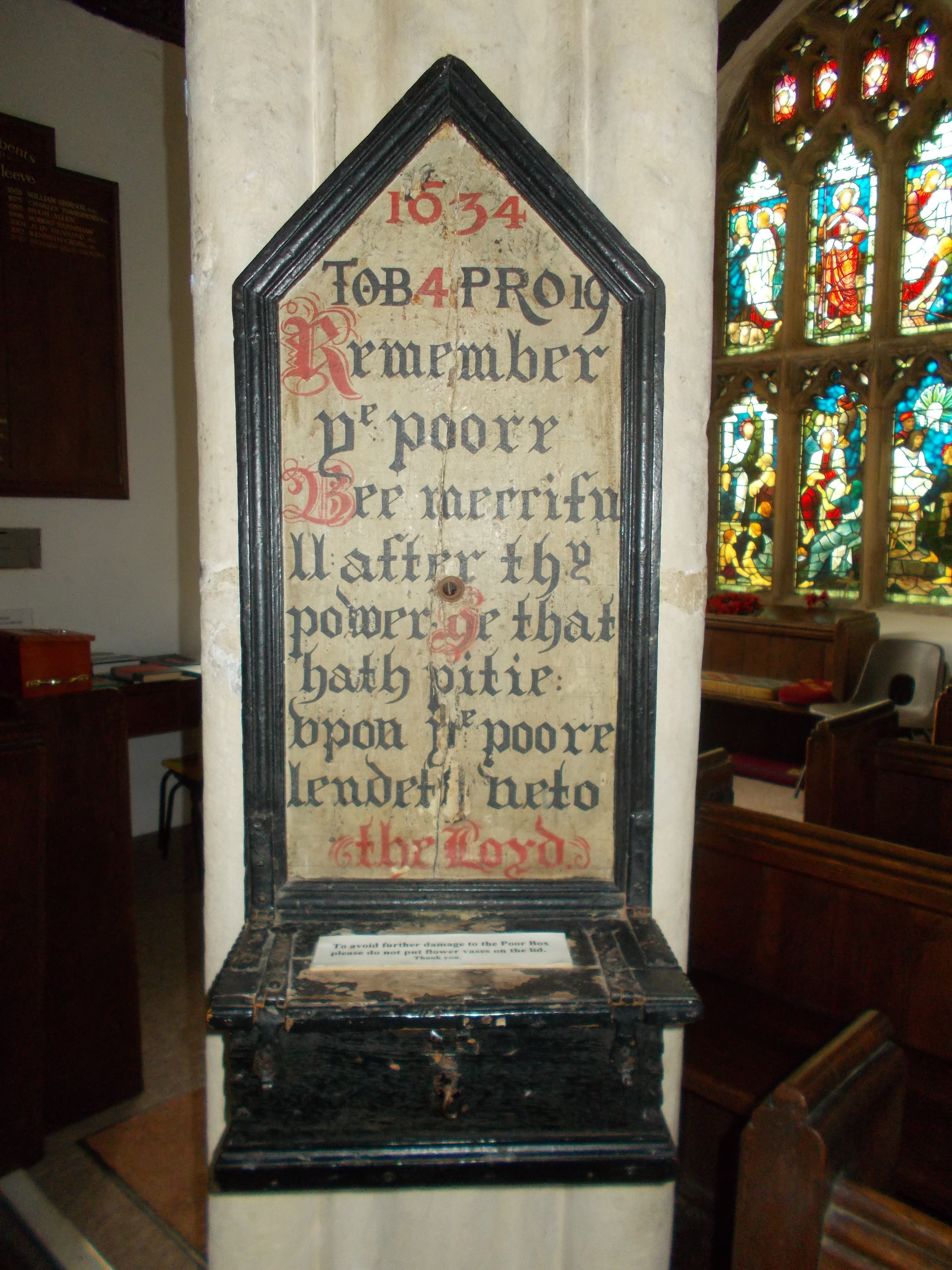
The decorative poor box is dated 1634.  The ancient wooden chest, which is made out of a hollowed tree trunk, has 3 locks on it: one for the rector and one for each of the churchwardens.

The carved bench ends were made by a parish Guild of Woodcarvers in the early 20th century, apart from one which was made by a local artist in 1981.  The nave roof has some fine medieval carved bosses.

The brass eagle lectern was given to the church in 1911 by Count Hochberg, who lived at Croydon Hall. The chandelier in the chancel was made by Thomas Bayley of Bridgwater in 1770.

There is a canopied tomb dated c1420.  It is thought to be the tomb of Sir John Golafre, who was Knight of the King's Chamber to King Richard II.  He was married to Philippa Mohun, who was heiress of Dunster.  Sir John's feet are resting on a cat, which has a rat under one of its paws.

Old Cleeve Parochial Church Council commissioned a new stained glass window to mark the Millennium.  It was designed and made by local artist Frankie Pollak.  It features an eclipse of the sun, ammonites, the churchyard pink sweet pea and the nets and fish of St Andrew.

The east window was made by Sir Ninian Comper in 1951 and was given in memory of members of the Lysaght family of Chapel Cleeve.  The west window was donated by the Vibart family, who lived locally, in memory of several members of their family who died in the Cawnpore Massacre in India in 1857.  The window was restored in 2021.

In 1974 Rachel Reckitt and Jim Horrobin were commissioned to make a tower screen for St Andrew's Church.  Four fibre-glass panels were painted with the patron saints of the churches in the same benefice.  Three large angels are arranged above the screen.

The church currently has a ring of 8 bells.  There were originally 3 bells.  In 1885 the metal from the 3 bells was used to make 6 bells and 2 more bells were added in 1924.  The 8 bells were retuned and rehung in 1994.

The floor of the porch is coated in pebbles with a heart shape in white pebbles.  It is dated 1614.

The original churchyard cross was defaced by the Puritans in the 17th century.  It was restored in 1909.  The lychgate was made in 1892.  There are 4 early 17th century chest tombs in the churchyard.

The roof and tower of the church were restored in the late 20th century and a gargoyle of Hugh Allen, one of the previous rectors, was added to the battlements at this point.

St Andrew's Church

Churchyard Cross

Heart pebble mosaic dated 1614

Chancel, east window and chandelier

Fish themed altar frontal

Poor Box

Ancient Chest

Pulpit

Four fish on a handmade banner

Canopied Tomb

Cat with rat under its paw

Eagle Lectern

Font and Paschal Candlestick

Medieval tiles

Screen designed and made by Rachel Reckitt

Bench End

Bench End

Bird Bench End

Dragon Bench End

Bench end with bishop's mitre and staff

Millennium stained glass window

Lychgate

Monday, 15 April 2024

Minehead's Maritime Heritage Plaques

In 2014, as part of the Minehead Maritime Heritage Project, seven plaques were created and mounted on the harbour wall. They were unveiled by the Les Smith, the Mayor of Minehead on 11th July 2014 at the Minehead Harbour Festival.  The plaques depict the seven eras of maritime heritage in Quay Town, Minehead and the vessels, which would have been in use at the time.

A series of workshops and projects, lead by Halsway Manor with sea shanty specialists Tom & Barbara Brown and storyteller Alex Simson, were held with local residents and schoolchildren to create the artistic brief.    The plaques were then designed and made by artist Sue Webber and author John Gilman.  Sue made 3-dimensional clay panels, which were then cast in resin and bronze powder by local company S&S Exmoor.  

The First Millennium and the Currach
The Celts sailed in light but durable currachs.  These were made of hide and wicker, could be up to 60 feet long and were capable of long voyages across oceans. This scene shows a saint looking for somewhere to live his life in prayer, solitude and learning.  He chose the spot where St Michael's Church now stands.

The 1100s - The Cog and the Carrack
The scene on this plaque is the raiding party of Welsh pirates led by William de Berkley, which arrived off the coast of Minehead on 1st August 1265.  They were defeated and William de Berkley and his crew were captured by Adam Le Gurdon, who was the master of Dunster Castle garrison.  They were executed by public drowning in Minehead Harbour. Cogs were oak planked boats with a single square sail.  They developed from the currachs.  Portuguese and Spanish boatbuilders later developed the carrack, which had 4 sails and fortified forecastles and aftercastles at the bow and stern. 

The 1500s - The Galleon
Galleons evolved from the carracks and were common by the 1500s.  They were fully rigged and had deeper keels that the carracks.  This meant they were capable of long sea voyages but couldn't be sailed in shallow inland waters.

The 1700s - Tops'l Schooner
Ships paid to shelter in Minehead Harbour .  A new harbour was built in Minehead.  Fees were levied to pay for the new harbour and for the removal of silt and shingle from the harbour mouth, as the former save haven located where Blenheim Gardens now are, had silted up completely. 
                                                                                                                 
The 1800s - Fully Rigged Ships
This plaque shows Minehead Harbour when it was at its busiest, with lots of herring boats.  Supporting industries e.g. ropemaking, sail making, chandlers and carpentry were located nearby.  Towards the end of the 19th century the herring were overfished and the catches declined as a result.

First World War - Steamers
Minehead is decorated with bunting and fairy lights during a July Gala Week when Battlecruiser HMS Furious and Destroyer HMS Vega were anchored offshore. On the Saturday night 3,000 people watched a light show.  A pier opened in 1901 and this allowed steamers to dock in Minehead.  The herring industry was in decline and Minehead was reinventing itself as a holiday resort.

Second World War - Lifeboats and Convoys
John Slade and Tom Escott are shown in the lifeboat Mouette.  They sailed to Blue Anchor Bay to examine a partially submerged object, which had been spotted.  It turned out to be a mine, which exploded as they approached it and they were both killed.  A minesweeper can be seen in the distance and Spitfires are shown in the sky.  A gasometer stands next to the lifeboat house.

Tuesday, 2 April 2024

Ice Houses

An ice house is a building used to store ice all year round. Ice was transported from lakes, ponds and rivers in winter by wheelbarrows or small carts.  It was packed into the ice house and then stamped on to form a solid mass. Sometimes salt was added to aid the freezing process.  When ice is packed together into a large mass, the relatively small surface area slows down rate of thawing.  It was then covered with a layer of straw to insulate it.  The ice would stay frozen for up to two years. Sometimes foods such as meat, fish, butter and fruit were stored in the icehouse.  

The most popular location for ice houses was the bank of a stream or pond and not too far from an estate road.  Almost all icehouses on country estates have an entrance, a passage, a vault and a drain (for meltwater, in the base of the vault). Most ice houses had roofs of either earth or thatch. Some ice houses had a chute in the roof above the centre of the vault to allow ice to be unloaded from above. Only a few ice houses were designed to be landscape features in the gardens of country houses.

Ice was stored in icehouses for use in the kitchens and dining rooms of stately homes. When ice was needed it was chipped out and taken to the house.  It was washed and placed in wine coolers and ice buckets to cool drinks and make iced desserts.  Fruit, fish and game were also laid on beds of ice to keep them fresh.

One of the first recorded ice houses in Britain was built in Greenwich, London in 1619. The idea for ice houses probably originated in France and Italy.  About 3,000 ice houses were eventually built in Britain and by the mid 19th century most country houses had at least one.  The majority of ice houses were built between 1750 and 1875. They were also built for commercial use, e.g. for packing and transporting fish or meat, for the manufacture of ice cream or for the sale of ice for domestic use.

From the 1840s crystal clear ice was imported into Britain from the USA, especially from Wenham Lake near Boston in Massachusetts, and later from Norway.  Ice houses continued to be used until the late 19th century when ice making machines and refrigerators became available.

There are very few icehouses in Somerset which are accessible to the public.  Montacute and Prior Park, which are both owned by the National Trust, have ice houses.  You can see the mound of the East Coker icehouse from a public footpath that runs close by. Nynehead Court has a very large ice house and the gardens are open to the public on certain days of the week but you need to book your visit in advance. There is an icehouse in a wood on the Ashton Court estate.

Montacute icehouse was built in the late 18th or early 19th century.  It has a Latin inscription over the door: "in superet Glacies frondeat atque Nives", which means "freshness springs from the ice and snow." It is situated halfway between the kitchens and the ponds in the park.

Entrance to Montacute Ice House

Looking down in to Montacute Ice House

Entrance to Montacute Ice House from inside

Diagram showing a cross-section of Montacute Ice House


Cut-away diagram of Montacute Ice House

East Coker Ice House

Entrance to Nynehead Court Ice House

Nynehead Court Ice House

The ice house at Nynehead Court was built in 1803.  It is made of brick and has an iron drain cover at the base.  There appears to have once been an entrance on the north side, but the current entrance way is on the south side.  It would probably have had 2 or 3 doors originally to act as insulation between the warmer air outside and the cool air inside the ice house, but it currently has none.  The ice house was filled with rubbish at some point after the 1950s, but it was emptied out and restored in 1995 by Taunton Deane Borough Council.

Prior Park, Bath
The Prior Park ice house is located half a mile downhill from the mansion it served, but close to the lakes, from which the ice was collected.  It was built c1755-60 for Ralph Allen.  He had the park laid out 1734-1740 and the mansion was built for him 1733-1750.  The external walls were made using Bath stone and the inside was lined with red bricks. During the Second World War it was used as a base by a top secret auxiliary unit of men, who would have led the resistance in the event of a German invasion. They made changes to the ice house, including digging an escape tunnel, which was accessed via a trap door and a wooden ladder. They also inserted timber beams into the internal walls of the chamber, so that they could create a second storey.

Further reading: 
Icehouses: Tim Buxbaum, Shire Publications, 1988

Friday, 15 March 2024

Rachel Reckitt, Artist and Sculptor

Rachel Reckitt was born in St Albans in 1908.  Her father, (Frank) Norman Reckitt was an architect and her mother Beatrice (nee Hewett) had studied fine art at the Slade School of Art.  She had two siblings: Vera and Basil.  In 1923 the Reckitt family moved from Hertfordshire to Golsoncott near Roadwater.  Norman Reckitt designed an Arts & Crafts style village hall for Roadwater in 1928.

Rachel studied at the Taunton School of Art in 1926 and then in 1933 she moved to London to study at the Grosvenor School of Modern Art where she was taught by the Scottish artist Iain Macnab.  She exhibited with the Society of Wood Engravers from 1933 but then turned to painting and sculpture.

In 1937 Rachel made the first of 5 sculptured signs for Somerset pubs out of metal sheeting.  Over the next 2 years she made signs for the Valiant Soldier at Roadwater, the White Horse Inn at Cleeve, the Butchers Arms in Carhampton, the Blackbird on the A38 near West Buckland and the Halfway House at Willand.  

Rachel Reckitt returned to live in London in late 1939. She studied at the Hammersmith School of Building Crafts from 1940 to 1945 and also studied lithography at the Central School of Art and Design. In the late 1940s she was commissioned to produce the illustrations for several books.

In the late 1960s Rachel began to learn the craft of blacksmithing and welding with Harry and Jim Horrobin at Roadwater Forge.  In 1974 she and Jim Horrobin were commissioned to make a tower screen for St Andrew's Church, Old Cleeve.  Four fibre-glass panels were painted with the patron saints of the churches in the same benefice.  Three large angels are arranged above the screen.

Examples of Rachel's work can be found in all the other parish churches around Golsoncott:

  • Jacob wrestling with the Angel (1972), wooden carved angel (1961) and candelabra at St Bartholomew's Church Rodhuish
  • Praying Figure carved from elm, St John's Church, Carhampton
  • Reredos, capitals and pulpit decorated with passion flowers and foliage; portrait of St Giles; candelabra at Leighland Chapel
  • Statue of St Nicholas in Withycombe

Rachel Reckitt regularly travelled around Europe with friends and family before and after the Second World War, in search of inspiration for her work.  

Rachel died in 1995.  After her death the proceeds of her estate were used to establish a charitable trust called the Golsoncott Foundation.  Rachel was the aunt of the author Penelope Lively.

Praying Figure, Church of St John the Baptist, Carhampton

Tower screen, St Andrew's Church, Old Cleeve

St Nicholas, Withycombe

Butchers Arms, Carhampton

Butchers Arms Pub Sign, Carhampton

Pulpit, Leighland Chapel

Close up of the decoration on the pulpit

Chancel capital, Leighland Chapel

Candelabra, altar and reredos, Leighland Chapel

Candelabra decorated with flying swans or geese, Leighland Chapel

Reredos, Leighland Chapel

Portrait of St Giles, Leighland Chapel

Valiant Soldier pub sign, Roadwater


Jacob wrestling with the Angel, St Bartholomew's Church, Rodhuish

Candelabra by Rachel Reckitt and Jim Horrobin,
St Bartholomew's Church, Rodhuish

Carved angel, St Bartholomew's Church, Rodhuish

St Bartholomew's Church, Rodhuish

The Blackbird pub sign

The Farm or House in Catalonia
This was painted by Rachel Reckitt in the 1930s.  The painting now belongs to Salford Museum & Art Gallery.

Roadwater Village Hall
There is a stone plaque next to the entrance door, which says that it was laid by Mrs Norman Reckitt on May 24th 1928